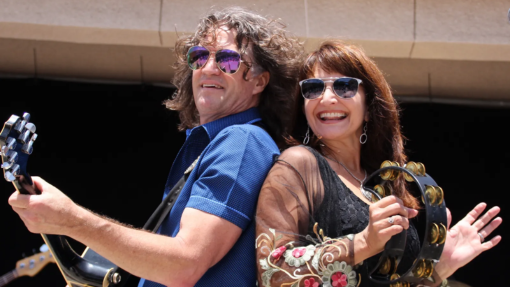
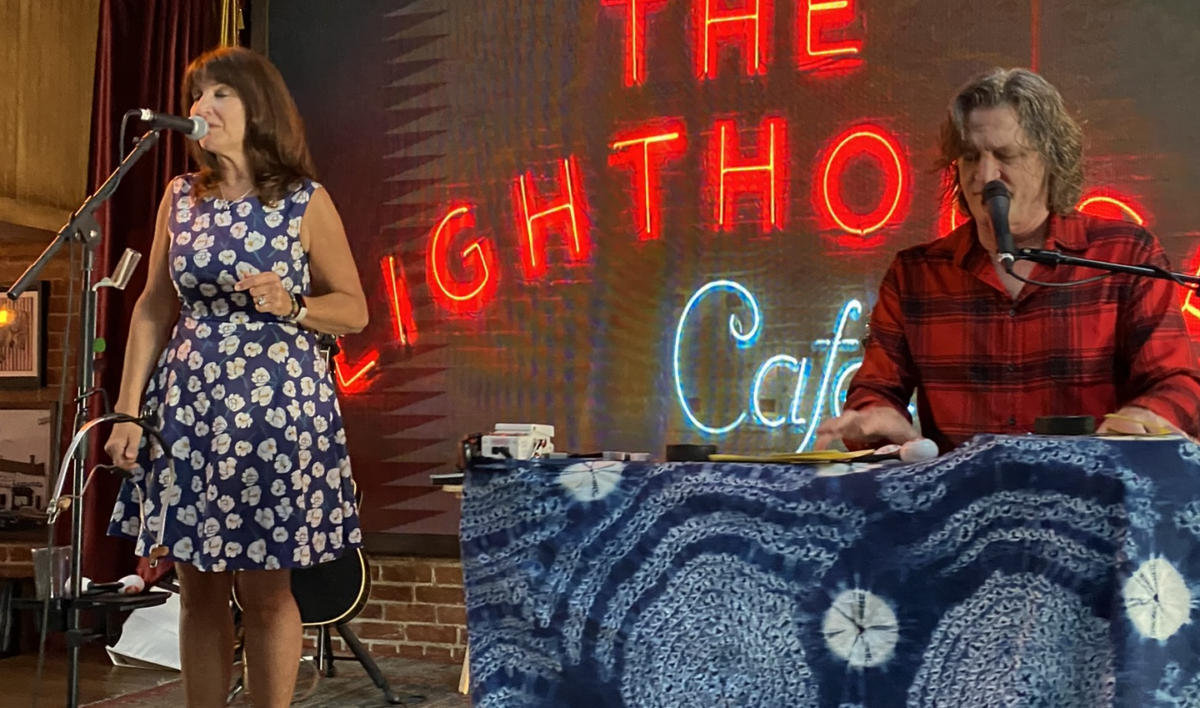
SoCal favorites, Andy & Renee, along with their band Hard Rain, have taken their unique sound and multi-instrumental skills to venues large and small all over the world. Named, “Best of The Beach” for many consecutive years by The Easy Reader, their seventeen CD and three DVD releases have also won them countless awards. They are known for their numerous energy-packed live performances and have made a name for themselves as producers and performers of Dylanfest, an 8-hour music festival attended by hundreds of fans and featuring many of L.A.’s top musicians annually in the Spring.
Check out this fabulous duo at the world famous Lighthouse Cafe in Hermosa Beach Tuesday, December 19 from 5:30PM to 7:30PM, or any other Tuesday! They play the Lighthouse nearly every Tuesday.
This is a once a month (every third Tuesday) show that is designed as a listening room for world class songwriters, to play their original music in an intimate setting. NO COVER BUT DONATIONS ARE STRONGLY ENCOURAGED AND GO TO THE SONGWRITERS. Project Barley serves excellent Food (Gourmet Pizza, wings, sandwiches, salads), wine, and award winning beer. Food served till 8:30pm. No reservations so arrive early to get a table. This month we are proud to present: David Serby/Ed Tree, Nick Justice/Richard Stekol, Jodi Siegel and Barley Unplugged!
DAVID SERBY (w ED TREE))
The Southern California-based country-rocker David Serby has made a name for himself with his evocative, gritty portraits of SoCal life that are both personal and universal. The LA-native has a unique perspective because he spent much of his childhood in a small farming town in Illinois before returning to Southern California as a teen.
Serby doesn’t shy away from Southern California’s many warts, as he demonstrates throughout his upcoming release, Low Hanging Stars. The record’s roadhouse rockers, country shuffles, and south-of-the-border two beats, are populated by a cast of maybe not quite losers, but certainly too lost to find the winners circle down-and-outers, and it is full of the clever word-play and heartfelt and introspective lyrics for which he is known.
This will be Serby’s sixth record with producer/guitarist Edward Tree. His previous, critically acclaimed releases include I Just Don’t Go Home (singer-songwriter); Another Sleepless Night and Honkytonk & Vine (roadhouse honky tonk); Poor Man’s Poem (folk); and The Latest Scam (rock).
Serby’s influences include the classic country artists played by his father on the family hi-fi- Roger Miller, Marty Robbins, Johnny Cash, Willie Nelson and other Nashville stars – as well as the edgier country rockers discovered by Serby as a Southern California teen – The Blasters, Dave Alvin, Rank and File, X and Dwight Yoakam to name a few.
Serby has remained an active member of the vibrant Southern California roots music scene for the last twenty years, and he has twice played the Palomino Stage at the Stagecoach Festival in Coachella, CA, opening for among others, Willie Nelson, Lucinda Williams, The Old 97’s, Robert Earl Keen, Kris Kristofferson and Rodney Crowell.
NICK JUSTICE (w RICHARD STEKOL)
Nick Justice hails from the Bronx, NY. He came out west in 1980 and fronted a few bands (Guns for Hire, Nick Justice Band, Chords of Fame) in the emerging cow punk era in southern California. Playing on bills with the Blasters, X, The Plimsouls, The Go Go’s, The Beat Farmers and The Bangles who were all going somewhere while he was going nowhere Justice fled to the Northwest living in Seatlle for most of the 90’s playing throughout the Northwest as a traveling troubadour for a decade mostly playing coffee houses, house concerts and juke joints. Justice came back to LA in 200o and quit the music business but never stopped writing. In 2015 he called up a few old friends like Greg Leisz, Bobby Cochrane and put out and EP “The Cry of the Street Prophet”. 4 records quickly followed in succession including 2019’s critically acclaimed “The Road Not Taken” with Richard Bredice (Jules Shear, Fallout Boy, Missiles of October, David Lindley) at the helm producing all 4 records. Justice’s newest release “Rope the Wind” charted at #1 on the Roots Music Report Top 50 Folk Rock Album Chart in April 2021.
BARLEY UNPLUGGED
Barley is feel good Americana band with a beach country vibe. Barley, who’s fearless leader lead singer/trumpet players and songwriter, Brent Reger, is also one of the owners of the three Barley Breweries located right here in the SouthBay. Barley, is a band of music brothers, with excellent harmonies, cool songs and seasoned musicianship! “It’s more of a family than a job. It’s not a job for us. We enjoy it and we have a good time together,” said Reger. There’s a lot of them in the band, eight to be exact: Brenton, Chris, Jason, Jay, Nate, Russ, Rusty, and Stephen. This band has stuck together for 10 years, playing all around the beach cities.
“Everything happens at the beach. We love the South Bay,” said Reger. Some of the members are from the South Bay and the rest have been here for years. It’s where they draw their inspiration from. Barley writes and performs their own music. Their sound they say is similar to the Beach Boys.
“Our music encapsulates that beach vibe. It’s a little folky. It’s a little beachy,” said Reger. They normally play with their full band – drums – guitars, bass etc….but for a few special shows, they do an unplugged type show where they sit on stools, and play and sing their songs accompanied by acoustic guitars. You can really hear the lyrics and their beautiful harmonies.
JODI SIEGEL
Jodi Siegel, originally from Chicago, IL, is a singer, songwriter and guitarist. Over the years Jodi has opened for and or shared the stage with many respected musicians including: Albert King, Robben Ford, Robert Cray, J.D. Souther, David Lindley, Fred Tacket and Paul Barrere (Little Feat) and countless others. Her songs have been recorded by Maria Muldaur, Marcia Ball, Tommy Ridgley and Teresa James.
She has recorded two CD’S; Stepping Stone and her latest CD, “Wild Hearts,” produced by Steve Postell (Immediate Family, David Crosby, Eric Johnson, Robben Ford, Iain Matthews), is filled with great songs, cool grooves, intimate, smart lyrics and some of the best of the best musicians in Los Angeles today including; Mike Finnigan (organ, piano), Hutch Hutchinson, Abe Laborial Sr., Alphonso Johnson (bass), Russ Kunkel, Michael Jerome Moore, John Ferraro, Arno Lucas (drums, percussion), Joe Sublett (Saxophone) and Maxayne Lewis and Clydene Jackson (background vocals). Each song has a soulful delivery with an undeniable down-home elegance. It has received great reviews by Patrick Simmons (Doobie Brothers), Maria Muldaur, Walter Trout, David Mansfield (T Bone Burnett), Leland Sklar, Mike Finnigan and Doug Macleod to name a few.
Every month we compare the level of home sales from the preceding month to the same month of the preceding year. For example, November of 2023 is compared to November of 2022 to determine whether the number of homes being sold is growing or shrinking. The year over year number of homes sold across the South Bay has been shrinking every month since October of 2021–until now. November of 2023 marked the first time since October of 2021 where the number of homes sold increased over the same month in the prior year.
Lest we become overly enthusiastic, we need to remember that at this time last year successful sales figures were plummeting, Closed escrows were shrinking at up to 50% below the prior year in fall of 2022. So a positive value could only mean we’re bouncing along the bottom.
Also on the positive side, there is some improvement in median price which has been shrinking most of this year. At least as of November, it’s looking like “scattered improvement” in the South Bay real estate market.
Beach: Home Sales Pull Out of Dive
After two successive months of declining sales volume and falling median prices November real estate activity brought positive news to the Beach Cities. Last month saw a 9% jump in sales volume over October, and a 4% increase in the median price. The number of homes sold climbed from 79 last month to 86 in November. Concurrently, the median price gained nearly $70K.
The downside was a 3% drop of the median price versus November of 2022. The sold median for last November was $1.700M compared to $1.656M this year. The year over year sales volume gained 8% with 86 sales versus last years 80 transactions.
Year to date remains in red ink with sales down 14% January through November. For the same time period, the median price has fallen by 2%.
Harbor: Volume and Prices Turn Upward
Compared to November of 2022, both sales volume and median price climbed by 7% last month. This is the second month of solid upward figures for residential home sales in the Harbor area. Sales figures for the area have been in red ink since the beginning of the year, so these are welcome statistics for home owners wishing to sell.
On a monthly basis, the number of homes sold in the Harbor area fell by 6%, dropping from 267 in October to 252 in November. despite a median price increase of 1%.
Looking at the longer term, median price for the first 11 months of the year has fallen from $756K in 2022 to $740K, for a decline of 2% in the year to date median price. Sales volume for the same 11 months went from 3,770 in 2022 to 3,076 this year, a decrease of 18%.
Hill: Sales Volume Down, Prices Up
Comparing November of 2023 to November from last year shows a 10% drop in sales from 51 units in 2022 to 46 units this year. Despite the decline in number of sales, the median price for November climbed 19%, going from $1.77M in 2022 to $1.94M this year.
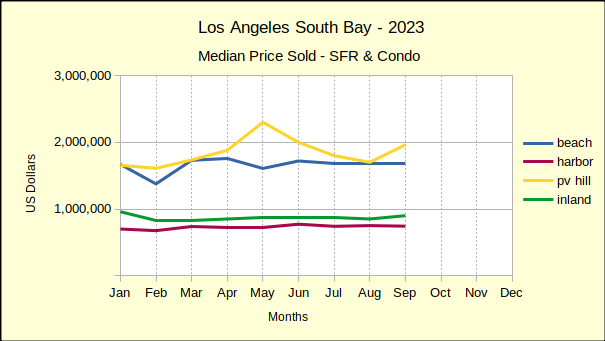
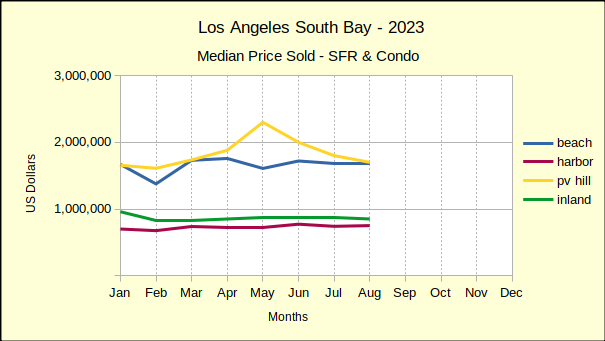
Monthly changes to the median price are much smaller and have been getting smaller as the year progresses. The November decrease was 1%, having dropped from $1.96M to $1.94M. The median price has varied monthly throughout the year. It ranged from a high of $2.3M in May of this year and fell as low as $1.6M in February. Year to date the median for the Hill is up 1% from 2022.
After having risen in September by 14% and in October by 13%, the number of homes sold on the Hill fell by 27% in November. Of course, part of the decline is seasonal. However, month to month sales volume for the first 11 months of 2023 was off by 19% in Palos Verdes with a similar drop of 16% overall for the South Bay.
Inland: Median Price Up from 2022
November 2023 was a good month for the Inland area compared to the same month last year. The number of homes sold climbed 11%, from 96 sold last year to 107 this year. Median price turned upward by 6%, ending the month at $851K, changed from $800K in 2022.
Compared to October of this year, Inland homes sales fell 8%, dropping from 116 homes to 107. That rate of change was slightly higher than the 6% drop across the South Bay. Median prices fell 7% for the month.
Year to date, the Inland area sales volume is off by 12% while the median price is up 1% from the same period in 2022.
Beach=Manhattan Beach, Hermosa Beach, Redondo Beach, El Segundo Harbor=Carson, Long Beach, San Pedro, Wilmington, Harbor City PV Hill=Palos Verdes Estates, Rancho Palos Verdes, Rolling Hills, Rolling Hills Estates Inland=Torrance, Lomita, Gardena
SARAH LEE GUTHRIE Holiday Show Fri, Dec 01, 2023, 8:00 PM, Doors 7:00 PM
Sarah Lee Guthrie sings originals plus the iconic folk songs made famous by her father Arlo, grandfather Woody and their comrades in music. Enjoy holiday cider and sing-alongs.
Sarah Lee Guthrie’s bright vocals prove that she is a force to be reckoned with in her own right. Over the past 2 decades, she has continued her ancestral legacy, touching the hearts of folk fans nationwide.
She released 6 albums so far, including her 2009 family album Go Waggaloo, featuring Arlo, her then-young children and unused Woody Guthrie lyrics. The album won a Golden Award from The Parents’ Choice Foundation.
And watch for their Thursday, November 30, 6:30-9PM show at the Banana Leaf & Beach Cities Social, 1408 S Pacific Coast Hwy, Redondo Beach, CA 90277
SoCal favorites, Andy & Renee, along with their band Hard Rain, have taken their unique sound and multi-instrumental skills to venues large and small all over the world. Named, “Best of The Beach” for many consecutive years by The Easy Reader, their seventeen CD and three DVD releases have also won them countless awards. They are known for their numerous energy-packed live performances and have made a name for themselves as producers and performers of Dylanfest, an 8-hour music festival attended by hundreds of fans and featuring many of L.A.’s top musicians annually in the Spring.
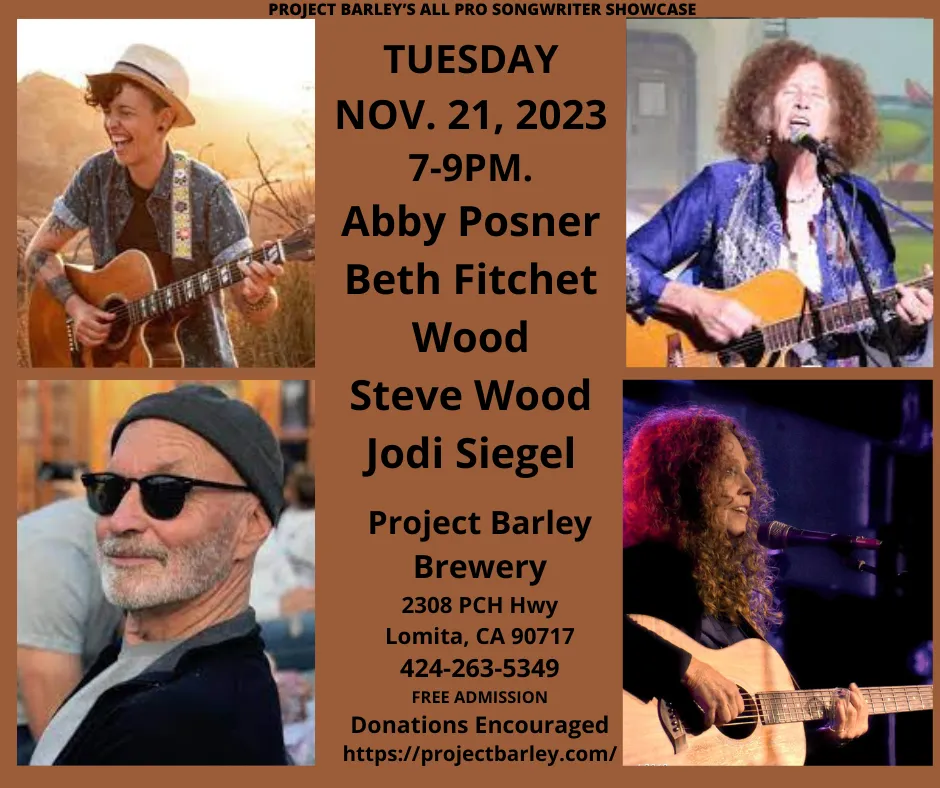
As always, Jodi’s Songwriter Showcase will be held the third Tuesday of the monthat Project Barley in Lomita. NO RESERVATIONS – Get there early to get a table! Put it on your calendar for November 21!!
Project Barley serves excellent Food (Gourmet Pizza, gluten free/vegan options, wings, sandwiches, salads), wine, and award winning beer. Food served till 8:30pm. 2308 E Pacific Coast Hwy, Lomita, CA 90717 https://projectbarley.com/
The Performers
Jodi Siegel
Jodi Siegel was born in Chicago, IL. The Home of the Blues! She eventually relocated to California and began playing and singing in countless blues, R & B, pop and original music bands throughout Orange County, San Diego and Los Angeles. Over the years Jodi has opened for and or shared the stage with many respected musicians including: Albert King, Robben Ford, Robert Cray, J.D. Souther, David Lindley, Fred Tacket and Paul Barrere (Little Feat) and countless others. Her songs have been recorded by Maria Muldaur (“So Many Rivers To Cross,”-cowritten with Daniel Moore and “If I Were You”-cowritten with Danny Timms) Marcia Ball (“So Many Rivers To Cross.”) and Teresa James (“Come Up and See Me Sometime”-cowritten with Danny Timms)
Abby Posner
Abby is an award winning, multi-instrumentalist, a featured artist on both CMT and the Americana Festival this year, and has composed music for commercials, TV, Radio and movies. Touring throughout the US and beyond, Abby has built a strong, loyal following. She has opened for such artists as Phranc, Sierra Hull and Dustbowl Revival. Her style goes from Americana/Country/Folk to pop, rock and even jazz. She has a fun rapport with her audience and is very entertaining! For more information go to: https://www.abbyposner.com/
Steve Wood and Beth Fitchet Wood
Keyboardist Steve Wood and guitarist Beth Fitchet Wood have a long, checkered past in music, together and separately (Honk, Kenny Loggins, Jackson Browne, Sting, Paul McCartney, Dave Mathews and film composition). Their music expertly combines folk, pop, rock and jazz with soaring vocal harmonies and well crafted songs that are lighthearted, serious, romantic, sarcastic and always unpredictable!
Beth has recorded a dozen well received solo albums in folk, jazz, pop and children’s music genres, and produced the decade long weekly Laguna Beach Songwriters Showcase, “Beth’s Tuesdays”. Beth has also received multiple awards for her songs over the years including winning the Best Song(s) award at the Tucson Folk Festival in 2009 for “Red Red Sky” and “Peace in the Valley.” Both Steve and Beth are impossible to categorize into any one genre; they do them all! They also have a fun onstage banter and are fun to watch and to listen to! For more information on both Steve and Beth go to: http://www.bethfitchetwood.com/http://www.stevewoodmusic.com/
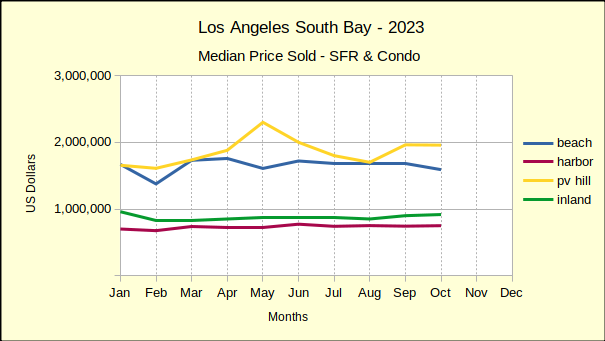
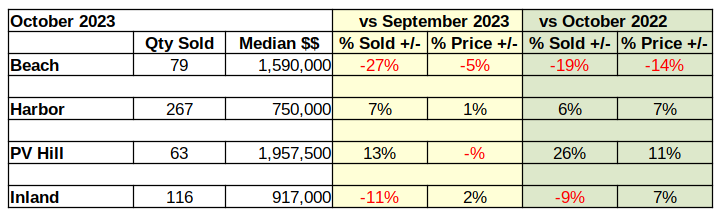
Home sales on the Palos Verdes Peninsula chalked up an impressive set of statistics in October. Comparing the October 2023 sales to October of last year showed a stunning 26% increase in sales volume beside an equally impressive 11% increase in median price. At the opposite end of the spectrum the Beach Cities October sales volume fell 19% from 2022, while the median price dropped 14%.
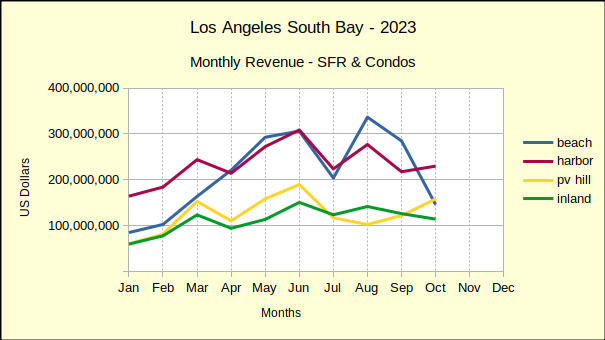
Elsewhere across the Los Angeles South Bay volume and prices were mixed with the general trend leaning toward decreased number of homes sold and prices struggling to stay level with last month while often slipping below.
Year To Date Sales Continue to Drop
In between the highs and the lows real estate activity in the South Bay has been mixed for the months of August through October. While many commentators are cautiously hopeful, it must be noted that year to date comparisons continue to show significant declines in the number of homes sold, with an average drop of 18% from 2022 for the first 10 months of the year. Likewise, median prices are falling for the January through October time frame. For example, median prices on the Hill were up in October, but have fallen 4% year to date compared to last year. Similarly the Beach area median is down 3% and the Harbor area is off 2%.
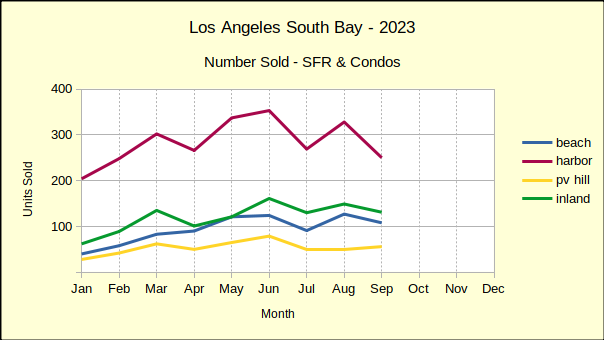
Sales volume is clearly down. By this time in 2022 sales were at 6700 units versus 5500 this year. Many buyers have been “priced out of the market” and many sellers are resisting the idea of “prices going backward.” The result has been a lot of deals not being made.
Year to date, the deals that have been consummated are still generally at median prices above last year, however the most recent three months have shown at least half of sold homes required price reductions to make the sale. With winter setting in, we expect continued reductions in both the volume of sales and in the prices of sold homes.
Home Sales at the Beach Hit a Wall
Throughout the year real estate in the Beach Cities has maintained spotty growth. Sometimes median prices improved, sometimes sales volume. But, October brought a wall of red ink for the Beach. Month over month sales volume plummeted by 27%, while the median price dropped 5% from September when it was flat at $1.7M.
Year over year transaction volume dropped 19% from September of 2022. The median price fell 14% for the same period.
Looking at the year to date statistics showed more declines with sales volume for the first 10 months of 2023 coming in 16% below that of 2022. At the same time, the median price was off by 3%.
In prior downturns the Beach area has been among the last to respond to market negativity and one of the first to recover. If the pattern repeats, sales at the Beach will continue to show predominately negative numbers for the late fall and winter months. Most chroniclers project a return to positive market conditions in late 2025 or early 2026 in general.
Harbor Volume and Prices Turn Upward
Home sales in the Harbor area moved from all negative last month to mostly positive this month. Sales volume on a monthly basis jumped from 24% down in September to a 7% increase in October. Similarly, the month to month median price went from -1% to +1% in October.
Annually, the number of homes sold in the Harbor area increased by 6%, a significant change from having fallen 26% in September. The median price came in at $750K, up by 7%.
That’s only the second time this year the Harbor area median price has come up into the positive range when compared to 2022. Overall, the year to date median sits at $739K, 2% below last year’s number of $756K. Sales volume for the Harbor is off 20% year to date. The number of homes sold for the first 10 months is 2824, compared to 3535 in 2022.
Palos Verdes Homes Star in October Sales
Home sales on the Hill came in at 63 homes sold with a median price of just under $2M. Month over month that represented a 13% growth in sales volume and no measurable change in the median price.
On an annual basis October sales were up 26% over the same month in 2022. This year’s median price was up by 11% over last October.
While these numbers reflect impressive growth it’s important to remember that the number of transactions on the Palos Verdes peninsula is quite small, which results in some dramatic percentile shifts. For example, the annual percentage of change in the median price so far this year has ranged from a low of -29% to a high of 17%. By comparison, the Harbor area where monthly transactions number in the hundreds, has an annual range from a low of -11% to a high of 7%.
On a year to date basis, the Hill showed a more common face with the January through October sales volume down by 20% from 2022. During the same time frame median prices fell by 4%.
Inland Area Sales Volume Down, Prices Up
In a surprising turn of events, the Inland area has shown an increased median price for both the monthly and for the annual sales figures. The median price came in at $917K this October, which was 2% above the September median. On an annual basis, the median was up by 7% over the $860K of October 2022.
With 116 units sold for the month of October this year, the sales volume was 11% lower than it was this September. The monthly decline was even greater than the drop of 9% for the year over year comparison to last October.
Year to date, the Inland area has outperformed the balance of the South Bay on median price and on sales volume. For January through October there is no discernible change to the median price from 2022 to 2023. In the same time frame the sales dropped by 14%, the smallest decline of the local areas.
Beach=Manhattan Beach, Hermosa Beach, Redondo Beach, El Segundo Harbor=Carson, Long Beach, San Pedro, Wilmington, Harbor City PV Hill=Palos Verdes Estates, Rancho Palos Verdes, Rolling Hills, Rolling Hills Estates Inland=Torrance, Lomita, Gardena
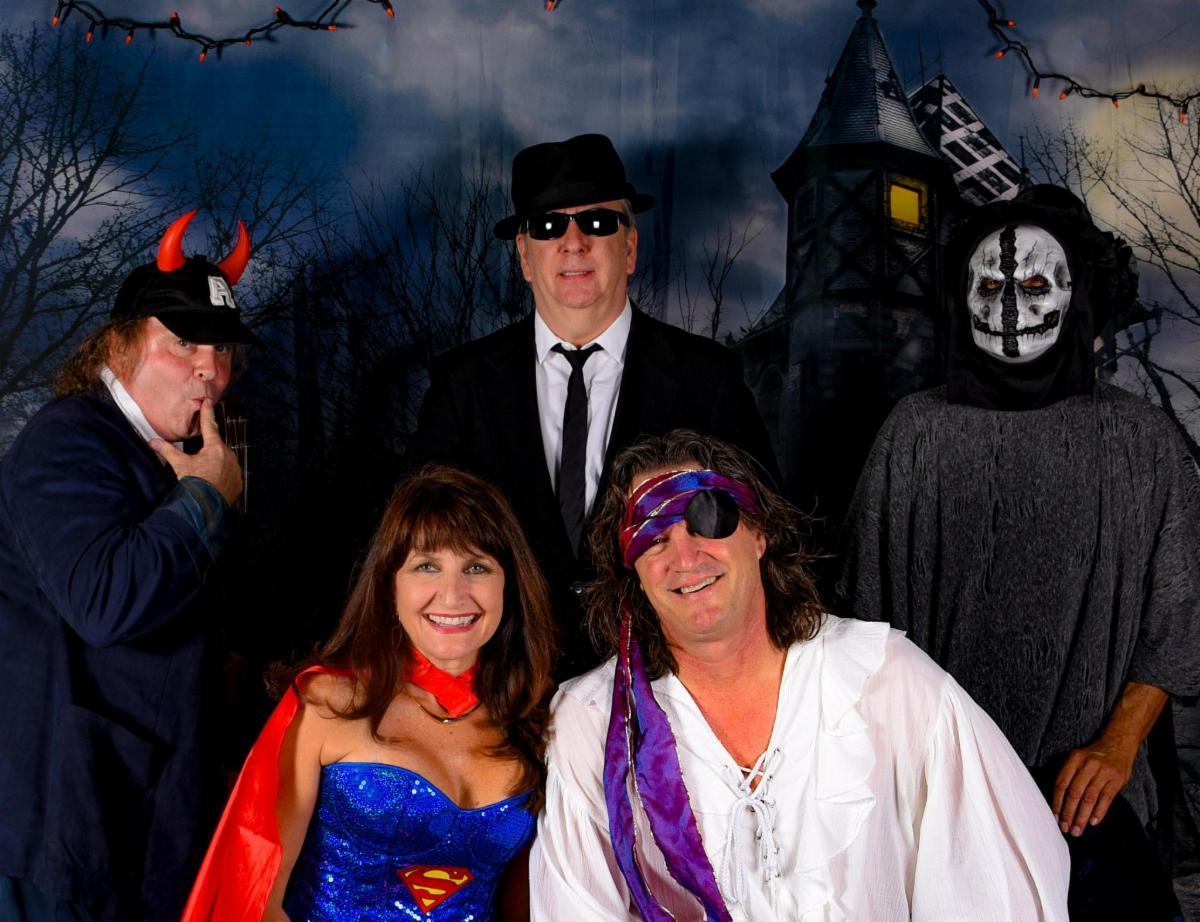
Next weekend, we have a Hard Rain Halloween Party, Saturday, Nov. 4th. We love Halloween, and we just had to have a dance party with the band! You don’t want to miss this….It’s always a great time! Dressing up is optional, but always fun!
Soulful, bluesy singer-songwriter gaining national attention for his TV soundtrack hits. His recent album, American Silence earned rave reviews from NPR Music, Rolling Stone and many more.
Dubbed “one of the most important American songwriters working today,” by 88.5 KCSN Los Angeles, Chris Pierce rose to international prominence when NBC primetime series This Is Us featured his song We Can Always Come Back To This. The single then reached #1 on the Billboard Blues chart and was nominated for several awards.
With his raw acoustic accompaniment and his unmistakably heartwrenching vocals, he aims to unite his listeners, inspiring them to rise up and stand for what is right.
Pierce was diagnosed at 15 with Otosclerosis, a rare hearing disorder that caused him to lose his hearing in one ear and become partially deaf in the other. In spite of this, his passion for music only grew and inspired him to dig deeper in his skills. Thanks to his determination, he has had the honor of performing with many incredible artists including Al Green, B.B. King, Aaron Neville and Seal, and will be on tour this fall with Neil Young
For more details see https://grandvision.org/event/chris-pierce-friends/
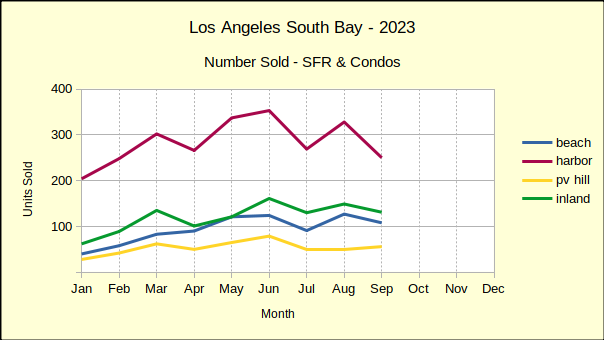
The summer selling period for real estate in the South Bay showed mixed results for August and September. July was down across the board, but both the volume of sales and the median price was able to rebound in some areas. Notably, the Beach Cities come out of the third quarter with median prices up by 2% over last August, and up by 3% over September of 2022. That growth wasn’t enough to make up for earlier this year when median prices were down by as much as 17% in year over year sales.
Year To Date Prices Down Across the South Bay
Comparing the first nine months of 2022 to the same period in 2023 shows median prices at the Beach down 2%, the Harbor down 2%, the Hill down 8% and the Inland area down 1%. Similarly, the number of homes sold dropped at the Beach by 15%, the Harbor by 22%, the Hill by 23% and the Inland area by 14%. On average across the South Bay sales volume was off by 20%.
To some extent this validates the supply versus demand theory. With interest rates above 7%, many potential sellers (who are simultaneously buyers elsewhere) have simply changed their plans. They’ll wait for interest rates to abate before trying to move. The California Association of Realtors reports that the number of homes sold across the State has fallen for 27 consecutive months. Locally, a couple of neighborhoods have shown year over year improvement a couple of times, but overall, the last time sales volume was positive across the South Bay was September of 2021, 24 months ago.
Because there are so few homes available for buyers in a must move situation, those buyers are forced to buy despite high interest rates and despite elevated prices. Mortgage interest rates are currently testing the 8% number, and are expected to stay there into 2024. Most forecasts expect the number of sales to drop even further, possibly offset by an increase in renters and a corresponding increase in rental prices.
Things don’t happen very fast in the real estate market. We mentioned earlier that sales have been declining here for 24 months already. But, prices are still up and interest rates are still climbing. Currently, we expect to see a shift in the pattern this winter. As time goes on, more and more sellers will surrender to the inevitable and lower their asking price. Coupled with an increasing number of short sales and foreclosures, that will create the key metric the Federal Reserve is looking for to quell inflation. Most pundits are suggesting 2025-2026 for the bottom of the current down-trend and the beginning of a recovery.
A Home or a House?
Are you buying a home? Are you looking for a neighborhood that matches your personality? Are you looking for schools for your children? And nearby businesses for your family needs? That’s a home. If you’re looking at the appreciation rate for the zip code and how much you can leverage, that’s a house. The difference becomes important when the real estate market is rocky. When you’re buying a home, you’re looking at time over generations. Percentages on a loan mean little then because the property can be refinanced many times before it belongs to the family.
Are you looking for a house? Are you measuring the appreciation and the cost to income ratio? Are you looking for a distress sale and a rock-bottom price. Now is the time to put your cash away. Make no mistake—cash will be required! That’s not to say you can’t finance part of your investment, but count on having “skin in the game.” Your lender will require it. Over the next twelve months, accumulate as much cash as possible, and make your broker your best friend. You want a constant finger on where good deals are happening and you want to be one of the first on the scene. The “bottom of the market” is a hypothetical point. Your best deal can be anywhere in the area and any time in the downturn. It just has to meet your investment requirements!
Beach Cities Holding Strong Over 2022
The median price of homes sold in the Beach Cities was flat for August and September, following a 2% drop in July. Coming in at just under $1.7M the month over month price has been mostly down for the first three quarters of the year. Following a similar pattern, the month to month sales volume has fallen after a strong start in early spring.
In year to year comparison, both August and September have shown a modest improvement over the same months last year. Median prices were up 2% in August and 3% in September. This improvement comes on the tail of four straight month of declining median prices. Supporting the growth in median price, sales volume was up 23% in August and 20% in September. The positive numbers at the Beach are a welcome respite following 21 months of falling volume.
Looking at year to date 2023 versus 2022, median prices are down 2% and sales volume is down 15%.
Harbor Volume and Prices Slipping
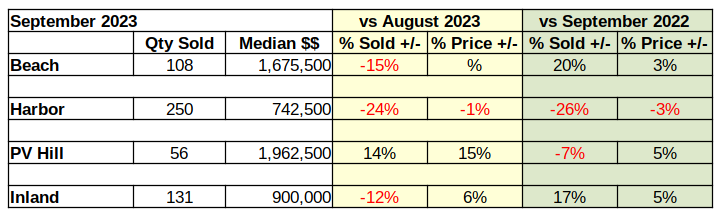
September found home sales in the Harbor area fell in all measures. On a month to month basis, sales volume dropped 24%. At the same time, median prices fell 1% below the August median.
Year over year showed the number of homes sold down by 26% and the median price down by 3% from September of last year.
Year to date for the first three quarters of 2023 sales volume was off by 22% while median prices dropped 2%.
This is a pattern we expect to see repeated again and again during the coming two years. First the sales volume declines steeply, and median prices begin a downward trend. Then as the sales volume continues to decline, sellers begin to panic and the few active buyers tighten up on the terms of their offers. The cycle typically continues until falling commodity prices and weak employment numbers convince the Federal Reserve inflation is under control. Then it will start lowering the interest rate and allow markets to float free again.
Palos Verdes Transactions Volatile
The PV Peninsula came through September with positive numbers for the month, though the annual and year to date numbers suffered some slippage. Sales volume for September came in 14% above August and the median price was a respectable 15% above the prior month.
Compared to September of last year, home sales on the Hill fell by 7%. That decline was countered by a 5% increase in median price over the same month in 2022.
Like the rest of the South Bay, PV suffered downturns in the year to date statistics. The first three quarters of 2023 ended with a 23% downward slide in home sales volume, accompanied by an 8% fall in median price.
Inland Area Sales Volume Mixed, Prices Up
The Inland area performed surprisingly well in September. Home sales in the Inland area typically mirror those in the Harbor area. Last month brought a surprise when the median price climbed 6% above August. This positive note came despite a 12% drop in sales volume.
September of 2023 compared to September of 2022 brought even more surprise with a 5% increase in median price as well as a 17% jump in sales volume.
Year to date activity for the first nine months of 2023 compared to the same time frame in 2022 fell in line with the rest of the South Bay, Sales volume fell by 14% and median price by 1%.
Beach=Manhattan Beach, Hermosa Beach, Redondo Beach, El Segundo Harbor=Carson, Long Beach, San Pedro, Wilmington, Harbor City PV Hill=Palos Verdes Estates, Rancho Palos Verdes, Rolling Hills, Rolling Hills Estates Inland=Torrance, Lomita, Gardena
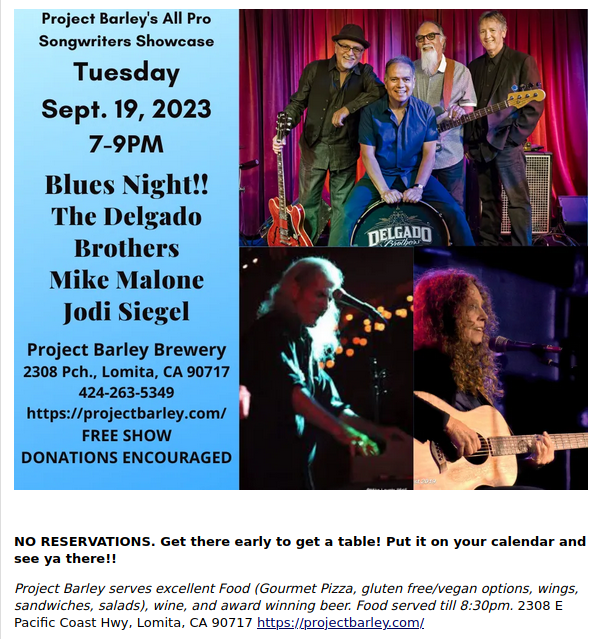
This promises to be a fantastic experience! Don’t miss the show! See the full lineup here: https://jodisiegel.com/event/5199180/652645464/project-barley-pro-songwriter-showcase-blues-night-with-mike-malone-the-delgado-brothers-jodi-siegel
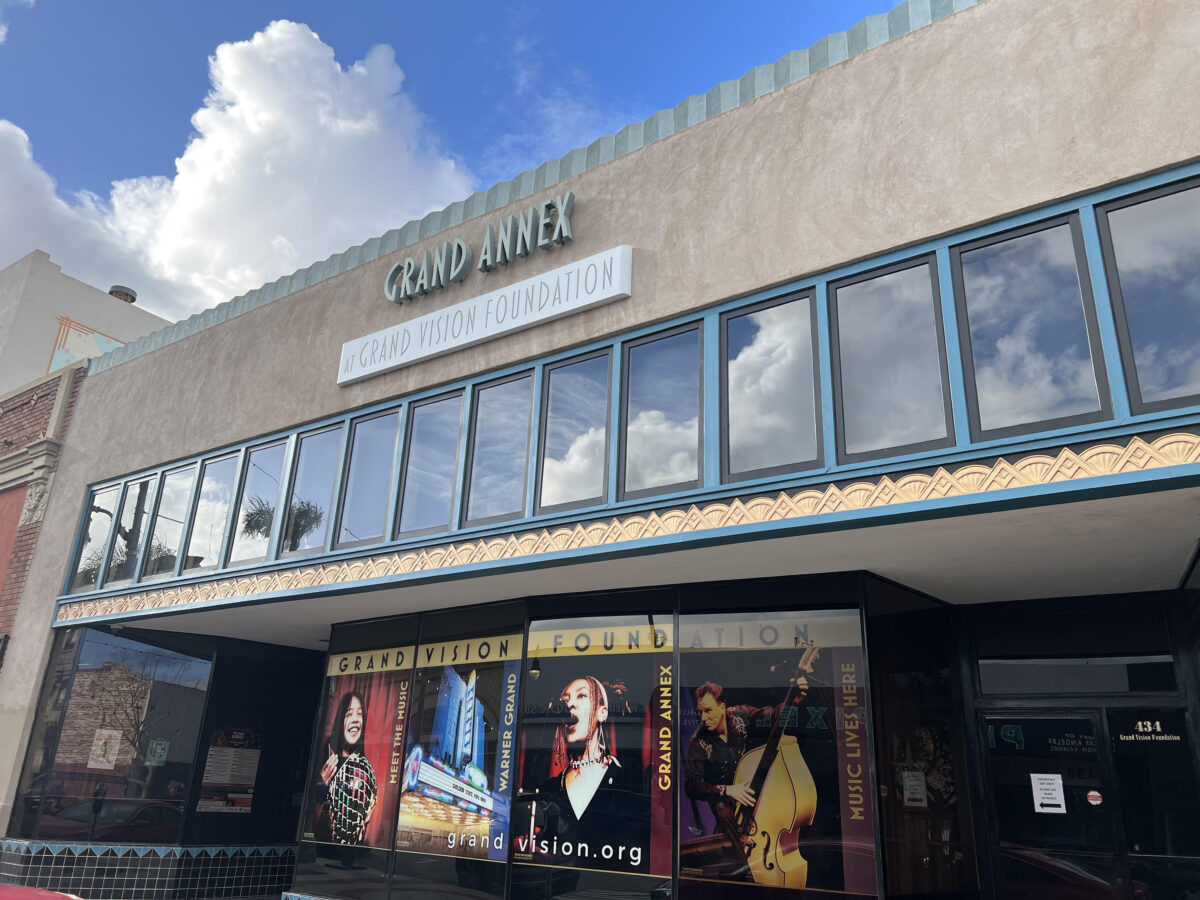
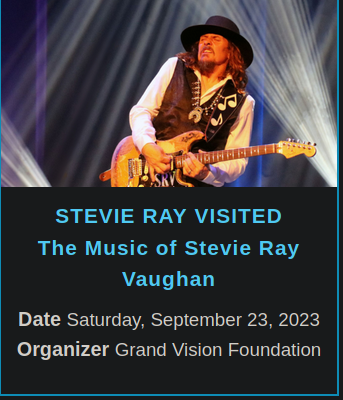
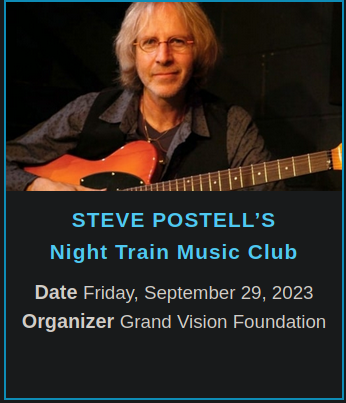
The fall musical program at the Grand Annex starts this month. Don’t miss some of these great shows. And, there are more at this link: https://grandvision.org/grand-annex/
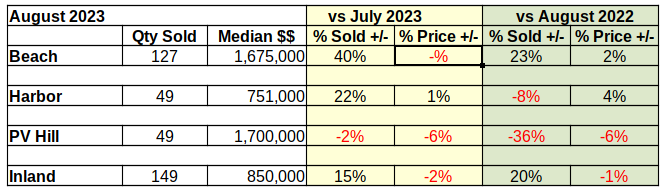
In August the South Bay real estate market showed some slowing of what has seemed a continuing slide into negative numbers. Closed transactions showed a partial recovery from the July report of declining sales and declining values, across both the past month and the past year.
August showed positive growth over July in sales volume except for transactions on PV Hill. Median prices compared to July were down except at the Harbor.
Annual statistics were similarly mixed with notable increases in sales at the Beach and Inland areas. Median prices compared to August of last year with modest increases in the Beach Cities and Harbor Area.
Beach Cities Show Strength in August
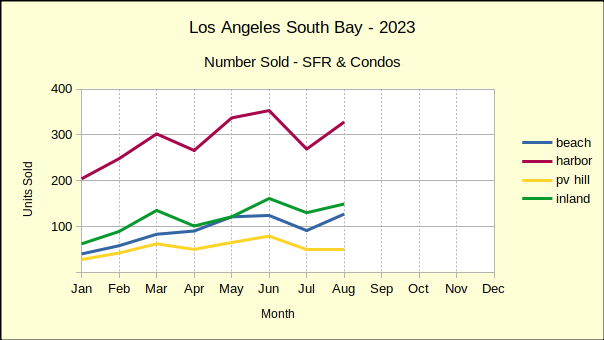
Sales volume at the Beach seemed surprisingly strong, however a look back in history reveals weaker than normal sales in July of this year and August of last year. The 127 units closed in August was much more in line with expectations, than the 91 sold in July or the 103 sold in August of 2022. Sales in a normal year would come in at about 125-135 units, showing that the Beach Cities are currently close to a normal number of transactions for the month.
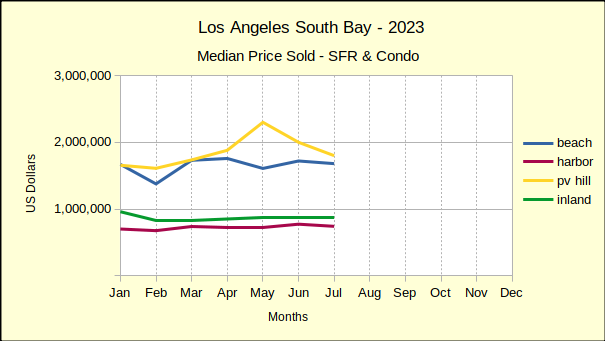
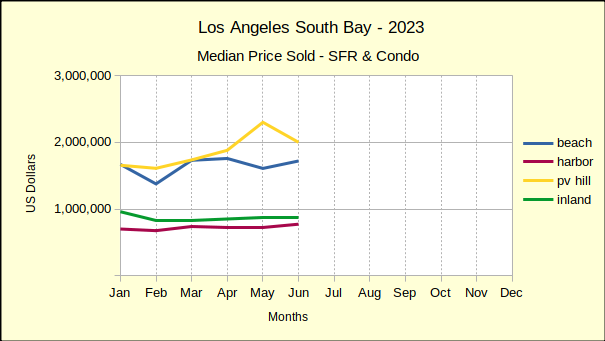
Median prices came in negative compared to July, though less than a 1% drop. Last year’s weak sales led to an increase of 2% in median price this August, despite an overall downtrend for the year. Hypothetically, assuming the Federal Reserve policy of 2% growth, median price at the Beach should have been about $1.62M in August. As the market stabilizes from the pandemic, the median has steadily dropped from a high of $1.76M in April to the August actual of $1.67M..
Year to date transactions showed a continuing decline in sales volume (-19%) and median price (-4%) versus 2022. Likewise, sales volume was off 31% compared to the baseline year 2019. Median price is still coming in positive compared to the baseline, up 28% from 2019.
August Harbor Area Sales Climb
Looking at August versus July of this year shows Harbor area sales volume up a healthy 22%. While the month over month numbers are positive, sales are off 8% compared to the same month last year. For perspective, note that in 2019, the last normal year of business, there were 436 homes sold compared to 328 this August. Using that reference point, monthly sales are off by 25%.
Median price for last month was $751K, up 1% from July and up 4% over August of last year. Going back to 2019, the median was $575K, giving the current median price an increase of 32% over our baseline year. At the same time, the high median for this year was in June at $772K, and the lowest was $675K in February.
Year to date, the number of homes sold at the Harbor is down 22% from last year and likewise 22% from 2019.That decline in sales volume is driven by the increased median price which is up 32% compared to the first eight months of 2019. Being generally an entry level market, the Harbor area has shown a drop in sales every month of this year. Likewise, the year over year median price has dropped every month until August.
Palos Verdes Volume and Prices Drop
Sales and median prices were mixed everywhere in South Bay except for the PV Hill. All the statistics for August went down on the Hill. Month over month saw a drop in sales of 2% and decline in median price of 6%. Both are modest changes by comparison to most of the South Bay, but are indicative of the direction of the market in general.
Looking at August of last year compared to August of 2023 shows a dramatic decline of 36% in sales volume. Closed escrows dropped from 77 units last year to 49 this year. Annually, median prices dropped 6%, the largest drop of the four areas.
It’s important to note that in 2019, which being the most recent ‘normal’ year of business, August saw 90 units sold on the Palos Verdes peninsula. Monthly sales volume has dropped off by nearly 50% from the reference year.
Year to date through August shows sales volume down 25% from last year, with median prices falling by 10% over the eight month period. Comparing to 2019 year to date volume is off 21%, while median price comes in at 32% above the 2019 figure.
The disparity created during the pandemic is gradually leveling out as the year goes on. Palos Verdes median prices have fallen six out of eight months this year. The same has been true of the balance of homes sold in the South Bay.
Sales Up, Prices Down for Inland Area
From July to August transactions in the Inland area climbed 15%. Simultaneously, median prices fell by 2% for the month. January kicked off the year with a 16% increase in the median price. February saw that pricing promptly reverse and fall 14%. Since then sales volume has gradually dropped each month and median prices have shifted into a pattern of decline.
Year over year pricing numbers are nearly identical with a 15% jump in median price for January, followed by dropping prices every month since. Similarly, most of 2023 has seen falling sales for homes in the Inland area. So far, August has been the only month with growth in closed transactions.
Year to date statistics compared to 2022 have been much the same with the number of homes sold dropping by 17% and the median price down 2%. In keeping with the rest of the South Bay, comparisons to 2019 reflect sales falling 18% while the median price remains 32% above what it was before the pandemic.
Where Is the Real Estate Market Going?
The number of homes being sold has consistently fallen this year. Likewise, the median price of sold homes has generally been falling since the beginning of the year. The driver behind this has clearly been mortgage interest rates rising from under 3% to over 7% in a matter of months. The Federal Reserve managers have been very upfront about continuing these rates into the foreseeable future.
Most estimates state that about one third of potential buyers can no longer afford to continue with their purchase plans. We see a continued decline in the median price, as sellers find it impossible to sell at the price points reached during the pandemic. When ‘’time on market’ increases without a sale, sellers who ‘must sell’ will gradually lower prices.
Polls are showing those who aren’t compelled to sell are finding it hard to let go of mortgage interest rates below 5%. This reluctance, combined with the sliding median prices, will contribute to more stagnation in the market.
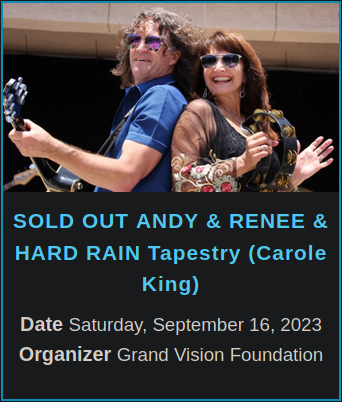
South Bay’s favorite folk-rockers open the new Grand Annex season September 16, 8pm, with their phenomenal homage to Carole King and her album, Tapestry. This promises to be an outstanding show, led by the unforgettable playing of Andy Hill and the sumptuous voice of Renee Safier. For tickets to see and hear the performance, go to https://grandvision.org/event/andy-renee-hard-raintapestry-tribute-to-carole-king/.
Andy Hill and Renee Safier with their band Hard Rain have been referred to as “America’s best kept secret.” Performing over 200 shows a year, the band delivers a style of Americana folk-rock that’s thoughtful, musical, danceable and full of memorable hooks. The duo are also behind “Dylanfest” the day-long music festival, now in its 33rd year, celebrating the music of Bob Dylan and featuring over 70 of L.A.’s best musicians.
With 17 CDs and 3 DVDs in their pocket, Andy & Renee have won countless awards, including “Americana Group of the Year” by the LA Music Awards, “Best Duo/Group” at the International Acoustic Music Awards and a Regional Emmy for their PBS concert special “Black Box Opens – Andy & Renee.” Their relatable lyrics, unforgettable melodic content and tightly crafted arrangements have brought together fiercely loyal audiences up and down the West Coast in the US and Canada.
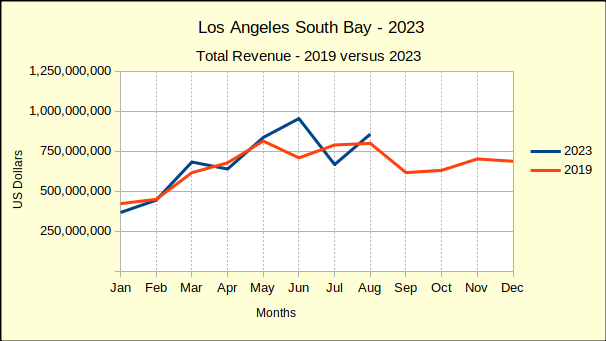
Year to date through July, the gross revenue for South Bay is a mere 3% above that of 2019. At the same time, sales volume, the number of homes sold, is 23% below the sales of 2019. By most standards, 2019 was the pinnacle of real estate business prior to the turbulent years of the Covid pandemic.
Many sources compare current business to that of the pandemic years, partially because it’s easy and partially because the “numbers look better.“ Undeniably, the statistics do look more favorable, however, this analysis takes comparisons beyond the normal “last month” and “same month last year” to include 2023 versus 2019. This allows our readers to see 2023 in a historical context and to more readily recognize the unfolding recession.
While median prices are still above those of 2019 right now, we project the median prices will also drop below the 2019 level before this recession ends. On a month to month basis, prices are falling approximately half the time. On a year to year basis, 2023 prices have dropped below 2022 medians 82% of the time. Median prices for June and July of 2023 fell below 2022 in all four areas both months. Buyers and sellers should anticipate the bottom of the recession in late 2024, or possibly 2025. Normal growth should return in 2026.
The July report from the Federal Reserve Bank (Fed) notes that inflation is expected to continue above the target of 2% through 2025. Accordingly, the Fed efforts to “restrain” the economy (meaning increase interest rates) will continue into 2025. The report indicates that while housing costs are slowing, they continue to increase at inflationary levels, necessitating further reduction.
In the meantime, buyers who are financially able should plan to acquire desirable properties at substantially better prices than will be available after recovery begins. Sellers who anticipate a need to sell before the economic turn-around, should look toward selling sooner rather than later, to minimize the impact of the down-trending market.
Beach Cities Summer Market Fizzles
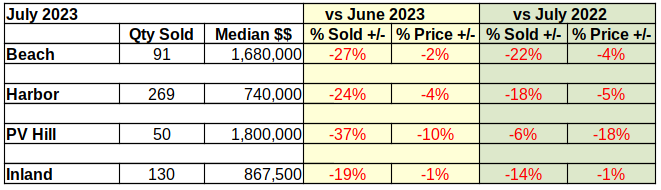
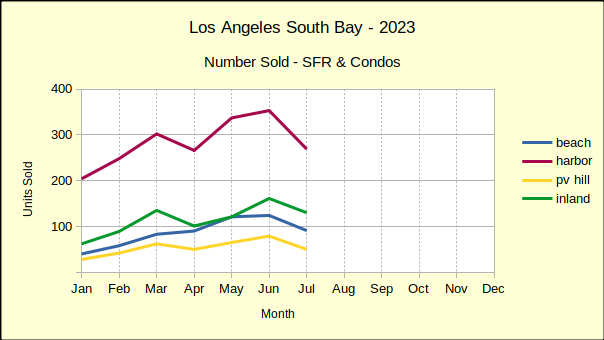
From June to July the number of homes sold in the Beach Cities fell 27% and those sold for a median price of 2% less. Some of the decline in sales is attributable to fewer homes available, as sellers hold properties off the market in hopes of improving conditions. Even more is a result of buyers who have lost significant purchasing power as mortgage interest rates have rocketed to over 7%.
Compared to July of 2022, the number of homes sold this July dropped 22% with a decline in median price of 4%. This set of statistics is somewhat deceptive in that last July the real estate market was still in the early stages of the downturn. As the current year progresses, year over year figures will demonstrate the slide more clearly.
Comparing the first seven months of 2023 to both 2022 and 2019 (the most recent year of business not impacted by the pandemic) shows the drift of sales and prices. The number of homes sold fell 24% from 2022 (802 homes) to 2023 (607 homes), while it was down 35% from 2019 (930 homes). The Fed dropped mortgage interest rates to essentially zero during the pandemic to keep the general economy afloat, which resulted in rapid price escalation which ultimately made purchasing a home unaffordable for about 25% of potential buyers. Then to control the resulting inflation, the interest rates jumped up around the 7% mark, which further slowed the real estate market by “pricing out” another 10-15% of buyers. With fewer buyers and stagnating prices, sellers are reacting by pulling property off the market and delaying planned sales.
Median prices fell 4% from 2022 and are still 28% above the median price of Beach Cities homes in 2019.
Harbor Area Sales VolumePlummets
Sales volume in the Harbor area has held up better than the Beach, possibly because median price has taken a greater hit. On a monthly basis, 24% fewer homes were sold (269 in July versus 353 in June). Comparing July of 2023 to July of last year, only 18% fewer closed escrow (269 versus 329).
Generally being an entry level market, the Harbor area tends to react faster to changes in market condition. More upscale neighborhoods frequently “stick to the price” for a longer period of time when markets are declining. Month to month median price dropped 4% in July to $565K. For July of 2022 versus July of 2023, the median fell 5%, from $780K to $740K.
Year to date through July, sales volume was off 24% from last year. Median price was down 4% when compared to the same period in 2022. Looking back to 2019, the number of homes sold during the first seven months of 2023 dropped by 21%. Median price for the same time frame shows up at 32% higher than 2019. Given the median price dropped 4% over the past month (from $772K to $740K), it’s reasonable to project the Harbor area median will end the year near $600K, as it was in 2019.
PV Hill Shows Volatility
Month over month, the number of homes sold on the PV Hill fell from 79 units in June to 50 in July, a decline of 37%. At the same time, the median price dropped 10%, ending the month at $1.8M. This despite a high sale of $12.5M, up from the high of $10M in June.
Year to year, July volume dropped 6% from 53 units in 2022, while median price plummeted 18%, from last year’s $2.2M. Palos Verdes is a unique community with large homes on large lots, many of them highly custom. Combined with the small overall number of homes, these properties truly need to be assessed on an individual basis for realistic projections.
Comparing cumulative sales data for January through July, volume is down 23% and median price is down 17% versus last year. Going back to the stable year of 2019, the number of sales is down 16% while the median is up 34%.
Interestingly, if the Fed’s annual 2% inflation target is added to the years between 2019 and 2023, the median on the Hill would be $1.5M today, instead of $1.8M. Under those circumstances, it would only take a decline of $300K to erase all gain from the past three years. Not a comforting thought for anyone who purchased recently.
Inland Cities Most Stable
The Inland area typifies a classic “middle of the road” performance in the real estate world. Generally the homes are everyday family properties, the sales trends are at the middle of the current South Bay market, and everything seems to happen with minimum drama. So there is little surprise at the minimalist 19% decline in monthly sales volume, the lowest of the South Bay. Likewise there is no shock the Inland cities came in with the lowest monthly price decline, a mere 1% below June.
Similarly, the annual sales volume showed July of 2023 only 14% below last July and the median price just 1% below the same month a year ago.
Year to date for the first seven months of 2023 compared to 2022 looks much the same. The number of homes sold dropped by 22%, 799 in 2023 versus 1021 last year. The median price fell 2% to $868K from $883K. Looking back to the 2019 sales volume for the same time period, the Inland area is off by 18% for the current year. Much like the rest of the South Bay, the median price in 2023 ($868K) remains above that of 2019 ($662K) by 31%.
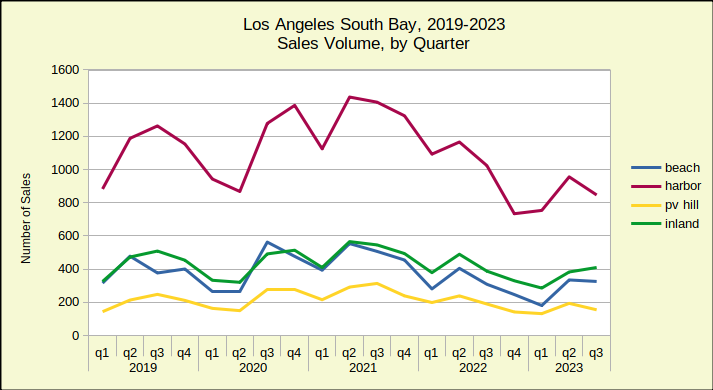
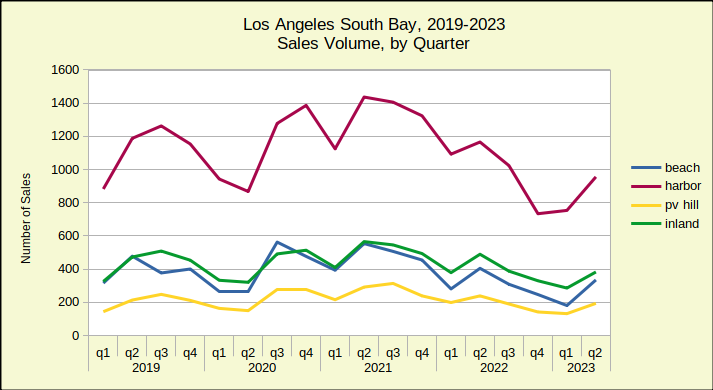
The number of homes sold in the Los Angeles South Bay during the first six months of 2023 is the lowest sales volume for a first half in the past five years. Fewer homes have been sold since the new year than sold during the same period of the worst year of the pandemic.
The first half of 2023 has ended with 24% fewer sales than the same period in 2022, which was itself down 15% from 2021. The peak of the market was early 2021, when interest rates were among the lowest in history, exploding the number of potential buyers. The lowest sales volume was during 2020 when 3311 homes were sold, which was still greater than the 3221 sold the beginning of this year.
Median Price Begins Downturn
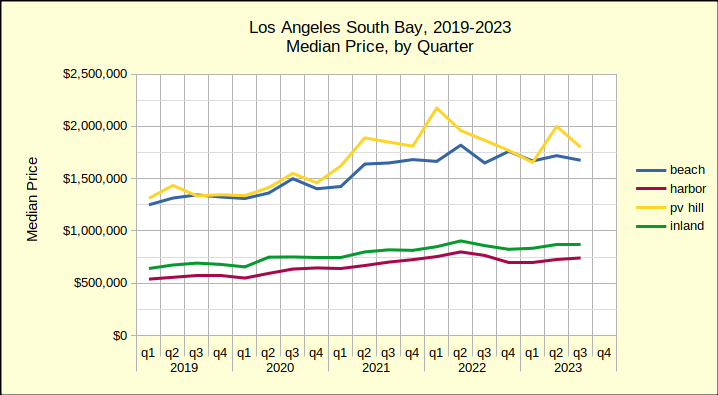
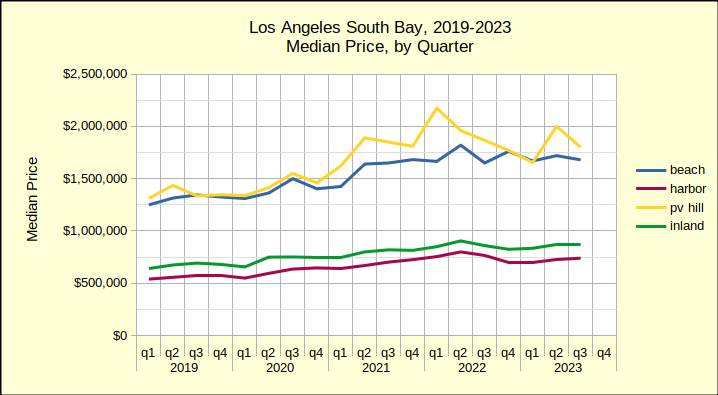
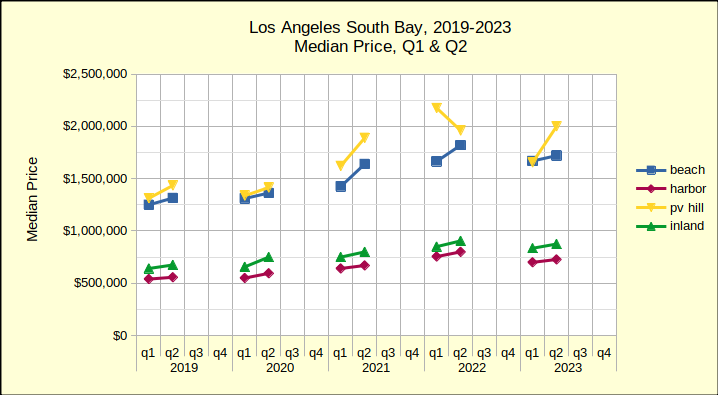
Coming right on the heels of the sales volume collapse is a drop in the median price. Prices today are down from where they were in 2022, which was the peak of the recent market. The chart below reflects the median price for the first and second quarters of the past five years. Typically, the first quarter is the slowest, with the number of sales increasing through the second quarter and then slowing again for the third and fourth quarters. Here the growth from Q1 to Q2 shows and we can see the change from year to year.
As always, bear in mind that the Palos Verdes Hill offers a comparatively small sample size, so a couple of significant sales can shift the plot lines dramatically on a chart. The chart above shows one such anomaly where PV the median price actually declines in the second quarter.
Looking across the years from 2019 all four areas show the same upward movement in median price until the second quarter of 2022. Then, comparing it to the second quarter of 2023, we can see the trend shifting downward. For example, the Beach Cities median fell from $1.82M in the second quarter of 2022 to $1.72M in the second quarter of 2023. The weakness in median prices is driven by increasingly steeper mortgage interest rates. Barring a change in market dynamics, anticipate this line turning into a steeper downslope for residential prices starting in winter of 2023/24.
When Is the Bottom?
The market is clearly taking a downward turn. Sales volume is off, median prices are turning down. Sellers are not putting properties on the market. Buyers aren’t buying. The few forecasters willing to make a guess this early are saying real estate won’t come back until 2025, possibly 2026. For those who are “waiting for the bottom of the market,” remember that by the time you read it in the headlines—you’re too late—the bottom is gone.
Beach Cities Sales Dropping Fast
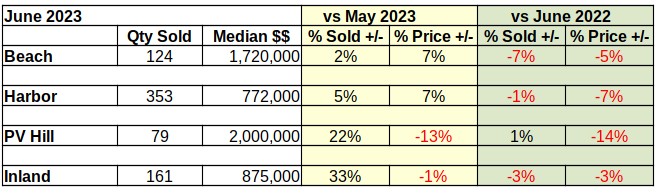
Median prices at the Beach have fallen 5% from last June, coming in this year at $1.72M, an even $100,000 below June of 2022. Year to year sales for June are down 7% from last year, at 124 units compared to 133 in June of 2022.
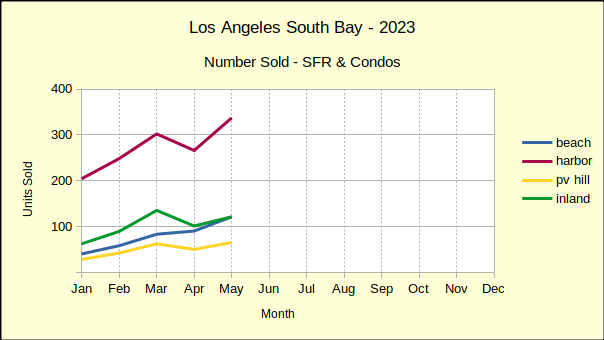
Month over month statistics have been highly volatile since the beginnning of 2023. Interest rates and prices have changed erratically, making short term forecasts nearly impossible. Month to month sales volume has bounced in a range from 2% to 45%. In just six months, monthly median prices in the Beach Cities have ranged between -18% and 26%.
Year to date sales volume at the Beach is down 25% from last year and is off a full 35% from 2019.
The year to date median is down 3% compared to 2022, though it is still 32% above the median in 2019.
Despite market conditions, homes in the Beach Cities remain highly desirable. For June, 78% of sales transactions closed within 30 days of listing and sold for 2.61 % above asking price. Beach homes also offer a great deal of diversity. June sales showed a 19 million dollar range between the low sale at just over $500K and the high sale at $19.5M.
Harbor Area Home Sales and Prices Down
Year to year-same month sales in the Harbor area have been negative since the first of the year. Prices were still holding up in June of last year, but sales volume had been dropping through all of May and June. As a result, the number of homes sold dropped a mere 1% coming into June of 2023. That looks good until compared with the year to date decline of 24%.
Market conditions in the Harbor last year gradually changed from joy for rock bottom interest rates at the beginning of the year to caution as sales tapered off and sales figures stated taking a hit. Median prices for June of the current year have fallen 7% from the June 2022 median of $830K.
Until now, the Harbor area has shown mixed results in the month over month statistics. For June compared to May sales volume was up by 5% (353 versus 337), while median price was up 7% ($772K versus $720K). Like the Beach Cities, the Harbor Area is following a more normal upward swing from the winter doldrums into the spring selling season.
That upward swing is not expected to go very high or last very long. At 1710 homes sold, year to date sales volume from January through June is down 24% versus 2259 sold in 2022. Sales volume is likewise down 17% from 2071 during the same six months in 2019. The variance in monthly sales is expected to drop into the single digits starting in July.
Median prices are down 4% compared to 2022 though still up 33% versus 2019. (Note: Using The Federal Reserve’s “target inflation rate”of 2% annually would have put the Harbor area median price increase at a little over 8%. That implies an “excess growth” of about 25% in median price during the pandemic buying splurge. Much of that difference, if not all of it, is expected to disappear over the next 18 to 24 months.)
June sales detail shows 77% of sales closing escrow within 30 days. Buyers were still bidding up, with the sales price exceeding the list price by 2.61%. The highest sale recorded in June for the Harbor was $4.25M; while the lowest was $527.5K.
PV Peninsula Volume and Prices Mixed
Palos Verdes, contrasting May versus June of 2023 shows a 22% increase in the number of homes sold for a monthly total of 79. At the same time, the median price dropped by 13%, falling to $2M even. Expectations for month over month statistics include fewer sales and more aggressive price reductions as 2023 wears on. The summer and fall months are projected to have weaker home sales, both in volume and pricing, as interest rates increase and buyers and sellers who “must move” run out of options.
Year over year same month sales, showed a volume growth of 1% (one sale), accompanied by a 14% drop in median price from $2.3M. That 1% increase is the first time in 2023 that any of the areas has shown positive growth in the number of homes sold. As such, and knowing that the PV Hill is considerably smaller that the other areas we measure, readers are cautioned about the wide swings in PV statistics.
Sales volume for the first six months of 2023 is down 26% compared to 2022 (326 homes in 2023 versus 438 in 2022. Similarly, sales are down 9% from 2019 when sales of 358 homes were recorded. Median prices of $1.8M for the same period are down 13% from 2022 prices of $2.1M and up 36% from $1.3M in 2019.
Market time has remained good, with 75% of sales closing withing 30 days. Sellers have enjoyed selling prices 2.3% higher than asking prices, a trend expected to disappear before the end of summer. Once again showing the range of homes available in the South Bay, the high sale in PV was $10M while the low was $610K.
Inland Area Makes Strong Showing
Sales volume of 161 homes in the Inland Area for June was up 33% over sales of 121 in May. With 33% more activity came a 1% reduction in median price, which fell to $875K after reaching $880K in May.
Comparing June of this year to June of last year showed a volume decrease of 3% from 166 in 2022. Likewise, this June showed a median price decrease of 3% from last year’s $905K.
Year to date volume for the first six months was down 68%, for 669 units sold, versus 869 in 2022. Going back to 2019, the most recent “normal business year,” sales volume was down 21% from 799 sold in 2019.
Median price of Inland area homes for the same six month period showed at $863K, down 3% from $887K in 2022; and up 32% from $652K in 2019. Days on market remained under 30 for 82% of the Inland area homes sold in June. Buyers offered 2.6% above asking price. The high market sale was $2.2M while the low was $390K.
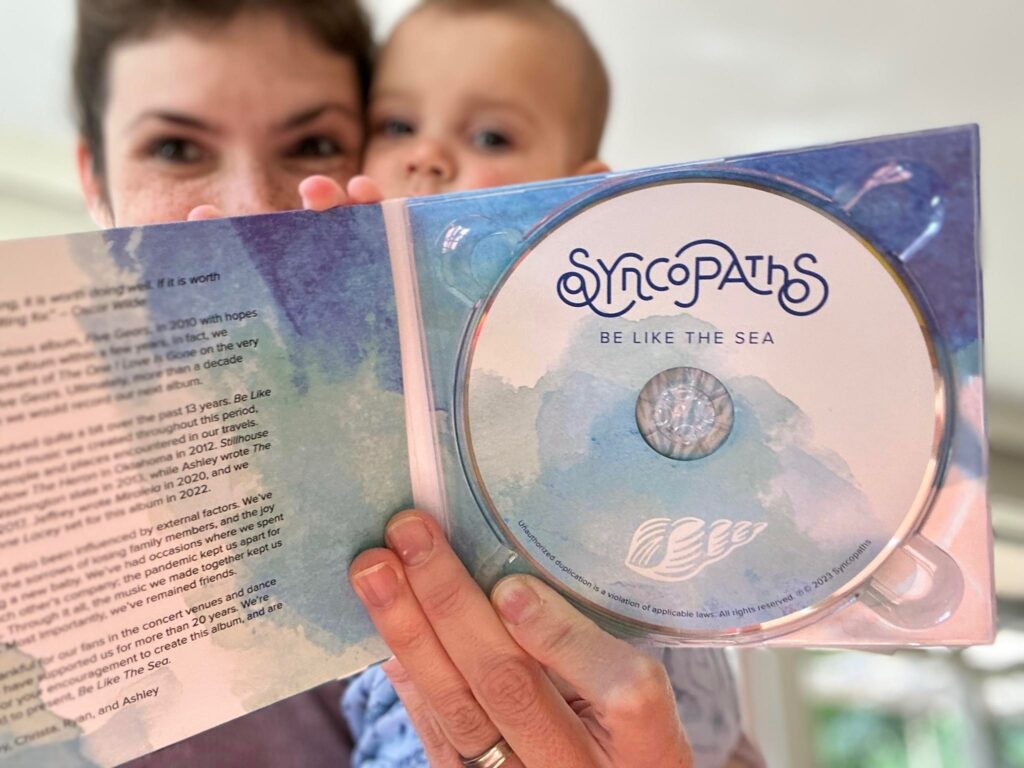
SYNCOPATHS “BE LIKE THE SEA” CD RELEASE CONCERT Saturday, June 17 / 8PM at the Grand Annex Music Hall
Celebrate the Syncopaths release of their new CD! “Be Like the Sea” delivers a wide variety of songs and tunes from the Irish, Scottish, and American traditions, as well as original compositions. It’s sure to be a joyous night of contemporary folk music featuring vocalist Christa Burch, Ryan McKasson, Ashley Hoyer and Jeffrey Spero this Saturday night at the Annex.
This is a once a month (every third Tuesday) show that is designed as a listening room for world class songwriters, to play their original music in an intimate setting. The music starts promptly at 7PM. No cover charge, but donations to the performers is encouraged. This month the performers include: JODI SIEGEL, T BEAR, BECCA BYRAM, ALFRED JOHNSON.
JODI SIEGEL
Jodi Siegel, originally from Chicago, IL, is a singer, songwriter and guitarist. Over the years Jodi has opened for and or shared the stage with many respected musicians including: Albert King, Robben Ford, Robert Cray, J.D. Souther, David Lindley, Fred Tacket and Paul Barrere (Little Feat) and countless others. Her songs have been recorded by Maria Muldaur, Marcia Ball, Tommy Ridgley and Teresa James. Her latest CD, “Wild Hearts,” produced by Steve Postell, is filled with great songs, cool grooves, intimate, smart lyrics and some of the best of the best musicians in Los Angeles today. Each song has a soulful delivery with an undeniable down-home elegance. It has received great reviews by Patrick Simmons (Doobie Brothers), Maria Muldaur, Walter Trout, David Mansfield (T Bone Burnett), Leland Sklar, Mike Finnigan and Doug Macleod to name a few.
ALFRED JOHNSON
The highly regarded singer/songwriter and funk piano player, Alfred Johnson is considered by some one of this century’s most animated and original songwriters. His energetic style of playing the keys brings a wonderful compliment to his music. Alfred co-wrote 3 songs with RICKIE LEE JONES, including the musical masterpiece “COMPANY,” which are all featured on her 1979 Platinum Grammy Award winning premiere album containing the hit single “Chuck E’s In Love”. Recognized as a true craftsman of his art, Alfred has written over 900 tunes, and at least 70 of them are published. He is best known for his lyric-driven tunes that will keep you captivated till the end. Alfred’s diverse musical style encompasses Funk, New Orleans, Pop, Rock ‘n’ Soul, Gospel, “Rhythm & Bluegrass” – as he calls it, and music that will have you wanting to dance and sing along. He enjoys sharing his work with good listeners.
T BEAR
T Bear, aka Richard T. Bear, is no stranger to musicians and fans all over the world. He has been a long time touring and recording session man and artist, and considered to be one of the best singer/songwriter/keyboard players in Los Angeles. He has returned to the stage with a striking new release, Fresh Bear Tracks, his first studio album in 25+ years. He’s re-emerged, feeling newly inspired, creatively recharged, and making some of the most engaging music of his career. A distinctive singer and talented keyboard player who made his mark as a solo performer and collaborator with many iconic artists — Crosby Stills and Nash, The Blues Brothers, Billy Squier, Cher, as well as Gene Simmons and Peter Criss of Kiss, to name a few — he’s now taking center stage and ready to share his newest music with the world. Fresh Bear Tracks features a host of special guests, including Stephen Stills, Robby Krieger, Edgar Winter, Tom Scott, Walter Trout, and Hutch Hutchinson,
BECCA BYRAM
Originally from England, Becca moved to the US early in her career, securing work as a session musician and songwriter in New York, developing a reputation as a highly regarded analog keyboard player and vocalist, and became a resident player at the world renowned Hit Factory after catching the ear of Eddie Germano. She signed with Caroline Records after Bill Laswell was swept away by her talent and her debut album, “Becca’s Smoke and Candy Store” was released. On the heels of that, she published a healthy catalogue of further recordings including “Nice to Be There, “ Childhood’s End,” “A Fair Forgery” and two live albums, “Live from CBGB’s” and “Live from the Living Room.”
Project Barley serves excellent Food (Gourmet Pizza, gluten free/vegan options, wings, sandwiches, salads), wine, and award winning beer. Food served till 8:30pm. No reservations so arrive early to get a table. 2308 E Pacific Coast Hwy, Lomita, CA 90717 https://projectbarley.com/