The Recession Continues – November Home Sales

Home Sales Plunge

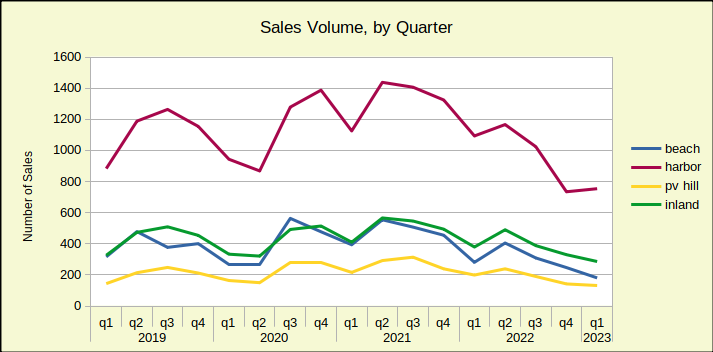
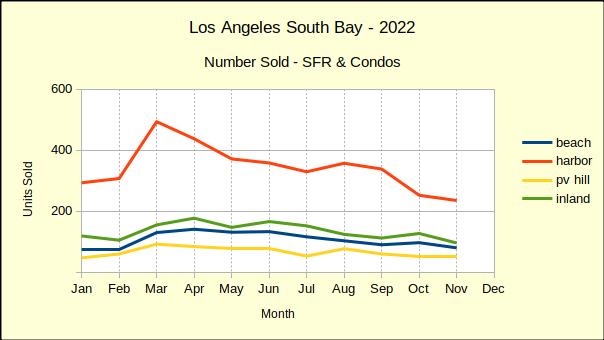
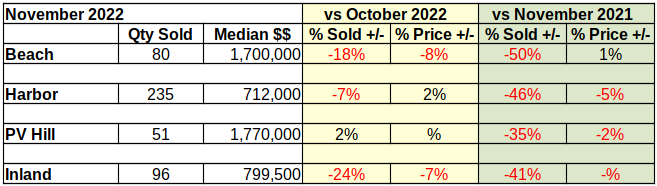
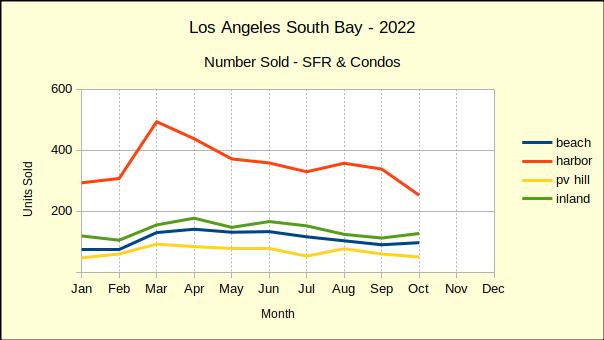
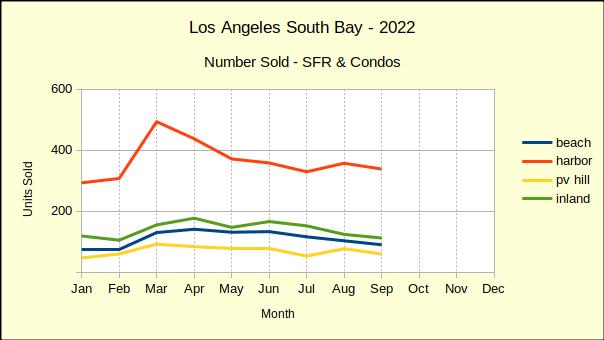
November saw the number of homes sold in the South Bay fall 12% from October totals. Sales volume has declined in seven of the eleven months on a month to month basis since the beginning of the year. Sales tipped up a modest 2% on Palos Verdes peninsula, while volume dropped 7% at the Harbor, 18% at the Beach and 24% in the Inland area.

Year over year sales look even more depressed with a 45% drop from 2021 sales across the South Bay. The Beach Cities led the plunge with a 50% fall, followed by the Harbor area at 46%. Palos Verdes and the Inland area brought up the rear with 35% and 41% respectively. The falloff in sales began with a 17% drop in January and has been increasingly negative since.

Because 2020 and 2021 were both significantly impacted by the coronavirus pandemic and the governmental response to it, 2019 is the most recent year with a normal business pattern. Comparing 2022 sales volume with 2019 provides the truest measure of the current recession. Overall, for the first 11 months of the year, the South Bay has experienced a 9% decline in sales compared to 2019.

Through the month of November, sales on the PV Hill have fared the best, showing a modest drop of 3% compared to the same time period in 2019. The Harbor and Inland areas which generally are entry level for the South Bay both fell back 8% for the same period. So far this year the Beach Area has suffered the largest declines with an 18% drop in number of sales versus 2019.

Annual Sales Dollars Off By $3.2 Billion

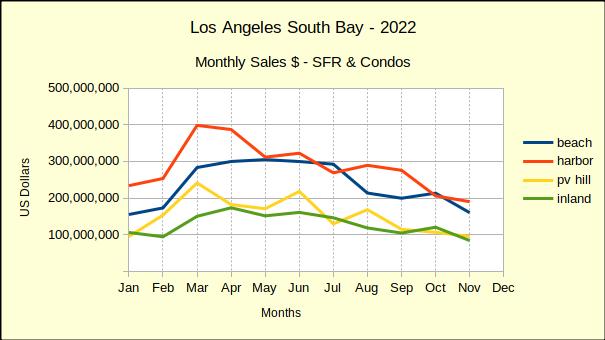
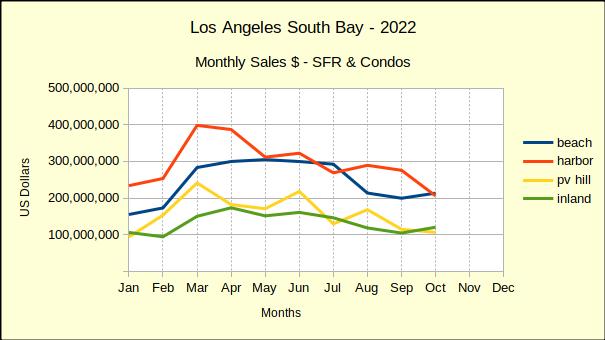
Comparing year-to-date sales of homes in the Los Angeles South Bay shows a drop in dollar value from 2021 to 2022 of over $3.2 billion. That represents an over-all decline of 22% in total dollars sold from the same 11-month period last year.

The Beach area has been the hardest hit so far with a drop of 34%. The PV Hill has dropped 29%, while the Harbor area has fallen 22%. The Inland area fared the best, only down 19% for the same 11 months.

On a month to month basis, the decline in sales accelerated from 7% in October to 18% in November. The Inland area which had flipped to a positive gain in October plummeted by 30% in November. Similarly the Beach which had been up 7% in October fell 25% in November. The Harbor and Hill areas were off by 8% and 11% respectively.

At this point year to date South Bay sales dollars for 2022 still exceed the total for 2019 by 22%. We expect the end of year numbers to be positive. However, with monthly sales figures shrinking by 30%-40%, we project 2023 to fall below 2019.

Median Price Shows Mixed Results

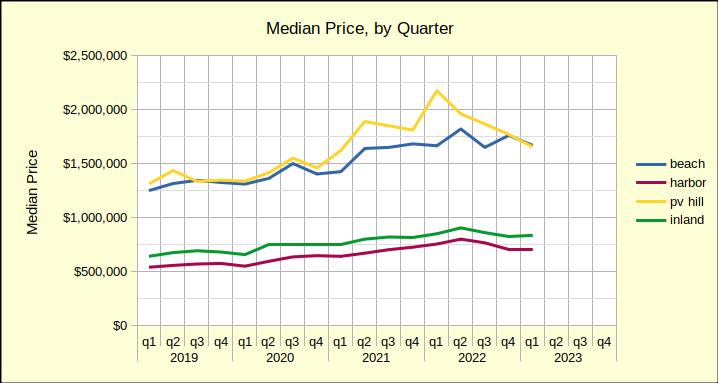
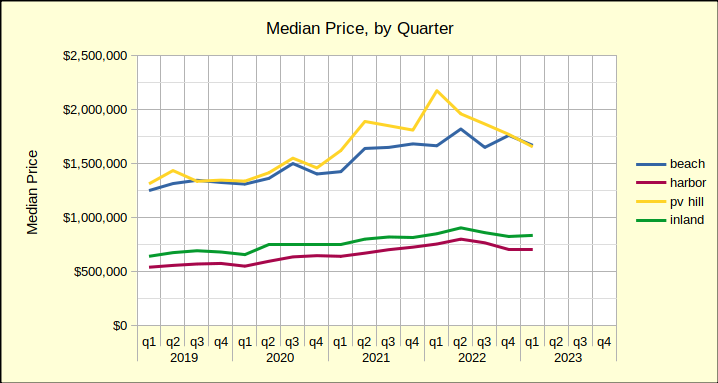
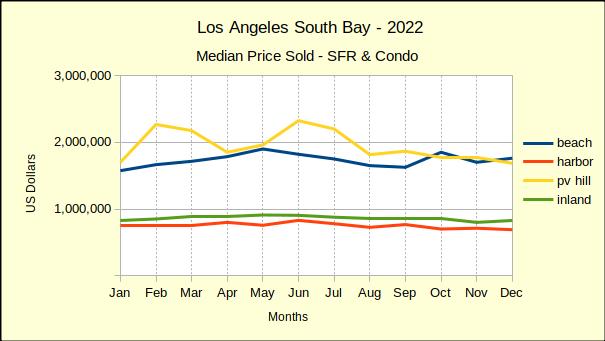
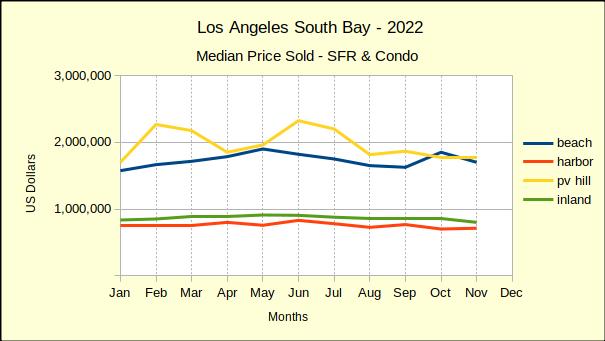
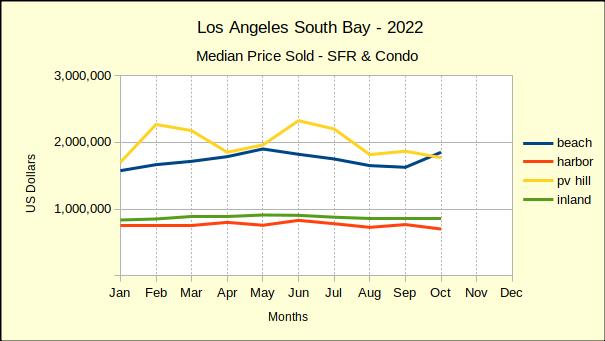
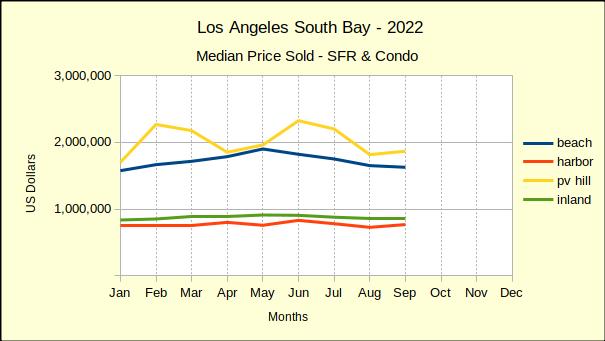
Statistically speaking, the Beach cities median price fell 8% from October to November. The reality is that the median in October was unusually high. Multiple sales of Strand property drove the median up 14% that month. The blue line on the chart below shows the one month blip and median prices dropping back to a steeper downward pace in November.

Palos Verdes was flat compared to the previous month. This is a rare event as one can see by the erratic yellow line on the chart. Because the physical area is smaller than the other geographical areas, the number of sales is smaller, and mathematically the sample size is smaller. Thus one or two outlier sales can create wide swings in the chart.

Similar to the Beach area, the median price dropped 7% in the Inland area. This decline follows two months of no change, preceded by three months of month over month negative median prices.

At the same time the Harbor area experienced a month to month increase of 2% in the median price. Researching this anomaly we discovered 11 new construction sales in Carson had been accumulated and posted simultaneously by the developer. It’s worth noting that Harbor area median prices have also been elevated to some extent by the new construction on Western Avenue in San Pedro.

From a year over year perspective, November median prices continued to fall in comparison to those of November 2021. The Harbor and PV Hill areas were down 5% and 2%, respectively. Median price in the Inland area dropped from positive 6% in October to negative .05% in November. The Beach cities remained positive with growth of 1% in November. That being in contrast to an unexpected growth of 20% last month caused by the sale of multiple Strand properties in Manhattan Beach.

Despite increasingly deep reductions in sales volume and in median price throughout this year, the median is still higher than it was in 2019. Palos Verdes home owners have fared the best with the current median price 40% above the November 2019 median. The Harbor area is still 34% higher and the Beach cities still maintain a 31% advantage. The Inland area has proven to be relatively stable throughout the pandemic and currently the median price is 27% above that of 2019 for the same 11 month period.

Year End Projection Updated

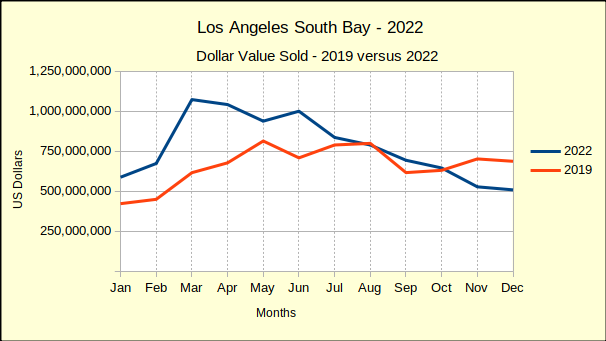
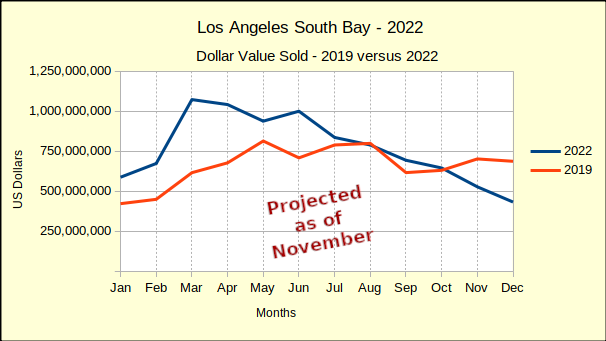
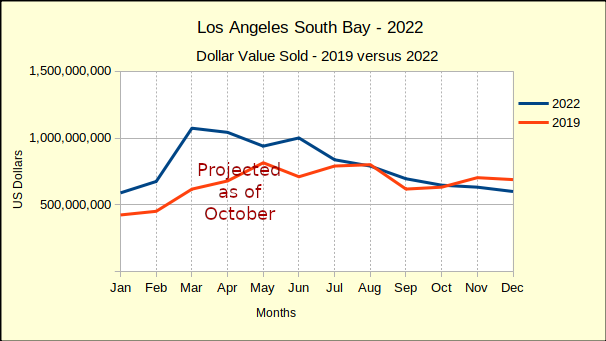
We’ve been comparing 2022 to 2019 all year because real estate sales during the height of the pandemic were so out of the ordinary, regular year over year comparisons yielded untenable results. The chart below depicts the current year total sales for the South Bay compared to sales from 2019.

Tracking the blue line, one can see where sales dropped below 2019 values in August, recovered in September, then slipped below again in October and November. Assuming the decline continues at the same rate, we are forecasting the December sales to drop another $75 million, or so.

The end of the year would then reflect accumulated sales of approximately $9.4 billion. That would mean 2022 total dollar sales come in at $1.4 billion above the $8 billion total dollar value sold in 2019. Across the South Bay that would be approximately an 18% increase.

Broken out by community, we forecast total dollars sold in the Beach cities to be 6% above 2019, followed by the Inland area with a 20% increase. Harbor comes in next with a 21% increase and the PV Hill with a 35% increase.

At a Glance

As 2022 draws to a close we find the final numbers for both sales volume and median price show the year to be rapidly declining from the final figures for 2021. However, the totals all remain positive. We expect December to continue the trend downward, though the year should end on a positive note.

With the number of units sold decreasing every month by 35% to 50%, and the median price now falling, 2023 should be firmly in the grip of the recession by mid-year.

Disclosures:

The areas are:
Beach: comprises the cities of El Segundo, Manhattan Beach, Hermosa Beach and Redondo Beach;
PV Hill: comprises the cities of Palos Verdes Estates, Rancho Palos Verdes, Rolling Hills and Rolling Hills Estates;
Harbor: comprises the cities of San Pedro, Long Beach, Wilmington, Harbor City and Carson;
Inland: comprises the cities of Torrance, Gardena and Lomita.

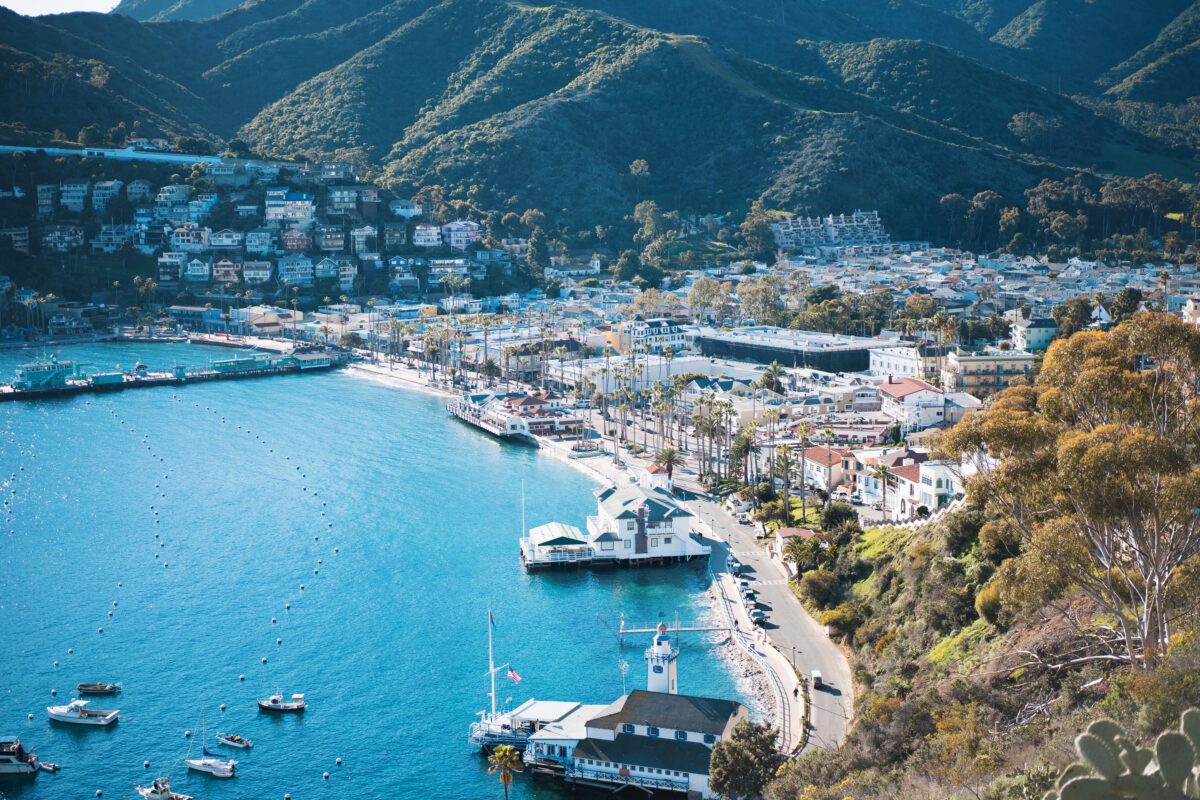
Photo by Elias Shankaji on https://unsplash.com/

October Home Sales Down 40%

Compared to October of last year, home sales in the Los Angeles South Bay have dropped by 40%. Hardest hit was the Harbor area which fell 47% from last year’s October numbers. The Beach Cities were down 40%, while the PV Hill and the Inland area fell 32% and 25% respectively.

Month to month sales across the South Bay were down another 12% compared to a 9% drop in September. Looking at the different communities found mixed results. The Beach and Inland areas improved sales over September statistics, while the Harbor area and PV Hill continued downward. Harbor area sales plummeted another 20%, falling from -5% last month to -25% in October.

The pandemic created a wild roller-coaster ride for Harbor area real estate. Being the least expensive of the four areas, Harbor area homes are the most affordable and attracted the most attention when interest rates were ultra-low and entry level buyers were able to qualify for purchase loans. Now, with the interest rate already double the 3.5% of 2021, many potential buyers no longer have the cash flow to purchase.

Note that 476 Harbor area homes sold last October versus 252 this October. Looking back to 2019, the most recent “normal” year we find there were 397 homes sold in the Harbor area. This demonstrates how artificially inflated sales figures were in 2021 and how far sales have already fallen in just seven months from the peak.

In mid-November, following another .75% increase by the Federal Reserve System, the Mortgage Bankers Association is reporting a drop of 46% in mortgage applications to purchase a home compared to last year. That decline is accompanied by an 88% decline in applications to refinance a home loan. That amounts to a lot of money out of circulation in the economy.

Total Dollars in Sales Declines $1.8 Billion

As of the end of October South Bay home sales for 2022 total $8.3 billion. That compares to $10.1 billion for the same time frame in 2021. Already this year the gross sales revenue has fallen by $1.8 billion, or 5%. As the market slips deeper into recession, we expect the monthly sales revenue will continue to decline, shrinking the total even more.

The graph above shows the downturn starting in March and generally trending down for the balance of the year. It’s important to remember that home sales are a major driver in the economy. Every home sold results in a miniature boost to the economy as new homeowners relocate, acquire new furniture & appliances, repair and update their new home. Most experts estimate an additional 15%-20% for ancillary economic activity stimulated by real estate sales.

Using 2019 as a baseline, we can trace the rise and fall of the South Bay real estate market through the pandemic. In 2019 the total cumuilative sales was $7.9 billion. In 2020, when the pandemic hit and the government began piling on financial assistance and incentives, the annual sales reached $8.7 billion. When 2021 rolled around the ultra low interest rate alone was enough to drive annual sales to $12.1 billion, an increase of 53% over the 2019 sales figures. Looking now at 2022, we are forecasting a year end total of approximately $9.5 billion, a decline of 22% from 2021.

An additional concern this year is the reduction in local and state tax revenues. The pandemic forced significant governmental expenditures to mitigate harm to citizens. A recession, coming on the heels of Covid-19, threatens to up-end the economy. California’s budget reserves haven’t yet recovered from the pandemic and state revenues are already slipping.

Median Price Shifting Down

Wealth is often measured by the value of owned real estate. For most families their real estate is the home they live in, which is valued per the median price of comparable homes. Thus, nearly everyone is interested in the median price for the area.

Year over year, comparing 2021 to 2022 for the same month, the median price continued to rise until August of this year. Since then results have been “choppy” with median prices down August, September and October for PV Hill sales, down two months out of three at the Beach, down one month in the Harbor area and up all three months in the Inland area. (How the areas are defined may be found at the end.)

Looking month over month, comparing each month to the one prior, shows a clearer picture. January started the year with declines compared to December, both at the Beach and in the Inland area. By July and August all four areas were showing declines compared to the prior month. The repeated monthly decreases in the median prices built up to the annual decreases which began showing up in August and have continued through October.

When Is It a Recession?

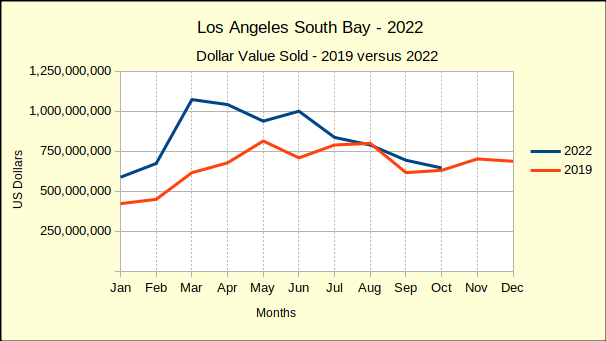
Since June of this year the total dollar value of South Bay sales has been declining. Combined, the precipitous drop in number of homes sold and the gradual decline in median price are driving the revenue below that of 2019 on a monthly basis. The chart below shows August as the first occasion where the total dollar value of homes sold in 2022 fell below the monthly sales in 2019. October sales for this year ended just shy of the same month sales in 2019.

Our projections (shown below) for the 2022 year end indicate the total sales for the year will fall below the 2019 total sales dollars. While this isn’t an official definition, or designation, it matches our understanding of a recession. Any time our financial situation is headed backwards in time we think of it as a recession.

The challenge now is to consider how this recession will play out in time. The Federal Reserve System (Fed) has changed the game rules since the Great Recession. A prominent change has been the speed with which the Fed raised the prime rates for member banks. In response to the Great Recession, the Fed gradually raised rates over a period of years. This gradually slowed home sales. This time, the Fed has raised rates much faster, resulting in much more immediate impact on the real estate market.

At the moment, all expectations are for another rate increase in December, despite indications the economy is crashing. A seriously disappointing Black Friday might convince the Fed to ease up, but we’re anticipating that relief. If history and the immediate data proceed along the current path we should see a lot of price reductions in 2023.

For those who must sell, it’s an unfortunate time. There are ways to ameliorate the negatives, but it will probably still be negative. Those who are in a postion to purchase have the benefit of reduced prices, combined with the negative impact of higher interest rates. Generally speaking, very few are happy with a recession, though we have talking to a group of buyers who think pooling cash and buying as a consortium/collective is a masterful idea right now.

At a Glance

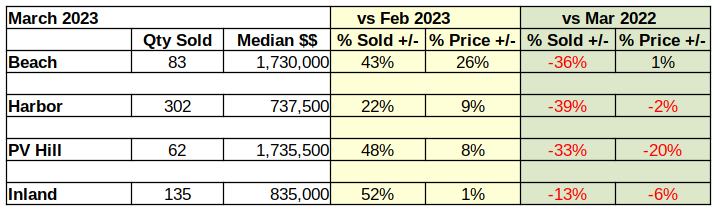
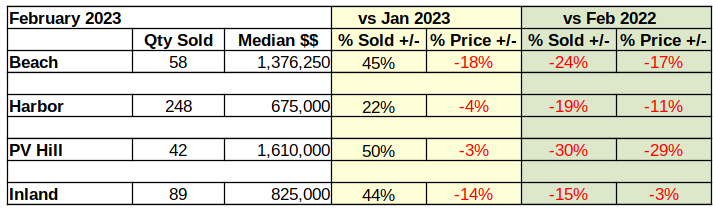
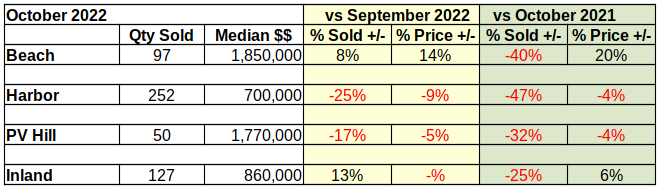
In addition to being relatively self explanatory, our At-a-Glance table is discussed throughout the above paragraphs. We won’t bore you with any more chatter about it, but we find it immensely useful as a quick reference. Some of our readers have even said they immediately go to the bottom of the article to see how much red ink there is. (Sorry. It is getting redder, but there are some delightful opportunities out there.)

Disclosures:

The areas are:
Beach: comprises the cities of El Segundo, Manhattan Beach, Hermosa Beach and Redondo Beach;
PV Hill: comprises the cities of Palos Verdes Estates, Rancho Palos Verdes, Rolling Hills and Rolling Hills Estates;
Harbor: comprises the cities of San Pedro, Long Beach, Wilmington, Harbor City and Carson;
Inland: comprises the cities of Torrance, Gardena and Lomita.

Photo by jordis small on Unsplash

More Live Local Music !

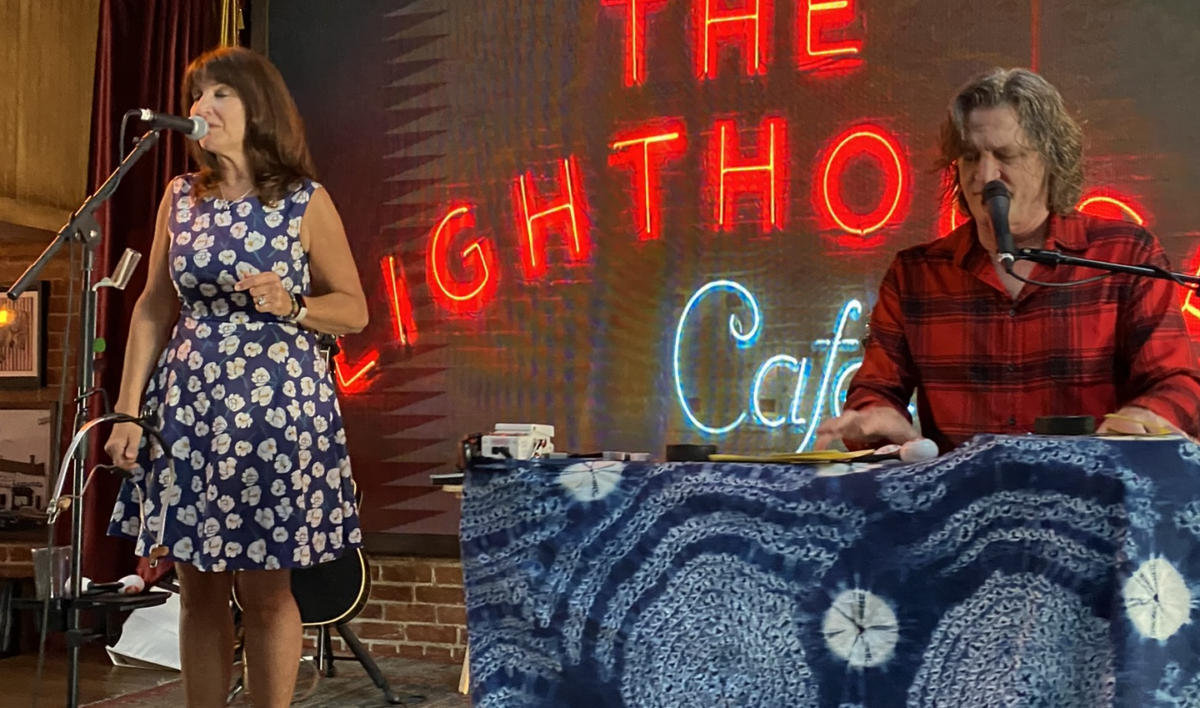
Andy & Renee-The Lighthouse-EVERY TUESDAY

TUESDAYS- 5:30-7:30PM (Every Tuesday!) 
The Lighthouse Cafe,
30 Pier Avenue Hermosa Beach, CA

Andy Hill – EVERY WEDNESDAY

WEDS- 8:30PM — 11:30PM
Fairmont Century Plaza,
2025 Avenue of the Stars, Los Angeles, CA

Andy & Renee

THURS- Oct 20th 6:30PM — 9:30PM 
Sister’s Barn
1408 S Pacific Coast Hwy, Redondo Beach, CA
424-452-6070

Songwriter Showcase – October

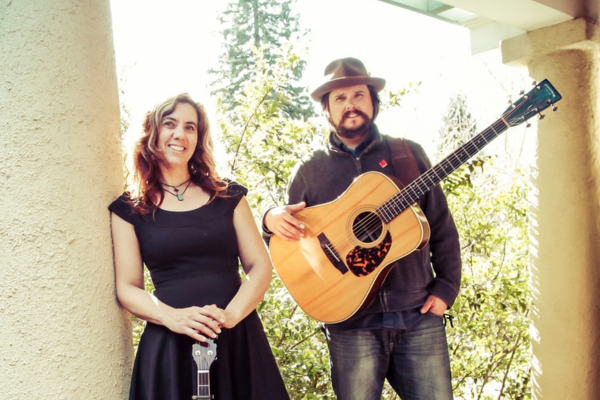
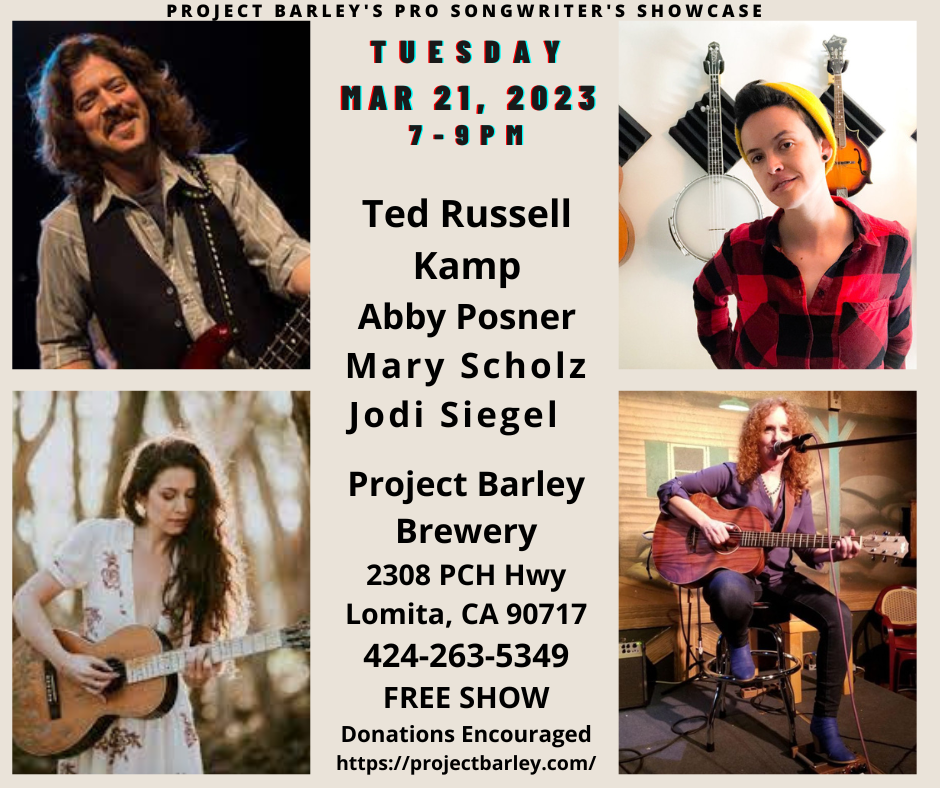
This month brings blues singer songwriter Teresa James, songwriter, producer, bass player, Terry Wilson (Teresa James and the Rhythm Tramps),guitarist, singer, songwriter Shawn Jones and our hostess, Jodi Siegel!

Teresa James  – https://teresajames.com/home
Terry Wilson – https://en.wikipedia.org/wiki/Terry_Wilson_(musician)
Shawn Jones –  https://shawnjonesmusic.com/home
Jodi Siegel – https://jodisiegel.com/home

Every third Tuesday of the month, 3-4 singer songwriters of all genres, come and play their tunes in front of an intimate audience. Admission has been free but donations are strongly encouraged to help pay the musicians. It has become more than a local showcase, but a concert in an intimate setting and a great hang of like minded music lovers!

The venue has the down home feel of a neighborhood bar, with the ambiance of a small concert hall, an excellent sound system and every seat is VIP.  The Showcase has gained a very loyal following of not only fans who attend every month, but it has also drawn some amazing music makers and hit songwriters too. Many have toured the world with legends.

Project Barley’s is located at 2308 Pacific Coast Highway, Lomita, CA 90717 They have award winning crafted beer, wine, sandwiches and their amazing pizza. For more information about the venue go to their website https://projectbarley.com/

A Recession on the Horizon

September Home Sales Down 35%

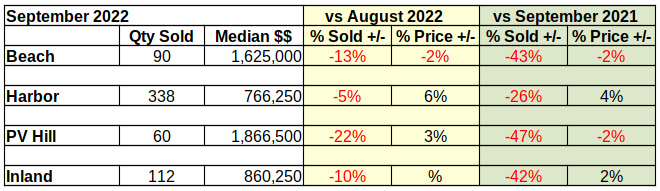
Last year saw home sales in the South Bay escalate dramatically as buyers sought to become homeowners while interest rates were still abnormally low. With interest rates rapidly rising it’s no surprise that sales are plummetting in 2022. The Harbor area, traditionally an entry level market, handily out-sold the balance of the South Bay with a drop of only 26%. The remaining areas suffered sales drops ranging from 42% to 47%, with the South Bay as a whole dropping 35%.

Compared to last year, cumulative South Bay home sales were down 21% as of September. The first three quarters of 2021 saw 7767 townhomes and single family residences sold, versus 6163 during the same period this year.

Recognizing that 2020 and 2021 were exceptionally aberrant, we also compared the 2022 year-to-date sales volume to 2019, the last normal year of business prior to the pandemic. As of the end of September 2022 cumulative sales volume was 4% lower than it was for the first nine months of 2019.

The decline from 2019 sales is uneven in that the biggest drop, 15%, is seen in the Beach area, which is typically at the high end of the market. Sales in the Harbor area only dropped back by 2%, while sales in the Inland area fell by 4%. The Palos Verdes peninsula fared best, actually increasing in quantity sold over 2019 by 4%. As always we offer a cautionary note when looking at statistics for property on the PV Hill. Because there are considerably fewer homes in that area, percentile statistics can take large swings.

Median Prices Mixed in September

The number of homes sold in 2022 has declined, indirectly affecting the median price of those homes, as well as the total dollar value of all the homes sold in the same period. A closer look at the median price of homes sold through September yields some surprising changes.

Since prices increased dramatically during the coronavirus pandemic we anticipated finding the median price from 2022 to be considerably higher than that of 2019. Indeed, that is the case with the median in the Beach area up 31% over that of 2019, the Harbor up 36%, PV Hill homes up a staggering 47% and the Inland area up 30%. But, that is gradually reversing.

July and August of this year showed depreciation in the median price across the South Bay. Prices consistently dropped in a range from 2% down (Inland) to 18% down on PV Hill. September sales broke the pattern with only the Beach cities losing value per the median. The Inland area was flat, showing no change from August. In an unexpected twist, both the Harbor area and the Hill came in with an increase in the median price. The growth was modest, up 6% for the Harbor area and up 3% for the Hill. Despite the slight improvement in September prices we anticipate continued downward pressure as inventory grows and time on market stretches.

Looking at the median price on a year-over-year basis, we find September with minor declines from August. The Palos Verdes cities showed prices dropping by 2% last month and this month. At the same time the Beach cities dropped 2%, while the Harbor and Inland areas increased by 4% and 2% respectively.

Median prices started 2022 with increases regularly coming in well above 10% growth. In April we saw the first negative where the median for the Hill fell 2% from 2021. Since then we have watched the rate of price appreciation decline from double digits until now in September with both the Beach and PV areas losing value.

We fully expect all areas of the South Bay to reflect declining median prices before the end of the year. While prices will be down on both a month-to-month and year-to-year basis, we don’t anticipate the median to fall below 2019 price points this year.

Total South Bay Sales Dollars

When the number of sales is decreasing and the median price of those sales is also decreasing, one has to assume the gross revenue will also decrease. Governor Newsome has been warning for several weeks that the 2022-23 fiscal year will not see the State level revenue surpluses California has been enjoying.

During the first quarter of 2022 gross revenue from real estate sales remained predominately positive, with year-over-year growth rates of about 6% per month. Since March the South Bay has only seen two instances of sales growth, 7% in the Harbor area for April and 3% in the Inland area for June. Every other entry on the chart is negative, with September declines averaging about 40%.

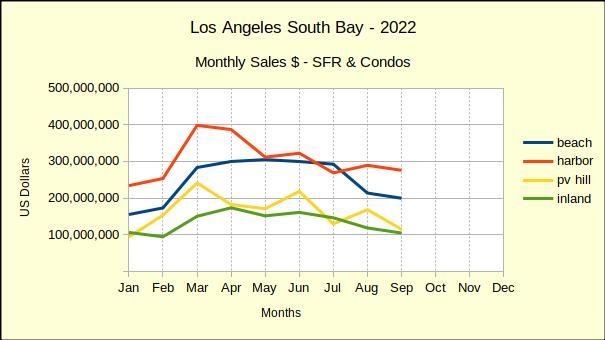
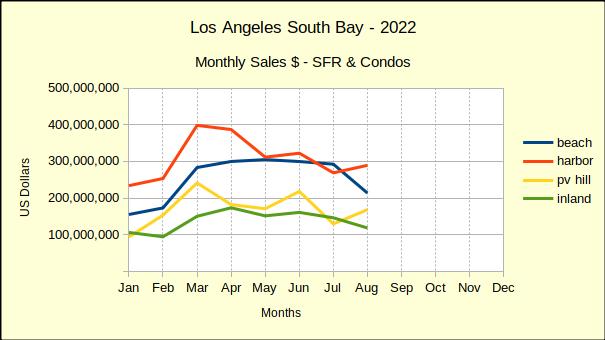
Cumulative sales for the first three quarters of 2022 were off by 29% compared to 2021. Our monthly sales dollars chart shows a zig-zag downward trend since spring of this year. Of course, 2019 is a more realistic point of comparison as a result of market gyrations created by the pandemic and our government’s fiscal response.

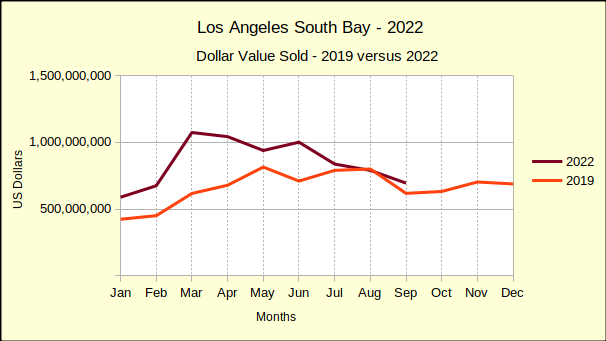
Comparing 2022 sales totals to 2019 yields a clearer picture of the current direction of the market. Instead of a sea of red ink, we can clearly see that 2022 sales have remained above those of 2019 with the exception of August. Sales started normally, then in March the Federal Reserve Bank announced a .25% interest rate hike, and promised more to come.

Buyers threatened with increasing monthly payments jumped into the fray and pumped sales up for a couple months. Then a new .5% increase, accompanied with the promise of multiple .75% increases throughout the year began a downward slide in home sales that is continuing.

Following the trajectory of the maroon line, and assuming the interest rates continue to increase, we predict 2022 sales will drop below 2019 again in October. The Federal Reserve Bank has already announced plans for another .75% increase in November, followed by a .5% increase in December. Adding another 1.25% will bring the full increase for the year to 4%. We envision the fall in sales growing steeper, bringing total sales below that of 2019 for the final quarter of the year.

Statistical Summary

This would be the heart of the discussion if we were dealing with a normal fiscal environment. Here we could talk about month-to-month changes and changes from the same month last year to this year. Instead we’re faced with an unanticipated side effect of the pandemic—out-of-control inflation followed by a steep recession.


The areas are:
Beach: comprises the cities of El Segundo, Manhattan Beach, Hermosa Beach and Redondo Beach;
PV Hill: comprises the cities of Palos Verdes Estates, Rancho Palos Verdes, Rolling Hills and Rolling Hills Estates;
Harbor: comprises the cities of San Pedro, Long Beach, Wilmington, Harbor City and Carson;
Inland: comprises the cities of Torrance, Gardena and Lomita.

Goodbye Marymount, Hello UCLA!

Marymount California University, is no more. But, shed no tears! The prestigious University of California at Los Angeles plans to open the site for classes in the fall of 2023-24. Escrow had not yet closed as of this writing, but all appears to be moving forward at good speed.

We are told the finalists included four developers and three educational institutions. We’re pleased that UCLA was the successful bidder. We’ve heard some of their ideas and look forward to having them as neighbors.

However, we’re also interested in what kind of potential the developers saw in this deal. There’s a total of 11 acres already developed as residential and 24.5 acres developed as a campus. What would that have looked like if a residential developer purchased the site?

The 24.5 acres, some of it with gorgeous ocean views, is the jewel in the transaction. A little “back of the envelope” calculation says that using an average of 15,000 square feet per lot, Which is about the average in that neighborhood, one could build about 70 high end homes at the location. New construction on similar sites is selling for about $7.5M today, giving a value for the finished project of approximately $525M. Not bad for a land purchase of $80M, especially considering we haven’t started looking at the 11 acres.

There exist some legal complications in the 86 unit, 11 acre property. Deed restrictions purported to require the land to be used to house students. That can readily be accommodated by an educational institution, like UCLA. Developers on the other hand might have to pay some serious legal costs to do anything else with the land.

And it might have been worth the legal expense. A quick look at the apartment building market in the South Bay shows roughly comparable buildings selling for about $420K per unit. That would make 86 units worth about $36M, almost half the stated purchase price.

We’ll never know what might have been. The entire South Bay can look forward though, to an educational revival. A refreshed campus with UCLA’s academic resources and access to the university program at AltaSea and other port projects is a great starting ground.

Photo by D koi on Unsplash

South Bay Median Home Price Plummets

With four months left in a very chaotic real estate year, we want to take this opportunity to lay some ground work for understanding why the market has headed into a recession. And, to keep things on a positive note, we end with a couple of suggestions on how you might profit from this turn of events.

Some of the nation’s most respected analysts (including Ivy Zelman of Zelman & Associates and Mark Zandi of Moody’s Analytics) are predicting recessionary price drops ranging from 10-20% and lasting through the next two years. (Arguing that we’re only looking at a brief correction, pundits at Goldman Sachs and the Mortgage Bankers Association continue to predict single digit growth.) Meanwhile, here on the street, we’re watching prices drop across the board for the second month in a row.

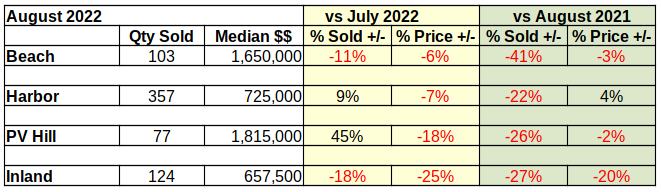
In August we reported that median home prices across the Los Angeles South Bay fell from July, the prior month. Now looking at August sales we find all four areas of the South Bay showed declining median prices again. The month-over-month price drops ranged from 6% at the Beach to 25% in the Inland cities. (See bottom for description of areas.)

Underlining the month-to-month price slippage, three of the four areas also showed declining prices versus the same month last year. Only in the Harbor area are homes still selling for more than they did in 2021. Even there, median price has slid from 9% down to 4% above August of 2021.

2022 Compared to “Normal” Business in 2019

The past two years have seen real estate stumble with the Covid lockdowns in 2020, then skyrocket with the low interest rates in 2021. It’s worth a look back to 2019 to see how the current conditions compare to the most recent “normal” market.

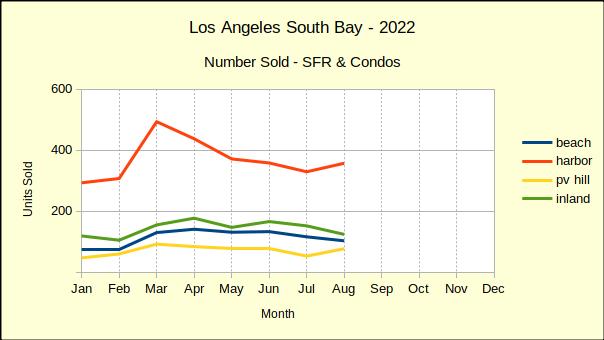
Looking at sales volume in the period January through August of 2019, 1064 homes had sold in the Beach cities. So far this year only 905 homes have sold. That is a 15% drop in sales since the last normal year of business. The trend line for the Beach area has been sliding downward since April.

For the first eight months of 2019 the Harbor area showed sales of 2955 compared to 2945 for this year. That is a drop of .3% – a statistically insignificant change. However, the trend line has been dropping since March. August sales were up slightly from July, which was an unusually slow month for the Harbor area. We expect sales to continue a downward trajectory into 2023.

Palos Verdes home sales for the same period in 2019 totaled 537 versus 568 in 2022. The Hill is the only part of the South Bay where year to date 2022 sales exceed those of 2019. At 6% it’s a healthy increase, too. Despite being the best performing area in South Bay, Palos Verdes sales volume peaked in March and continues to slide. Sales in July were unusually weak, so August shows an upward step in the trend line.

Sales in the Inland area, very much like the Harbor area are down only .4% from 2019 sales for the same period. The difference is statistically insignificant, and the trend line is headed downward.

Declining sales volume creates a larger inventory of homes to sell. As the inventory grows, sellers have more competition and buyers become more demanding and prices start declining. We anticipate continuing growth of available inventory, followed in late fall or early winter by a spate a price drops.

Median Price Up 54% Since 2019

Palos Verdes homes have seen the greatest impact of the Covid-era buying mania. Comparing median prices from the first eight months of 2019 to the first eight of 2022, we find a 54% escalation on the Hill. Normal growth over a three year period would have created 9-10% in price appreciation. Expect much of that excessive price expansion to be erased over the coming months.

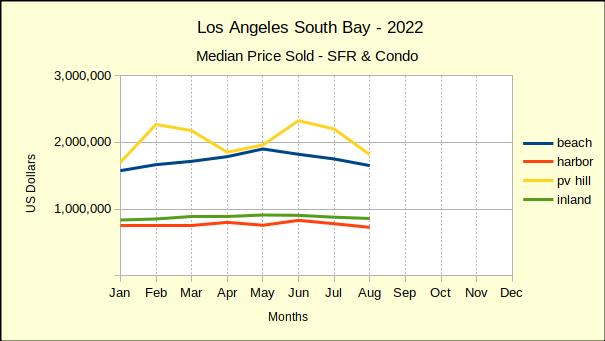
Compared to 2019, Beach area median prices have shot up by 32%. This is easily three times normal growth. As we see in the chart below prices started adjusting downward as early as May in the Beach cities.

Since 2019 median prices for the Inland area have climbed 30%. Here in the August 2022 chart below we see Inland area prices have been dropping steadily since May when the median was $910K. During that four month period values have slipped by over $50K.

In the Harbor area home prices have escalated 34%. From 2019 at $565K to 2020 at $607K the Harbor area median grew $40k. Then in 2021, it added another $90K reaching $700K. So far in 2022 the median has reached as high as $830K – another $130K increase, but has now dropped back to $725K, losing $105K off the June median.

Most home buyers are constrained by their income to a particular price range, and salaries have not increased at a rate even remotely similar to real estate prices. Recent studies have shown about 25% of potential buyers were priced out of the purchase market in California by the soaring Covid-era prices.

Interest Rate Shrinks Annual Sales Dollars

In total sales dollars for January through August of 2019, the South Bay weighed in with $5.3 billion. During the same period in 2020 the aggregate amount shrank back to $4.9 billion, followed in 2021 by an upward explosion to $7.9 billion. So far in 2022 the area has reached $6.9 billion.

Each time the Federal Reserve System (fed) increases the short term interest rate the pool of potential buyers shrinks again. As this is written, the Fed is preparing to increase the rate by at least .75% in mid-September and two more increases are anticipated by the end of 2022.

At the current rate of declining value, we estimate the 2022 annual sales value to be approximately $9.5 billion, a decrease of 27% from 2021. Remember that huge budget surplus California had last year? Do not anticipate another this year, and possibly not for a couple of years as the state works its way through this recession.

The Silver Lining in the Cloud

One theory of success in real estate is “Buy low, sell high.” Flippers subscribe to that concept, buying at the bottom, updating and selling at the top of the immediate market. Another theory, not as well supported, but statistically more profitable, is “Buy and Hold.” Buy a piece of property at the best price you can and use it or lease it but – never sell it.

A deep market adjustment doesn’t come very often, so when it does one should take maximum advantage. At the moment it appears there will be a heavy price contraction starting late this year. We’ll know better in late fall and early winter, but all indications today are that a wise property investor should be preparing to buy at the bottom of the market – soon. We constantly search the Southern California coast for outsstanding investment bargains. Tell us what you want to invest – we’ll tell you where to buy.

Methodology

For purposes of comparing homes in the LA South Bay, we have divided the South Bay into four areas. Each is composed of homes of roughly comparable style, geographically similar location and physical characteristics, as well as approximately similar demographic characteristics.

The areas are:
Beach: comprises the cities of El Segundo, Manhattan Beach, Hermosa Beach and Redondo Beach;
PV Hill: comprises the cities of Palos Verdes Estates, Rancho Palos Verdes, Rolling Hills and Rolling Hills Estates;
Harbor:. comprises the cities of San Pedro, Long Beach, Wilmington, Harbor City and Carson;
Inland: comprises the cities of Torrance, Gardena and Lomita.

Main Photo by Amelia Noyes on Unsplash

SongWriter Showcase – Sept 20

I’m looking forward to this upcoming songwriter’s show. Tuesday September 20, 2022 7-9PM. with JOEL RAFAEL, FREEBO, ALICE HOWE AND JODI SIEGEL!

Joel Rafael is a legendary artist in the folk and Americana world. He has worked with such legends as David Crosby, Graham Nash, Van Dyke Parks, Jackson Browne, Bonnie Raitt, Jason Mraz, Jennifer Warnes and more…his songs are guaranteed to move and inspire you.

Freebo and Jodi go back decades. As many of you know, he played bass with Bonnie Raitt for ten years, as well as many other legends (Ringo Starr, John Mayall, John Hall of Orleans, Dr John and more including my friend Maria Muldaur.) Also, many years ago Freebo  produced a record that Jodi and her good friend Will Brady did called “Beer and Donuts”. Freebo has also had quite an interesting career as a singer/songwriter, guitarist over the last ten years or so, with many solo records to his name, songwriting awards and as a producer. 

Alice Howe, before hooking up with Freebo (as her musical partner and producer), was already winning songwriting awards and creating a name for herself in the folk world. She has a new record coming out, “Circumstance” produced by Freebo, and it was recorded in Memphis at Fame studios. She will play some new and older stuff I’m sure, and will be backed up by Freebo on some tunes.

Jodi Siegel has created a heady and dynamic stew of musical influences (blues, pop, R & B, soul and jazz) into a sound and a style that make her a triple threat; songwriting, singing and guitar playing. Jodi’s fine-tuned solo performances are likened to a “one-woman” band!!  Her truly original style can fill a room with explosive slide guitar, jazzy vocals and a fun, easy going rapport with her audience. She can go from funky bluesy grooves to folk, to jazz and back again with ease. She’s an old soul with a fresh sound.  

Project Barley’s is located in Lomita (south of Torrance/Redondo on PCH). They have great food,(Gourmet pizza, sandwiches, gluten free/vegan options and of course  wine and beer! ! For more information check out their website https://projectbarley.com/

If you live in the South Bay, you already know Carl and Arda Clark! They are two of the most generous people on the planet and huge music lovers and we at the showcase are so grateful for their continued support!
For all your real estate needs give them a call or check out their website :
https://carl-and-arda.beachcitybrokers.net/

Hope to see you all at this fabulous, one of kind, musical event…no reservations, so arrive early to get a table.

Live at the Lighthouse

Freshly back from their annual West Coast tour, Andy Hill and Renee Safier have landed a weekly gig at the world-famous Lighthouse Cafe in Hermosa Beach. The new owner has remodelled the club and established a full schedule of varied entertainment. Andy and Renee have the first showtime at 5:30-7:30pm every Tuesday. Get there early and take advantage of the easy parking (by Hermosa standards) and 4-7pm Happy Hour.

Do yourself a special favor and show up on September 13 for the Patrick’s Birthday Celebration. Renee says there will be cake!

South Bay Home Sales Drop -17%

The 2022 recession appears to be coming in stronger and faster than predicted. Year to date home sales in the South Bay have dropped -17% compared to 2021 sales through July. Month to month, the change from June to July was -12%. The July drop followed a lackluster June performance of only 1% over May which was itself down -13% from April.

Money was cheap and readily available in 2021, and the Federal Reserve Bank (Fed) was fore warning everyone that the mortgage interest rates were going to rise. The number of homes sold sky-rocketed, purchased both by owner-occupants and by investors hoping to snag interest rates at the absolute lowest in decades. Along with that came the bidding wars and the escalating prices. Looking back, one can readily see a correction in the making. At the time most experts were considering 2021 a trade-off for all the transactions lost during the 2020 lockdowns.

The last year we could consider normal was 2019. Compared to 2019, the number of homes sold during the first seven months of 2022 is nearly identical, hinting at a return to normalcy. However, a deeper look shows recent months dipping as much as -25% below 2019 sales volume. If sales volume continues to drop at this pace, we can anticipate starkly lower prices before the end of the year.


Steeply climbing interest rates have cost today’s buyers over 25% of their purchasing power so far in 2022. Some of those potential buyers will simply buy a less expensive home. Some of them will wait and save longer for the down payment. Some of them will become permanent renters. On the other hand, sellers have fewer options. They can decide not to sell, if that’s possible for them, or they can lower the price until a buyer can afford the home.

Median prices fell in all four market areas for July versus June of the current year. The overall drop was approximately -5%. (See chart below for detail.) So far in 2022, median prices have remained higher than those from last year. But, since April of this year median prices have consistently fallen on the year over year comparison. As noted earlier, we anticipate the median price dropping below last year sometime this fall or early winter.

Should we wait to purchase?”

We hear this question a lot, and the answer is an unequivocal “No.” In the end result, chasing the elusive “bottom of the market” is a fool’s quest. By definition, when one recognizes the bottom of the market, it‘s already gone. We recommend that when you find a home that meets most of your needs and is within your budget, you should move on it.There are several reasons.

First, because the Fed is already projecting future interest rate changes which could easily eclipse the savings to be found in a correction. Alternatively, those future rates will prevent some potential purchasers from qualifying for a loan.

Second, because economics today is a web that reaches around the world. As we have seen just in the first few days of August; allowing grain movement on the other side of the world will affect our stock market, and available interest rates overnight. We live in a very volatile world and a perfect deal today may not exist tomorrow.

Sales Volume Down, Inventory Up

In March of this year there was essentially no inventory of homes for sale in the South Bay. Sellers were reporting literally dozens of competing offers on the few homes available. Today, in August, there is easily two months of inventory and homes are sitting on the market for increasingly long periods of time.


Sales in July fell in all four sectors. The Harbor area has now shown declining sales in four consecutive months. PV Hill sales have been off three of the last four months.

The Average Days On Market (ADOM) for the homes sold in July was 17, meaning it took 17 days from the time it was listed on the MLS until an offer was accepted. The ADOM for the homes currently active on the MLS is 46 days, a full month longer than those closing escrow in July.

A lesser known indicator of market condition is the number of homes that don’t sell before leaving the MLS. In July alone, 194 homes fell off the MLS. Of those, 41 Expired never having received an acceptable offer. The remaining 153 were removed because buyers were not showing interest at the listed price. Some of those sellers truly need to sell and will come back at an improved price. Most of them were hoping for a financial windfall and have set aside their plans.

Median Price Falling for South Bay Homes


The median price fell in July for all areas. The hardest hit was the Harbor area with a -6% drop in the median. The Hill was next, with a -5% loss, followed by the Beach and the Inland areas with -4% and -3% respectively.

Of the 116 homes sold at the Beach, 22 (19%) required a price reduction before getting an offer. The Harbor required 59 out of 329 (18%), the PV Hill 9 of 53 (17%), and the Inland area 17 of 153 (11%). Those were price reductions necessary to get an offer on the property, followed by a successful sale. Let’s look at properties active on the market, still trying to get an offer.

As this is written, the Inland area, shows 211 properties available with 77 having taken one or more price reductions already, without receiving an offer. That represents 35% of the currently available Inland homes. Homes at the Beach show 96 reduced of 228 (42%), on the Hill 53 reduced of 140 (38%), Harbor 215 reduced of 547 (39%).

So we see that nearly 20% of the homes sold in July needed a price reduction to get an offer. We also see that roughly 40% of the homes currently on the market have had one price reduction and may need further changes to stimulate offers.

Total Sales Revenue

The decrease in the number of homes sold in July, combined with the decline in median price for those homes pretty much guaranteed that the total sales value would drop as well. Across the South Bay revenue fell from last month by -16%. This will not make our tax assessor happy. Interestingly enough, Los Angeles County Tax Assessor Jeff Prang recently announced with pride a $122 billion growth in County property tax assessments as of January 1, 2022.


The Beach area fared the best, dropping only -2% in value. We noted quite a number of homes being sold as furnished rentals in July, like this one in Hermosa Beach. The Beach Cities are noted for their short stay vacation rentals (often referred to generically as AirBnBs) whether approved by the various cities, or not. Unfortunately there is no official accounting system for these properties. Even if one existed, many of the operators would be very resistant to a governmental accounting which could cause them taxation issues.

For the moment, Beach values seem to be the strongest of the South Bay. The Inland area followed with a -9% decline in total sales dollars. The Harbor area was next, off by -17%.

On the surface homes on the Palos Verdes Peninsula took the worst beating with a -41% decline in value from June sales. We remind our readers that the PV Hill is small by comparison to the other areas. As such, statistical measurements often appear distorted because many of the homes are unique and generate significant sales prices. Having said that, this month was a relatively mundane one for PV. Of the 53 sales, the low was an attached two bedroom, two bath condo which sold at $557K. The high sale was a six bedroom, 8 bathroom house in Rolling Hills which sold at $8 million. (For your valuation purposes, click here to see photographs and descriptions of the two homes.)

Lots of Red Ink


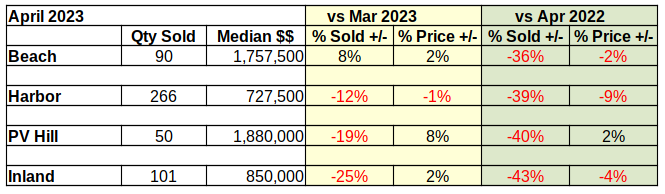
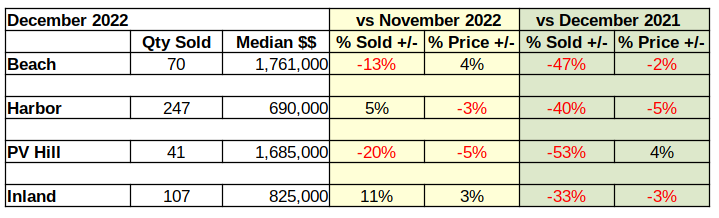
The table below shows the percentage of change in the number of homes sold and the median price of those homes two ways. The yellow shows change for the current month versus the prior month. The green shows change for the current month versus the same month last year.

From a seller’s perspective, these numbers would ideally all be black/positive. When any of them become red it shows a retrenchment in the South Bay real estate market.

From a buyer’s perspective the red ink is a good sign. It means purchasers can get more home for their money. For them, the real savings will come when that last column turns red.

Photo by Sandy Millar on Unsplash

Songwriter Showcase – August 16

August 16, 2022 will be an epic soul/blues show at Project Barley Brewery & Pizzeria with Preston Smith, Brophy Dale, Mike Malone and organizer; Jodi Siegel. Put it on your calendar–it’s gonna be rocking!

Preston Smith

Guitarist Preston Smith is a multifaceted talent that has enabled him, both with his band and solo acoustic, to have worked with legends like: Robert Cray, Albert Collins, Foreigner, Salt-N-Pepa, The Red Hot Chili Peppers, Bonnie Raitt, Social Distortion, Wall of Voodoo, Concrete Blonde, Savoy Brown, Charlie Sexton, k.d. lang, John Mayall, Tower of Power, Joe Satriani, The Ventures, Dick Dale & the Deltones, Eric Burden & the Animals, Delbert McClinton, Paul Butterfield, Poco, Santana and many more!! His one man band performances are mind blowing!!

Brophy Dale

Guitar player Brophy Dale, originally from Texas, has worked with The Stray Cats bassman Lee Rocker, as well as Robert Lucas of Canned Heat, Smokey Wilson, Joe Houston, & King Ernest to name a few, on the Southern California blues scene. He’s also had the opportunity to work with some of his heroes, which include Dave Edmunds, Delbert McClinton and a few tours with Scotty Moore.

Mike Malone

Keyboard/vibe player, Mike Malone has shared the stage/ recorded/ worked with Eddie “Cleanhead” Vinson, Mick Taylor, Jimmy Vaughn, Mark Ford, Top Jimmy, Papa John Creach, Pee Wee Crayton, Guitar Shorty, Joe Houston, Deacon Jones and Big Joe Turner.

He plays with many Southern California bands including the Broughams, The Mighty Mojo Prophets to name a few and his jazz trio; an instrumental band featuring his fine vibe playing!! Mike recently released a solo album called “Just Passin Thru.”

Jodi Siegel

Host, guitarist, singer/songwriter Jodi Siegel has opened for and or shared the stage with many respected musicians including: Albert King, Robben Ford, Robert Cray, J.D. Souther, David Lindley, Fred Tacket and Paul Barrere (Little Feat) and more.

She can go from funky bluesy grooves to folk, to jazz and back again with ease. She’s an old soul with a fresh sound.

Patrick Simmons (Doobie Brothers), Walter Trout, Maria Muldaur and more, give her new CD, “Wild Hearts,” rave reviews!

Wild Hearts is produced by Steve Postell (Immediate Family, David Crosby) is filled with great songs, cool grooves, intimate, smart lyrics and some of the best of the best musicians in Los Angeles today.

Andy & Renée: Live in the South Bay!

Andy & Renée

TUE, JUL 19 @ 5:30PM — 7:30PM The Lighthouse Cafe, 30 Pier Avenue Hermosa Beach, CA 90254 310 376-9833, Hermosa Beach, CA 90254

Andy & Renée & Hard Rain

WED, JUL 20 @ 6:30PM “Summer Concert Series” Malaga Cove Library Park, 2400 Via Campesina, Palos Verdes Estates, CA. https://www.bestpalosverdeshomes.com/malaga-cove-concerts-park/

Andy & Renée

SAT, JUL 23, 4-7pm. R6 Distillery, 909 E El Segundo Blvd., El Segundo, CA 90245

Andy & Renée

SUN, JUL 24 @ 12:00PM — 3:00PM The Depot, 1250 Cabrillo Ave. , Torrance, CA 90501 310-787-7501

Outside in the parking lot, next to The Depot. $20 Cover. Food and drinks- Cash Only. Doors open at 11am

Please make reservations at 310-787-7501. Bring a beach chair!

PV Prices Surge; Beach Plummets

Palos Verdes Median Up +19% From May

We’ve said for years that land on the Palos Verdes peninsula is undervalued. We may not be able to say that much longer. Last month property on the Hill took another big jump upward in median price. That’s the second time in six months. When that yellow line peaked in February we found several new construction homes closed escrow in the same month boosting the median price dramatically.

PV Median Up $364K while Beach falls by $80K

This time we found two homes, selling in the same month, at over $10,000,000. To put that in perspective, during the past 12 months only four properties on the Hill have reached the $10M mark. So what are these rarefied houses that bring in over-the-top median prices? Let’s take a closer look. (Photos at link.)

The listing agent described 2005 Paseo del Mar as a single level with 5 bedrooms, 4 1/2 baths, formal living and dining rooms, 2 family rooms, pool, 4 car garage with gated entry and circular driveway. So what makes it worth $12.4M instead of $2M?

It seems 4582 square feet of house sitting on over an acre of land on the bluffs above the Pacific Ocean is worth about $10M more than if it had an inland address.

Similarly, 1417 Lower Paseo la Cresta is a grand estate offering over 15,000 square feet of lavish living space spread over 3 levels, with 9 bedrooms,13 bathrooms and two full kitchens. Additional highlights include the custom 15-seat theater, Italian Fantini mosaic pool, elevator, generator and an extensive home automation system.

Beach Cities Sales Down -34% From 2021

The Inland cities clearly leap-frogged the other three areas in volume of sales for June. Sales in the Inland area out-paced the rest of South Bay, erasing a -17% decline from May of this year and adding a +13% increase for June .

The next closest monthly sales volume was a +2% at the Beach. Harbor area sales showed the poorest comparable performance, dropping by -4% for the month, continuing a three month slide. Monthly sales volume in the Harbor area has declined 135 units just since March.

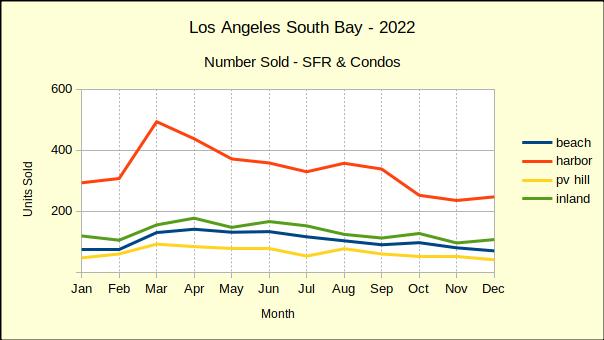
Let’s focus on the Harbor and that red line on the chart for just a moment. Remember this is an entry level market, where a little rise in the mortgage interest rate can quickly price a new buyer out of the running. Notice that sales in the Harbor area were at about 300 homes per month in January. By February a few buyers had noticed the interest rates climbing and took the leap.

Then March became the proverbial “last chance” to buy in the fast moving current market. Sales volume shot through the ceiling with a 61% increase in homes sold. Since then we have watched a classic collapse with prospective buyers melting into the woodwork, waiting for another opportunity.

Annual statistics are still reflecting the impact of two plus years of pandemic. Compared to June of last year, sales were down dramatically. The Inland area fared the best, coming in with a drop 0f -6% from 2021. Sales in the Beach cities and the Harbor area fell the farthest with a -34% and a -29% respectively.

Total Dollars Sold Up 71% In Just Two Years

Back in 2020, the first six months of the year had netted slightly over $3.1B in South Bay home sales. Fast forward to the first six months of 2022 and total sales is slightly over $5.3B. Restated, that’s a 71% increase in dollars spent on real estate in just two years.

Much of that increase was the result of the phenomenally low interest rates created by the Federal Reserve Bank (Fed) to offset the financial impact of the pandemic. It was good for all those people who wanted homes and had down payment money. Investors did especially well, though we saw another big expansion of the inequality gap.

Coming out of the pandemic, we’re seeing the four areas moving erratically. The steep climbs of 2020 and 2021 seem to be leveling off, as the Fed tries desperately to slow what is viewed as a runaway real estate market.

Total sales dollars in 2019 were $7.9B, in 2020 up to $8.7B, and in 2021 up again to $12.1B. Since mortgage rates are still climbing, it’s a little early for forecasting, but we anticipate 2022 total sales to come in at about $11.3B.

Where Are We Going?

Comparing last year’s market to 2022 shows a continuing decline in sales, while simultaneously a continuing increase in median prices. That may still change before the end of the year.

In May we saw the quantity sold drop into the red numbers across the South Bay. For June the sales volume is only off in the Harbor area, but the Hill and the Beach are both marginal. We expect sales to gradually slow as the year closes. Indications are the Fed will ratchet up the mortgage interest rate another 2% which should bring transaction volume down substantially.

May also saw the median price drop at the Harbor. Then in June the median fell for the Beach cities and the Inland areas, while the Harbor bounced back. We expect both the median and the sales volume to fall back into the red zone by the end of the year.

Sales volume should move first. Then as sales slow and buyers become more selective, sellers will begin retrenching on price. We don’t anticipate major price reductions until 2023. However, there are a lot of moving parts to this years economy. Events on the other side of the world may still make big changes here.

Photo by Josephine Lin on Unsplash

Jodi’s SongWriter Showcase – July

Project Barley’s is located in Lomita (south of Torrance/Redondo on PCH). They have great food,(Gourmet pizza, sandwiches, gluten free/vegan options and of course  wine and beer! ! For more information check out their website https://projectbarley.com/

At about 7pm on the third Tuesday of every month, we indulge our taste for live music. Jodi Siegel created the Songwriter Showcase as a means to bring original songs, performed by the original songwriters, to local people. There isn’t a bad seat in the house, and by 7pm every seat is filled with music lovers. Come on down and check it out! Here’s this month’s program.

Tracy Newman : Tracy is founding member of The Groundlings Improv Theatre, which is one of the main farm companies for SNL. She was a TV writer/producer for 16 years, starting as a staff writer on Cheers. In 1997, she won an Emmy and Peabody Award for co-writing the groundbreaking “coming out” episode of Ellen. In 2001 she co-created the ABC comedy, According to Jim. Tracy has been playing guitar since she was 14 and is now a full-time singer/songwriter, doing shows for both adults and children. She has a new company called Run Along Home, focusing on age-appropriate lyrics for very young kids. Tracy’s CDs for adults: A Place in the SunI Just See You,and That’s What Love Can Do to Your Heart. Her CDs for children: I Can Swing Forever, Shoebox Town, and Sing With Me. 
Websites: www.tracynewman.com and www.runalonghome.com.

David Plenn: Singer-songwriter-guitarist,  Plenn has developed a career as a in demand sideman, a producer as well as a professional songwriter. His “Easy Driver” was a 1978 chart entry for Kenny Loggins, while “The Forecast (Calls for Pain)” — produced by another important musical mentor, writer-producer Dennis Walker — appeared on Robert Cray’s 1990 album “Midnight Stroll.” His tunes were heard on such hit TV shows as Beverly Hills 90210, Melrose Place and Touched By an Angel.

David’s new album, produced by Plenn and Lloyd Moffitt and comprising 10 beautifully crafted, emotionally affecting original songs, finds the veteran Southern California performer backed by a group of longtime colleagues who rank among the region’s best-known players: legendary singer-songwriter-arranger Van Dyke Parks (architect of the Beach Boys’ Smile), drummer Jay Bellarose (Elton John, Bonnie Raitt, Aimee Mann, etc.), bassists Jenny Condos (Bruce Springsteen, Jackson Browne, Stevie Nicks, etc.) and James “Hutch” Hutchinson (Willie Nelson, B.B King, Linda Ronstadt, etc.). Several other contributors — Moffitt, vocalists Tara Austin and Llory McDonald, bassist David Jenkins, drummer David Goodstein — backed the late singer- songwriter Jerry Riopelle during Plenn’s decades-long association with the musician. For more about David, go to his website https://davidplenn.com/

Michael McNevin: Michael’s songs read like short stories, full of heart, humor, and a keen eye for detail. Winner of the Kerrville New-Folk award in Texas, Performing Songwriter Magazine “DIY Artist Of The Year”, 7-time grand finals “Song Of The Year” winner for West Coast Songwriters. Accomplished guitar work and seasoned vocals underscore the characters and places he comes across in his travels. He grew up in the train town of Niles, CA, in the east bay hills the San Francisco Bay Area. He started out playing underage in East Bay bars, mixed in a six-month stint busking the streets and subways in New York and has has since logged 25 years on the U.S. songwriter circuit.

He’s shared hall stages with Johnny Cash & The Carter Family, Donovan, Shawn Colvin, Richie Havens, Iris Dement, Greg Brown, Christine Lavin, Robert Earl Keen, and many of others. He’s been a main-stager at Strawberry, High Sierra, Kerrville, Redwood Ramble, American River, SummerFolk in Canada, and the Philadelphia Folk Fest. He’s also been a 3rd place finalist at both the Rocky Mountain Folks and Telluride Troubadour Competitions in Colorado, and was nominated Artist Of The Year by the National Academy of Songwriters. He tours as a solo act in the US and parts of Europe, and occasionally gets a band together as McNevin & The Spokes. In addition, Michael is an Etch A Sketch artist of some renown, delighting and dumbfounding audiences. Not kidding, he illustrates his songs on the little red toy. Michael has been a guest on CBS “Evening Magazine”, plus segments on NBC, ABC, and dozens of cable music shows.

When he’s not on the road, Michael also owns and operates the Mudpuddle Shop, in downtown Niles, a former barber shop. Now in it’s 14th year, it is a 15’x15′ creative hive for showcases, workshops, song swaps and jams. His Etch A Sketch drawings hang on the walls, waiting for an earthquake.. https://michaelmcnevin.com/

Jodi Siegel: Jodi was born in Chicago, IL. The Home of the Blues! She eventually relocated to California and  began playing and singing in countless blues, R & B, pop and original music bands throughout Orange County, San Diego and Los Angeles. Over the years Jodi has opened for and or shared the stage with many respected musicians including: Albert King, Robben Ford, Robert Cray, J.D. Souther, David Lindley, Fred Tacket and Paul Barrere (Little Feat) and countless others. Her songs have been recorded by Maria Muldaur (“So Many Rivers To Cross,”-cowritten with Daniel Moore and “If I Were You”-cowritten with Danny Timms) Marcia Ball (“So Many Rivers To Cross.”) and Teresa James (“Come Up and See Me Sometime”-cowritten with Danny Timms)

MEET OUR NEW SONGWRITER’S SHOWCASE SPONSORS
I adore these two wonderful folks! Everybody’s cheerleaders in the music community! 

For all your real estate needs give them a call or check out their website :https://carl-and-arda.beachcitybrokers.net/

Hard Rain Summer Concerts!

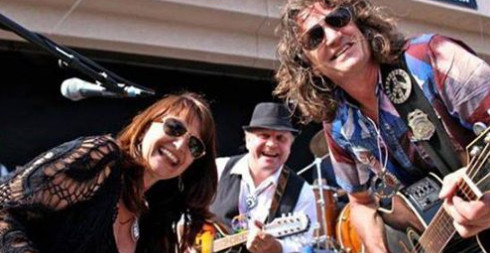
Hard Rain, featuring Andy & Renee is a perennial favorite in the South Bay, taking the title of Best Original Music Band nearly every year. While Andy & Renee perform as a duo at several different venues each week, the whole band gets together about once a week for an outdoor performance. Below are the next few weeks of gigs for Hard Rain with Andy & Renee. For more information about the band or the duo, tickets when required, and the full calendar, go to https://andyandrenee.com/

South Bay Festival of the Arts, Torrance

Saturday, June 25, 1:00pm — 2:30pm Torino Plaza, Torrance Cultural Arts Center, 3330 Civic Center Drive, Torrance, CA 90503. Event runs 11a-5p. Our set time is 1-2:30pm.

Get tickets and info at https://torrancearts.org/festival/

Nelson’s Sound Series, Terranea, RPV

Sunday. July 3, 6-10pm, Nelson’s @Terranea Resort, 100 Terranea Way, Rancho Palos Verdes, California 90275. Call for reservations (310) 265-2702

Get details here: https://www.terranea.com/sound-series

The Last Waltz, Grand Annex, San Pedro

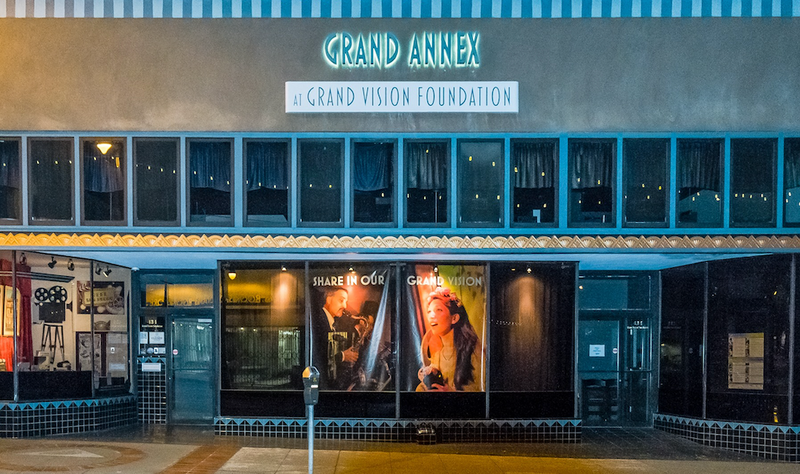
Saturday, July 9, 8:00pm The Grand Annex, 434 W. 6th St., San Pedro, CA 90731

Get Tickets at https://grandvision.org/…/andy-renee-hard-rain-summer…/

Concerts in the Park, Malaga Cove, PVE

Wednesday, July 20, 6:30-7:30pm, Malaga Cove Library Park, 2400 Via Campesina, Palos Verdes Estates, CA

Get details here: https://palosverdessource.com/2022/06/06/palos-verdes-malaga-cove-2022-summer-concerts-in-the-park/

LA South Bay Real Estate: May 2022

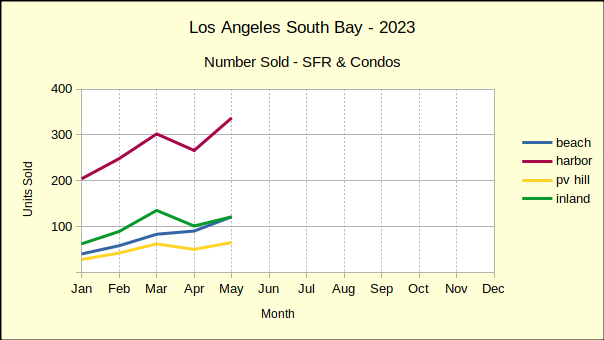
Number of Homes Sold

The number of homes sold in the South Bay has declined from last month, and has declined from last year. The quantities are actually rather dramatic given that May is typically a time of increasing sales. The drops range from -7% to -17% lower than April sales of this year, and from -17% to -25% below May of last year.

With over half the year remaining, mortgage interest rates have doubled, currently sitting around 6%. The hike in interest rates has so far reduced the average buying power by about -25%. Coupled with home price increases estimated to have risen 38% since the start of the pandemic, the immediate future of real estate looks dismal.

202205_sales_vol_chart

Inflated consumer prices are also blocking potential home buyers as the Consumer Price Index (CPI) climbs toward a 10% annual hike. There’s little chance of saving for a down payment when the price of everything on the shopping list is going up..

Retirement accounts are often a source of down payment funds. As of this writing the major stock market indices are all down: Dow Jones Industrial Average, -16%; S&P 500, -22%; Nasdaq Composite, -31%. Forecasts are growing for a Fed-induced recession that may begin as soon as this fall. Some potential buyers may see borrowing from their retirement fund to purchase a property as a means to preserve the capital during a recession. Others may not be in a position to do that.

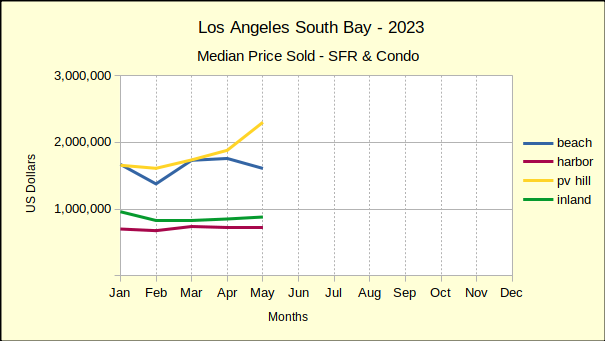
Median Price Sold

May prices delivered a mixed message. The Palos Verdes Peninsula, which had seen two months of decline from a temporarily high median price, headed back up again. The Beach cities continued a steady climb, and the Inland area showed a modest price increase after having dropped 1% in April.

However, the Harbor area, which is as large as the other three areas combined, took a -6% hit to prices. We anticipate the Harbor and Inland areas, which comprise the bulk of the traditional middle class family homes in South Bay, to be the first to react to the economic stress.

Typically, the recession cycle starts with a slowing of sales. As properties languish on the market, sellers begin to reduce prices. One after another, median sales prices will drop until the price reduction offsets the impact to buyers. At that point, buyers will begin to support the reduced purchase prices and we can see growth in the market.

Experts differ in their estimates of how long this cycle will take, and when we can expect the market bottom. There are some predicting a rapid fall based on the speed with which the Federal Reserve Bank (Fed) is reacting. The June meeting of the Fed ended with a .75% hike in the prime rate, and a promise to raise it at least another .75% before the end of the year. While that could slow the economy as early as the beginning of 2023, more conservative minds suggest the end of 2023 for a turn-around.

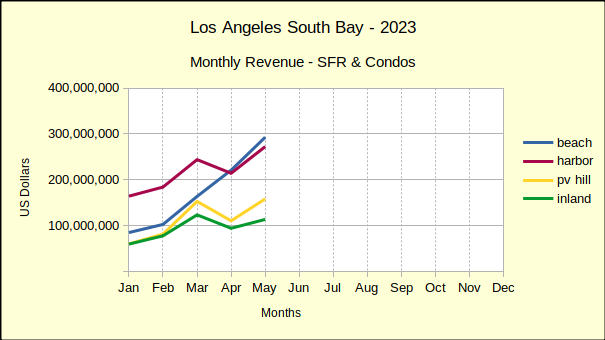
Area Sales Dollars

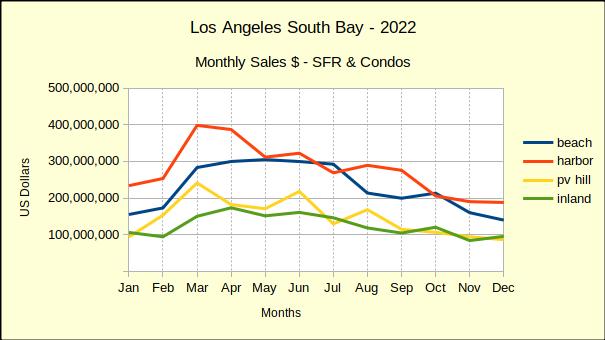
The total sales dollars tell the truest story. While sales are slowing and median prices are beginning to slow, the combination shows up here.

Everywhere except the Beach is showing reductions in total sales on a month to month basis, and on a year over year basis. The declines are small to date, with year over year ranging from -1% to -10% in May. Month to month changes ranged from +2% at the Beach to -19% in the Harbor area.

202205_monthly_sales_$_chart

These early numbers follow the general pattern we’ve seen in recent recessions, whereby entry level homes are the first impacted and the last to recover. We anticipate the Harbor area to lead the charge down, followed by the Inland area. Recent years have shown the Beach to be the strongest growth area, so we expect the recession to hit there last, following declines on the Hill.

The nature of the impending recession is still uncertain. Some pundits are saying that at least initially we should expect “stagflation,” that odd environment we first encountered back in the 1990s when prices of everything continued to climb, along with job layoffs and massive unemployment. Other forecasters suggest that because the international economy is roiling with continuing high tariffs (courtesy of the last administration) and new monetary sanctions daily (courtesy of the current administration), this particular recession may last much longer than normal.

In Summary

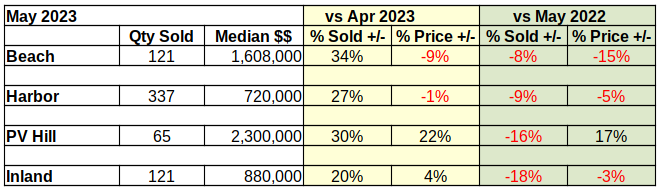
As the table below shows, the majority of the negative impact for May happened in the quantity of housing units sold. With one exception, prices continued to escalate. We believe this is temporary and likely to change before the end of the year. The -6% drop in median price at the Harbor presages the direction of home pricing as inventory grows and listings stagnate.

Approximately 3 out of 4 listings coming across our desk recently have been either Price Reduction or Back On Market. That means property is staying on the market longer. The Average Days On Market (DOM) for May ranged from 10 days on the PV Hill to 14 days in the Harbor area. As recently as this winter we were still seeing multiple offers on the first day the property was available.

Another measure of the market condition is how far the average sales price declines in the first 30 days on market. We did a quick look for May and came up with these statistics. Thirty days after the original listing, the price had dropped from the original: at the Beach, -9%; the Harbor -6%; PV Hill -18%; Inland -5%. As of May, we’re also seeing property that has been on the market for several months, with several price reductions.

Notable Properties

The high and low sales for May were not terribly dramatic. A Manhattan Hill section home and a downtown Long Beach condominium. Thay are simply very big, and very small.

High Sale

Located at 812 5th St, this Manhattan Beach hill section home was originally listed at $10.5M and sold for $8,980,000 after 34 days active on the market. The home offers six bedrooms and seven full bathrooms in 5576 sq ft. Amenities included ocean view, pool, spa, custom waterfall & fire features, a full basement with recreation/media room, home theater, storage, a temperature-controlled wine cellar, and private guest quarters.

Low Sale

Measuring barely 381 sq ft, the studio condo at 819 E 4th St #25 sold for $215,000 in one day. Located in the vibrant East Village of Downtown Long Beach this tiny home offers a remodelled kitchen and bathroom. The unit sits on the second floor, overlooking the intersection of 4th and Alimitos and within walking distance of many downtown shops, clubs and eateries.

Main photo by Kostiantyn Li on Unsplash

Songwriters’ Showcase

Born out of the Covid pandemic, Jodi Siegel’s Songwriters’ Showcase is an exceptional opportunity to hear original music played by the same people who created the songs. Jodi’s been making music for a while, and claims many of LA’s most notable musicians as close friends.

The folks that stop by the Project Barley Brewery on the third Tuesday of every month for Jodi’s show are not your typical beer pub crowd. Many of them are musicians in their own right, and many are songwriters who have, or will, perform in a show. Indeed, audience members have been known to step up and fill in on a keyboard or with a guitar when a song called for another instrument.

Below we’ve included a pitch for the June Songwriters’ Showcase. We go every month and are delighted every month!

Songwriters’ Showcase – June 21, 2022

Jodi Siegel
It’s nearly summer and the music community is also warming up with gigs galore and music fun to be had everywhere you turn! I’m grateful to be working a bunch of local gigs too…but first check out the new songwriter’s night coming up in less than two weeks!! June 21, 2022 I’m proud to host three good friends and killer songwriters: Harold Payne (Bobby Womack, Snoop Dogg), https://haroldpaynemusic.com/ Alfred Johnson (Rickie Lee Jones) https://www.facebook.com/alfredjohnsonmusic/https://www.facebook.com/alfredjohnsonmusic/ and the one and only Chauncey Bowers (new CD now available!) https://chaunceybowers.com/https://chaunceybowers.com/ It’s also my Birthday on that night so it’s gonna be a party!! As always come early to grab a table. This is a free event, donations go to the musicians. Project Barley’s is located in Lomita (south of Torrance/Redondo on PCH). They have great food, wine and beer! ! For more information check out their website https://projectbarley.com/ MEET OUR NEW SONGWRITER’S SHOWCASE SPONSORS I adore these two wonderful folks! Everybody’s cheerleaders in the music community!  For all your real estate needs give them a call or check out their website :https://carl-and-arda.beachcitybrokers.net/ TO CHECK OUT WHO IS COMING IN THE NEXT FEW MONTHS GO TO https://jodisiegel.com/songwriter-show 

LA South Bay Real Estate: The Recession Has Arrived

In a normal year one would expect April to be the turning point for the LA real estate market. March is still cold and the children are still in school for another 10 weeks. April’s the month when the weather turns warm, the flower buds poke up, and the buyers come out to start the spring buying season. It hasn’t happened that way this year.

Prices had gone through the ceiling by the end of 2021, much of the activity stimulated by fear of escalating mortgage interest rates. Usher in 2022–January and February were typically slow and in March home sales bounced up like an indicator of business as usual. But, interest rates continued to climb and April ended with the total number of home sales down instead of up. Likewise, total sales dollars were down across the South Bay.

Number of Homes Sold

Judging from the charts, entry level homes in the Harbor area were clearly the center of activity for South Bay real estate. As interest rates pushed against the 5% mark, panic set in among first time buyers who had been outbid multiple times. Prices went up as high as buyers could afford, a number that shrinks amazingly fast with each tenth of a percent increase in the interest rate.

Across the South Bay, the number of homes sold in April dropped by -4% from March, which had been an increase of 59% over the prior month. As we see from the chart below, sales were uneven between the various areas.

On the entry level front, at the same time Harbor area home sales were dropping off, Inland homes gained sales. On the high end, sales on the Palos Verdes peninsula were also facing declining numbers, while Beach area sales increased.

So far declining sales counts have been modest, but a decline overall, coupled with a decline in half of the individual areas covered indicates that buyers are pulling back. Part of the resistance is a matter of simply being priced out of the market. Another important piece is the anticipation of price corrections in the near future. We have heard multiple buyers say they are watching and waiting for lower prices later this year.

At this point we’re well into the second quarter of the year and it looks as though those folks may be on track for some savings. even some of our most gung-ho pundits are beginning to see a market downturn on the horizon.

Median Price Sold

Interestingly, Harbor area prices went up at the same time the number of sales went down.The March to April price increase was a modest +6% compared to a +21% increase over April of last year. Similarly, the Beach cities had a month over month increase of +4%, while showing +19% year over year. While sales prices are still rising in those areas, the increase is a fraction of what it was last year.

Sold prices on the Hill continued to slide downwards. Because the February increase in the median price was created by the sale of new construction, and that building phase is now sold out, a downward turn in median price is expected. We anticipate that leveling off soon.

In the Inland area the median price for homes sold during April of 2022, was +12% greater than sales in April of 2021. By comparison, the median price of those sold in March of 2022 versus April of 2022 decreased by -1%. It’s a modest decrease that points to the direction of the South Bay real estate market for the balance of the year.

Area Sales Dollars

The total dollar value of home sales in the South Bay usually tracks right along with the number of units sold. The few times it differs are important times like these when the number of homes sold is dropping, and/or the sales prices are dropping. Today, of the four areas we track, PV Hill has a declining number of sales, both in comparison to last year and in comparison to last month. As we noted above, the area also is declining in total dollars compared to last year and last month.

As we discussed in last month’s issue, some of the reason for the drop is found in new construction homes that sold at a much higher price than the typical Palos Verdes resale home. The rest of it can be found in longer days on market waiting for a buyer, and in price reductions.

At the opposite end of the spectrum, the Beach cities showed gains last month for both number of units sold and for the total sales value of those homes. The only decline this month for the Beach was in number sold compared to April of last year. Sales this April were off by -21%.

The Harbor area still trended upward in dollar value, both month over month and year over year. But, the number of units sold was down for both time measurements. The price competition was very stiff in what is generally an entry level market. During the past couple years, bidding wars and over-asking sales prices have kept the dollars high. The April numbers show that changing rapidly.

Total dollar sales for the Inland community increased 15% month over month. That was the highest growth of all four areas. Scanning those individual transactions showed an odd pattern. Sales in the price range from about $325K up to about $750K were a familiar mix of some under asking price, some at asking and some above asking. The degree of variance was about what one would expect. Unexpectedly, for sales over $750K, nearly every property sold above asking price, and in many cases well above asking.

We found no clear explanation for why this phenomena occurred. There is a suspicion that buyers who were priced out of Beach properties may have shifted their bidding wars into the increasingly popular parts of west Torrance. This theory is supported by the distribution of sales among the various neighborhoods.

In Summary

In the table below are the core statistics comparing April to March of this year, and comparing April of this year to April of 2021. The prevalence of negative numbers is convincing evidence that high prices and high interest rates are pushing the South Bay real estate market into a recession.

Notable Properties

One of the more interesting properties sold in April is a four bedroom, five bathroom home located in west Torrance. The home was purchased by the seller as their family home in 1990 for just above $360K. The children grew up and the parents remodeled in 2022 and sold the house.

As would be expected in a good neighborhood with a contemporary remodel, the home sold for over the asking price of $2.7M. The final selling price was slightly over $3M. and just happened to be almost exactly $360K over the asking price.

In the 32 years that family owned the home it appreciated at an average rate in excess of $84K per year. It’s the classic “American Dream.”

Main photo by Amy Vosters on Unsplash

Inflation Hits Los Angeles: South Bay Real Estate – March 2022

The Federal Reserve Bank tries to keep annual inflation at around 2%. Over the past 12 months the median price increase of a home in the South Bay ranged from 7% (Inland area) to 32% (PV Hill). Clearly housing in the LA area is exceeding the desired inflation rate.

The recent Fed report to Congress stated, “Mortgage rates for households remain low despite recent increases.” In other words, the Fed considers 5% mortgage rates to be “low.” As part of the battle to control runaway inflation, the Fed is expected to implement rate increases. Estimates for how much higher we can expect mortgage rates to rise in the coming year range from approximately 1% to 2% more.

Rates currently at about 5%, we can already see an impact on sales volume and prices in our local monthly data. Real estate industry pundits are projecting an imminent recession. Some say “mild, in 2023.” Some are comparing the current market environment to the 2007 lead-up to the Great Recession. Keeping a probable recession in mind, let’s look at the March sales data.

Sales Volume

March is the month when South Bay denizens shake off the winter doldrums and get serious about real estate. The chart last year looked very similar to this. This year the Hill and the Beach were up slightly from last year. The Inland and Harbor areas increased at the same rate as in 2021. Compared to last year’s market, 2022 is distinctly more normal.

The chart makes it look like the Harbor area took an especially large leap in March. That’s just because the Harbor area is so much larger and so many more homes are sold there than the other three areas.. On a percentile basis, sales of Beach homes actually increased at a steeper rate. Sales at the Beach were up from the prior month by 71%, while Harbor area sales increased by 61%.

Normally, we would expect the sales volume to level off now and remain roughly a even line until winter when sales taper off again. If, in the battle to contain inflation, mortgage interest rates climb as fast as the Fed has indicated, we can expect to see the number of homes selling decline. We expect buyers who must buy will adjust the size of the purchase to meet their financing capability. Buyers who aren’t compelled to buy will probably delay and wait for better circumstances.

Median Price

Today, the best measure of home prices is comparing to last month. The market in 2021 was recovering, so some statistics are comparable, while others are still showing signs of impact from the pandemic.

March gave us a month-to-month downturn of -4% on the Hill. Of course, if you remember from last month, February saw escrow close on several new construction homes. Those units pushed the median price exceptionally high, so what we’re seeing now is a return to normal.

While median prices on the Hill were dipping, the Harbor area was flat. Prices there were +4% in January, slowed to +1% in February and had no change in March. This is the largest market area in the South Bay and is often a precursor for change.

The Beach and the Inland areas show continuing price increases of 3% and 5% respectively. Looking back to the first of the year, the Beach has been varied. The March price shift at the Beach is down from the February increase of 6%, but is up from the January decrease of -12%. The Inland numbers show steady growth from -2% in January to +5% in March.

Monthly Sales Dollars

The dollar value of March sales in the South Bay showed positive increases for all areas for the first time this year. This is important because normal growth in our capitalist system will almost always show the sold value from the current year to be larger than that of the preceeding year. The negative numbers from January and February are reflections of the troubled economics of 2021.

We expect the sales dollars to level out as the median price pulls back to a normal growth pattern. If the Fed is to realize any kind of reasonable slowdown for inflation, the monthly median prices have to stabilize at a rate of increase barely above zero. As of March the cumulative median for each area ranges from +3% to +20%. We’re not going to get to +2% inflation with those results.

The Statistics

Supposedly, charts are easier to read for most people. I like to include this table because it packs all the data from the three charts above, plus background detail, into a fraction of the space. Here we see the specific quanties sold in each area, plus the median price of the area, for the month of March.

% symbol indicates no change from prior period.

More importantly, the table shows at a glance how March 2022 compared to February of this year, and March of last year. All four areas currently have increasing sales, in part because the inventory is growing. In addition, there’s a bit of panic from the rapid interest rate increase.

At the same time, the table quickly shows that the median price has moderated in all four areas from what was happening in 2021.

Notable Sales

The South Bay in Los Angeles is a highly diverse area. In the distance of a few minutes it’s possible to drive from the lowest priced property sold in March to the highest priced property sold in March.

This studio condo in Long Beach sold for $249,900. It offers 441 sqft of airspace, no assigned parking, has an HOA fee of $149, and was originally built in 1913.


This 7 bedroom, 15 bathroom house in Palos Verdes Estates sold for $17,150,000. It offers 13,000 sqft on a 3 acre lot, has 5 garage spaces and was built in 2006.

Main photograph by Randy Jose on Unsplash

February 2022 Real Estate News for Los Angeles South Bay

Palos Verdes New Home Sales Surprise!

February sales data carried a surprise for South Bay residents. With fewer monthly sales than last year, the median price for PV homes sold has made a huge jump. The average number of homes sold on the Hill in 2021 was 88, and December recorded 87 sales. January saw 47 sales and February 60. At the same time the sales volume was dropping, the median sales price jumped by over 33%! (Details at Median Prices below.)

Sales in the Harbor area were up 5% from last month. Increased real estate activity and prices in the Harbor have been anticipated for some time now and are gradually coming to fruition. The multi-billion dollar investment in the West Harbor commercial development has spawned a number of smaller development projects throughout San Pedro. On the east side, Long Beach has been steadily adding infrastructure across much of the city. The net result is improved real estate markets across the Harbor area.

The number of homes sold in the Beach cities was essentially flat with 75 sold in January and 76 in February. This is however significantly down from the average monthly sales of 159 units in 2021, and from the December sales of 132 units. In a unique twist, the drop in sales volume is a return to sales numbers we were experiencing before the Covid19 pandemic.

In a further shift downward, Inland home sales dropped off from an average of 168 in 2021 and a total of 160 homes sold in December. January fell to 119 and February fell again to 105 homes sold. A modest decline in sales volume is expected during the winter months. Once again, as we saw at the Beach, we’re seeing the same return to pre-pandemic numbers for Inland home sales. One could almost think things are normal again.

Median Prices Going Up, Up & Up

Take a look at what’s happening with PV prices. That yellow line on the chart below shows an explosion in median prices on the Hill. Pre-pandemic, the median was just under $1.5M. January it was $1.7M–February it’s $2.3M.

We found that 19 newly constructed residences have been sold at the Rolling Hills Country Club development over the past six months. Those homes sold for a median price of $4.1M, boosting the median dramatically and adding $80M to cumulative sales for the Hill.

The median for Beach cities home sales is up $100K from January and stands at $1.6M, up from the pre-pandemic median of $1.3M. Harbor area and Inland prices are similarly up showing signs of a pending correction from the overly enthusiastic bidding wars of the past couple years.

We anticipate a leveling of the median prices across the South Bay, with the exception of unique circumstances like new construction at the Rolling Hills Country Club. As the Federal Reserve Bank increases interest rates, some buyers will drop out of the market. Sales are expected to slow while time on the market expands and prices contract.

Cumulative Home Sales Dollars

We wrote above about the steep yellow line for sales on the Hill. If nothing else, adding $60M to the monthly sales total should serve to demonstrate that if someone will build homes, they will sell.

The Beach and Harbor areas are both up about $20M over January numbers. Although slower than it was last year, the demand for housing is still strong.

Inland total sales dollars are down $6M for the month of February. Occasionally we see February sales totals drop from January, however it’s rare. We suspect the sales decline for the Inland area is a harbinger of the future for all of the South Bay.

The Statistics

As usual we’ll close with the statistics for last month as compared to the prior month and compared to the same month last year. The negative numbers (red) will quickly show that Inland home sales declined from January to February. Glancing at the other areas, we can see the Beach area volume was a mere 1% growth, while the Harbor showed strong sales and PV went through the roof compared to prior month.

Three red blocks jump out comparing to February of 2021. This is not surprising considering we were well into a panic buying season this time last year. This is reminiscent of most months in 2021 when we were able to only compare to the prior month because of Covid-contaminated statistics.

The strong Harbor area performance stands out here. A 4% gain over last year versus a 30% drop in volume at the Beach is certainly something to watch next month!

Photo by Olga Subach on Unsplash