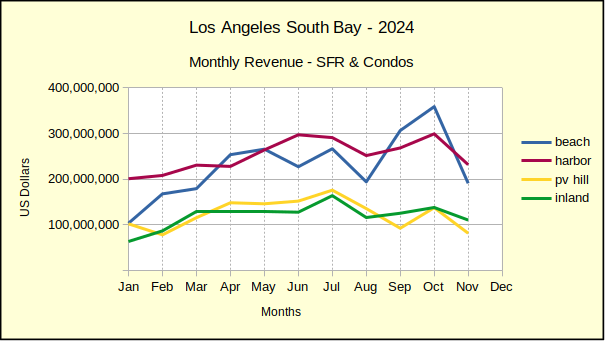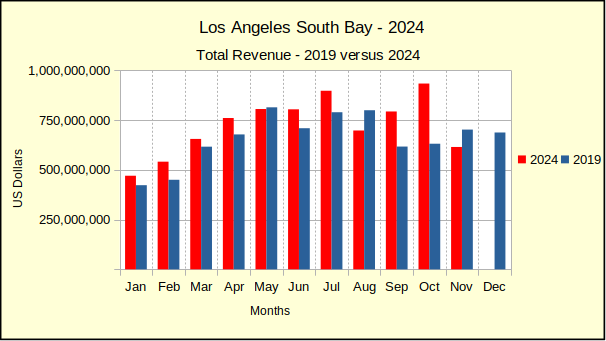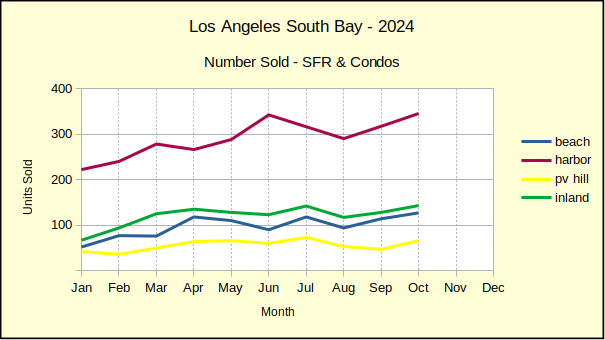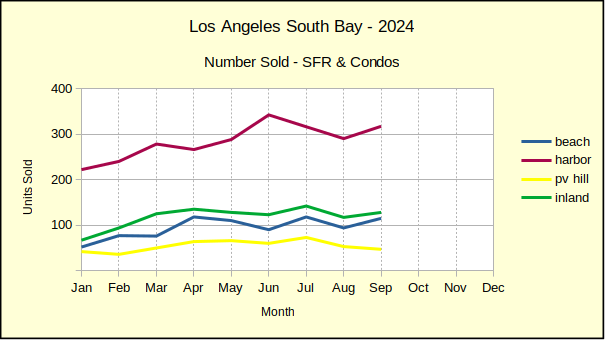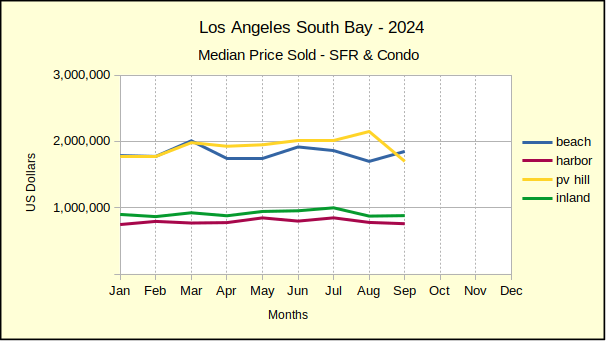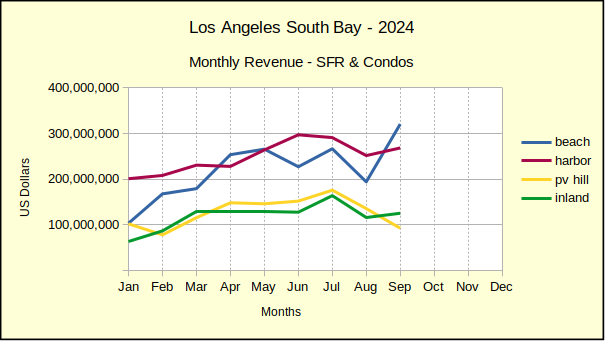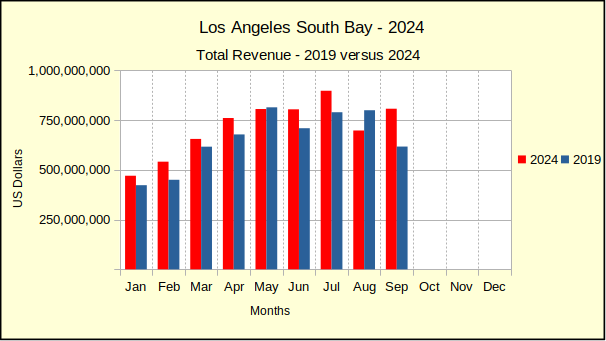
South Bay Real Estate – Headed for a Slow Winter

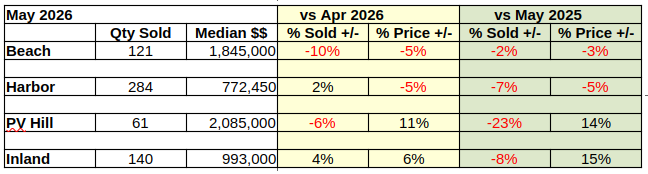
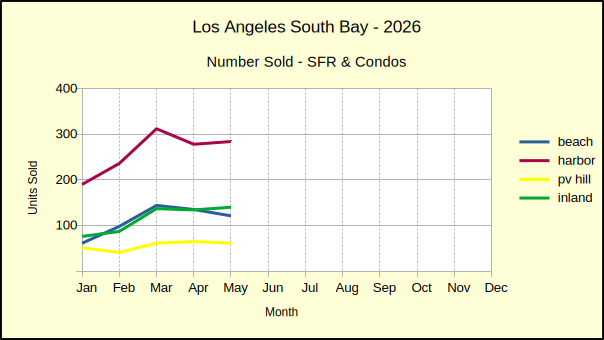
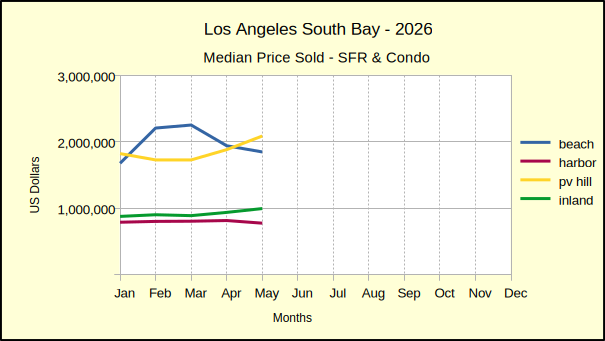
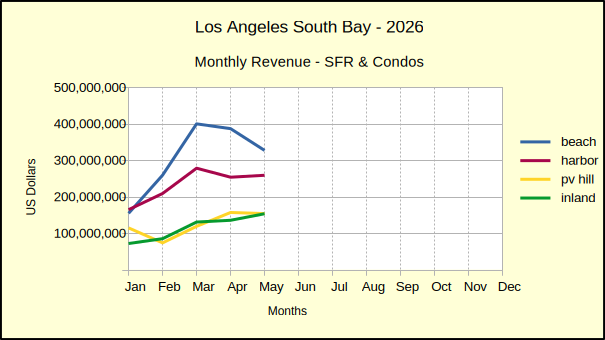
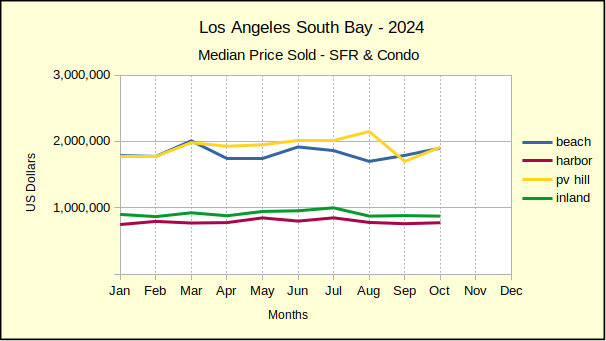
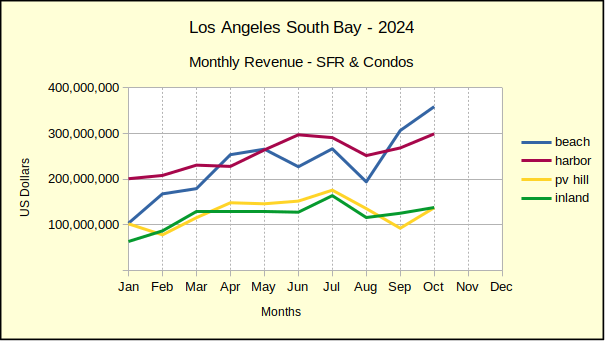
Real estate sales in the Los Angeles South Bay have been a blend of red and black ink all year. Both the sales volume and the median prices have flipped and flopped from month to month. It hasn’t mattered whether the numbers are comparing last month to the prior month, or to the same month in the prior year. They’ve all been crazy with huge, wild swings.

Before the Covid pandemic, about 8,600 homes were sold each year in the South Bay. Because the artificially low interest rates during the pandemic created a rush on the market, many buyers who would have purchased in subsequent years, stepped into home ownership early. In 2024, the market transferred slightly over 6,600 homes, still about 30% below the norm. As a result, the number of homes sold each year is anticipated to continue increasing until the market catches up with the extra 4,000 units sold during the market explosion of 2021.

Despite that, the pace of sales has become sluggish, with property staying on the market much longer, and many times not selling at all. Some are being pulled off the sale market and leased out. A few are being pulled back for refurbishment. Many are seeing multiple price reductions before receiving an offer.

Median prices are declining twice as frequently as they were at the beginning of the year. Of the four market areas in the South Bay, only the Beach Cities have a positive median price for the year to date. The Harbor, Inland and Hill areas are all showing lower median prices as of August. There are four months remaining in the year, so there is still time for the outlook to change. Next month ends the third quarter–let’s see what happens!

Beach:

With the heat of August rising and the pressure building to move before school started, home sales in the Beach cities responded positively. Leaving behind most of the red ink, the only negative number was a 17% drop in the number of homes sold in August versus July. Looking at the raw numbers shows July came in with 130 homes sold, the highest in a single month this year, compared to 108 in August.

Despite the slippage in sales volume, the monthly change in median price showed a 1% increase over July. The month ended positively for the first time after six months, with a median of $1,863,000.

Annual sales volume at the Beach has found 2025 higher than 2024 every month of the year so far. This differs from monthly in that monthly sales have been up only four out of the first eight months of the year. August sales were up 15% from August of 2024. Showing a lot more volatility, the median price in August was up 10% from last year, however, the median had dropped by 1% each of the last two months.

Year to date through August reflects a 22% increase in sales volume, though sales are still down 16% from 2019. The median price was up 8% for the same period, which is 47% higher than in 2019.

Harbor:

With 310 homes sold, the Harbor area had a 1% increase in monthly sales volume for August compared to July. That was matched by a 1% increase in the median price, ending the month at $779,500.

Annually, August turnover showed a stronger 7% increase in sales from last August, though the Harbor area registered below the South Bay total of 10% upturn. Compared to August of 2024, the median price dropped $20,500 from $800,000 creating a reading of -0%.

For the first eight months of 2025 the Harbor area produced a 4% lift in the number of homes sold compared to the same period last year. Sales volume remains 21% lower than it was in 2019, the last pre-pandemic year. Year to date the median price has fallen a modest 1%. Compared to 2019 the median is still 41% higher than it was then.

Hill:

There were 59 homes sold on the Palos Verdes Peninsula in August, representing a 21% decrease in sales for the month compared to July. The fact the Hill is such a small area with so few homes bears repeating at this point. Two or three sales, more or less, can swing the percentages to seemingly ridiculous levels. In August, the median price likewise took a dive, falling 18%, to $1,800,000.

Year over year, comparing the same month in 2025 to 2024, shows Palos Verdes splitting another way. Sales volume was up 11% over last August, and at the same time the median price fell by 16%.

The first two thirds of the year have brought the number of homes sold up by 3%, still 15% lower than in 2019. The same time frame shows median price falling by 2%, though still up 43% from 2019.

Inland:

From July to August the number of homes sold in the Inland area climbed to 133 for a 2% increase. At the same time the median price tumbled 10%, falling to $880,000.

Year over year sales volume jumped by 14% in August, reversing the trend of the past two months where sales fell by a cumulative 15%. The median price bumped up by 1%. The Inland area has only had one other positive month since February.

Year to date sales volume is up by 2%, which is still down from 2019 by 17%. Median price for the same period has fallen 1%, and continues to be 35% higher than 2019.

Beach=Manhattan Beach, Hermosa Beach, Redondo Beach, El Segundo
Harbor=Carson, Long Beach, San Pedro, Wilmington, Harbor City
PV Hill=Palos Verdes Estates, Rancho Palos Verdes, Rolling Hills, Rolling Hills Estates
Inland=Torrance, Lomita, Gardena

Photo by Gavin Ruane on Unsplash

South Bay Real Estate – Stagflation?

South Bay: Market Shrinking

In July the South Bay real estate market made a valiant attempt to maintain a positive stance. It failed. Compared to June of this year, things looked better on the sales volume side, but June was already in the tank, so even the summer bump was only modest help. Looking back to July of last year gave a depressing picture. Overall sales for the south Bay were off by 1%. In itself that’s not a huge number, but considering the market started this year at well over 10%, it’s a big drop in sales.

Median price was an even greater disappointment. In January every area of the South Bay was in positive numbers. By July, every area except PV (which has been negative four out of seven months), was shrinking.

Year to date numbers have overall pointed in an equally negative direction. For the first seven months of the year the South Bay is looking at a 6% increase in homes sold. Compared to the 11% that started the year, one has to conclude the local real estate economy is trending down. The median price tells an even more down-trodden perspective with nearly all areas showing prices falling by 1% to 3% from the same period in 2024.

Beach: A One Month Jump?

The number of homes sold in the Beach cities during July jumped to 130 units, up 11% from June sales. Keep in mind, the increase follows a 4% drop in June, which followed a 2% drop in May. Month to month sales have been erratic at the Beach, while annual sales volume has been steeply up compared to 2024. July sales continued the trend with a 10% increase over the same month last year.

Median price is another matter. At the Beach the median came in at $1,844,000, down 3% from June. July was the sixth successive decline in month to month median prices for the Beach area. Annually the median has shown mixed results compared to 2024, ranging from a 32% increase in January to a 1% decline in July. This drop in July followed another 1% decline in June, continuing what looks like a year long slide in median price and in sales volume. While still higher than in 2024, July was the second lowest month this year in terms of homes sold.

Cumulative sales for 2025 were 23% higher than 2024, though still down 15% from 2019, the last normal year of business preceding the pandemic. For the same period, the median price is up 9% over last year, while coming in at 49% above the median in 2019.

Harbor: Volume and Median Down

July was not a positive month for the Harbor area. Compared to June, sales volume and median price both fell by 8%. The number of homes sold for the month fell to 307 units, while the median price dropped to $775,000. This was the steepest monthly drop seen at the Harbor in 2025.

Annual statistics weren’t any better. Looking back to July of 2024, shows sales volume declined by 3%, and the median price fell 9%, the largest annual drop this year. If the current trend continues for the balance of the year, Harbor area real estate may take a serious hit.

Year to date sales through July came in at 3%. While still positive, it’s important to note the Harbor started the year with sales volume at 10% and has been dropping all year. Similarly, the median price has gone from 1% up in January to 9% down in July, ending the first seven months falling by 1%.

A quick comparison to 2019, shows year to date sales volume still down 20% from pre-pandemic business. Median price is still 43% above the 2019 median.

Hill: Strikingly Good

The Palos Verdes Peninsula saw a strikingly good real estate market in July. Month over month sales climbed an astonishing 53%. Of course, it’s not so impressive when one notes that sales dropped 34% last month. Even at that, 75 homes were sold in July, well above the average sold in any month for 2024 and the highest number in yet this year. At $2,185,000, a 13% increase over June, the median price was likewise the highest month for 2025.

Though not as dramatic, the year over year statistics were also impressive with a 3% increase in the number of homes sold compared to July of 2024. Increasing at 8% over July of last year, made PV the only area with a positive median price this month.

Viewing 2025 versus 2024 year to date sales brought another increase of 2%, roughly on par with the rest of the South Bay. Then came the only negative on the Hill for July—a drop of 1% in the median price.

Year to date sales compared to 2019 are still down by 11% , while the median price remains up by 44% from 2019.

Inland: Long Term Slowdown

July versus June numbers showed surprising strength for the Inland area. Those cities kicked the sales volume by 15%, with the number of homes sold climbing to 131 units. While boosting the median price 1%, to $979,000, the Inland area topped the market except for the highly volatile PV peninsula.

The monthly trend reversed with the annual statistics. July 2025 compared to July 2024 showed a 8% drop in the number of sales, accompanied by a 2% drop in the median sales price.

Year to date for the first seven months came with mixed results. Sales volume showed a 1% increase. For the same period, the median price dropped 3%, ending very much like all areas except the Beach, which continued to show positive results.

Once again looking back to 2019, before the real estate market was irremediably shaken by the Covid pandemic, current sales are down 15% and median prices are up 36%. With five months left in the year and economic forecasts leaning toward stagflation, this could well be a tipping point.

Beach=Manhattan Beach, Hermosa Beach, Redondo Beach, El Segundo
Harbor=Carson, Long Beach, San Pedro, Wilmington, Harbor City
PV Hill=Palos Verdes Estates, Rancho Palos Verdes, Rolling Hills, Rolling Hills Estates
Inland=Torrance, Lomita, Gardena

Photo by Jake Blucker on Unsplash

South Bay Real Estate Speculation?

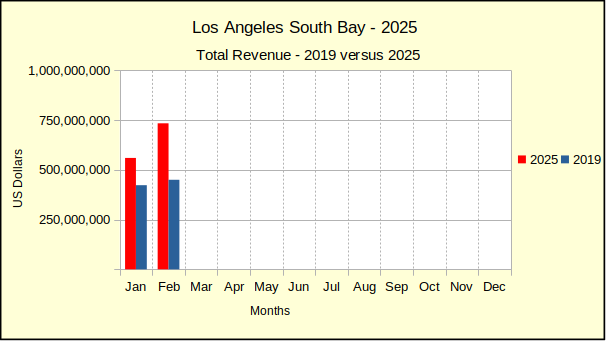
As 2025 rolls by the real estate market in the Los Angeles South Bay continues to slide downward. January started the year with 11% more homes sold than in 2024. Now, with June in the books, the difference is 0% growth in sales across the South Bay. From month to month the numbers are up and down, but the end result is down.

With the exception of the Beach cities, the same thing is true for the median price. The four areas of the South Bay are distinguished from each other by the basic appeal of each area to potential home owners. Comparing real estate from 2024 to 2025 shows a distinct difference between the Beach cities and the other three areas.

Consider the sales volume, for example. Across the South Bay the cumulative change in the number of homes sold for the first half of each year, shows a 7% increase. However, the Beach area measured in at a 26% increase. The Harbor area was 4%, Palos Verdes peninsula was 2%, and the Inland cities were 3%. Different South Bay buyers are definitely viewing things differently.

Looking at the median price shows a similar story. In the same order, Beach was 11%, Harbor was 1%, Palos Verdes was -1% and Inland was -1%.

Clearly, buyers in the Beach cities have a different perspective than those in the rest of the South Bay. It would take some serious research to study the various purchases, what type of buyer was involved, how the property is currently being used, and how big of a premium the buyer was willing to place on the property, etc., in order to understand the motivations. An early guess is speculation. Buyers with sufficient available resources are speculating that the value will continue to go up without interruption. There might also be some number of those buyers who believe short term rentals will help defray the carrying costs. And probably a few who just want to live at the beach.

The key tying them all together though, is speculation. Those Beach area buyers believe the economy is going to hold and their purchases are going to further advance in value. That opinion appears to be changing though. The June median results for the Beach shifted from positive to negative in what may be an indication of the direction of our economy. We’ll be back next month with an update.

Beach: Mostly Down

Compared to May the Beach cities real estate performance was a bust. June is the second “down” month in succession for the Beach. At 117 units sold, monthly sales volume dropped 4%, after dropping 2% in May. Median prices in the Beach area have been negative since February. The median for June was a mere $5000 below last month’s $1.9M, leaving a statistically insignificant 0% drop.

In year over year sales volume, the Beach did much better, with a 30% increase in the number of homes sold over June of 2024. However, median price took a nosedive from June of 2024, falling from positive 9% in May to a negative 1% in June this year.

Contrasting the first six months of 2025 to the first half of 2024 lends the Beach cities a win. While the South Bay as a whole saw an increase of 7% in the number of homes sold over those sold in 2024, the Beach area jumped by 26%. For the same period of time, Beach prices climbed by 11%, far better than any of the other three areas.

As a point of reference, the number of Beach homes sold in the first half of 2025 is 17% below the number of sales in 2019, the last “normal” business year before the pandemic. Over the same time frame, median prices have increased 54%.

Harbor: Mostly Up

Real estate in the Harbor area showed surprising resilience in June. With 335 homes sold, sales volume was up 14%. At the same time, the monthly median price of $838,000 at the Harbor was up 3% from the prior month.

In the only decline for the Harbor in June, the annual sales volume slipped slightly with a 2% decline. This was offset by a 5% increase in the median price over the same month last year.

Year to date statistics brought even more positive news for the Harbor area. Sales volume for the first six months of the year was up 4% over sales in 2024. The median price was also up, with a modest increase of 1%.

Much like the Beach cities, when looking back to pre-pandemic real estate, the sales volume is 18% below that of 2019 while the median price is up 46%.

Hill: More Down

On the Palos Verdes Peninsula, the only positive number for June was the median price, which rose from $1.85M in May to $1.94M in June, for a 5% increase. Heading the opposite direction, monthly home sales dropped by 34%, ending the month with 49 sales.

In comparison to 2024, PV cities lost ground in sales and in prices. The number of homes sold fell by 18%, while the median price lost 4%.

With the first half of 2025 in history, homes on the Hill appear to have settled in with modest sales volume increases accompanied by small decreases in price. As of June, homes sales are up by 2% and the median is down 1%.

Compared to the first six months of 2019, Palos Verdes volume is off by 9%. For the same period, the median is up 44%.

Inland: And More Down


After four months of sales growth this year the Inland area flipped with a 20% drop from last year. Running the opposite direction from the sales decline, the median price jumped by 11%, coming in at $965,000.

Year over year statistics likewise ended with a drop in the number of homes sold and an increase in the median price. Compared to 2024 sales volume was down 7%, while the median climbed 1%.

At mid-point in the year, the Inland area is posting a 3% increase in sales over 2024 business. That number seems quite reasonable, especially when compared to the monthly sales which range from 18% increase to 20% decrease. While the total number of sales is down, the median price for the first half of the year is up 1%.

Continuing the year to date comparison with pre-pandemic activity, the Inland area is showing sales at 14% less than 2019, combined with a median price at 38% higher than then.

Beach=Manhattan Beach, Hermosa Beach, Redondo Beach, El Segundo
Harbor=Carson, Long Beach, San Pedro, Wilmington, Harbor City
PV Hill=Palos Verdes Estates, Rancho Palos Verdes, Rolling Hills, Rolling Hills Estates
Inland=Torrance, Lomita, Gardena

Photo by Matthew Davis on Unsplash

Sales Volume Shaky, Prices Falling

South Bay Prices Falling

The real estate market in the Los Angeles South Bay kicked off 2025 with an 11% increase in the number of residences sold for January. That increase in sales volume was accompanied by median price bumps that ranged from 0% in the Inland area to 32% in the Beach cities.

Fast forward to May, almost halfway through the year, and the sales volume has dropped to a 7% increase over May of last year. With the number of homes selling declining, the median prices have likewise moved from the positive side to the negative. Comparing the median prices to May of last year shows prices falling in three of the four South Bay areas. Only the Beach cities managed to stay positive with a 9% increase, albeit compared to 32% in January. The other three areas dropped by as much as 8%. (See below for more detail.)

This South Bay Market Snapshot shows where the market is shifting and by how much. It’s designed to help clients understand the direction of the market. Those who watch the market trend will see increasing larger chunks of real estate market are sliding toward recession either in the number of homes sold for a given period, or correspondingly dropping in median price. The mid-year report next month should provide a more definitive comment on the future of local real estate.

Beach: Still Up, but …?

May was not a good month for real estate in the Beach cities, but it was better than last May. The month over month statistics are red ink, with the number of homes sold dropping by 2% and the median price falling 3% from April. Sales volume came in at 122 units, compared to 125 in April. The median price was $1,900,000 down from $1,955,000 last month.

Annual sales volume was more impressive at 11% increase in the number of homes sold. Similarly, the median price at the Beach escalated by a relatively high 9%, compared to the other areas of the South Bay.

Year to date, 541 homes have sold in the Beach area, 25% greater than the first five months of 2024. At $2,000,000 the median price surprises, since the median month to month is only $1,900,000. How could the median for the year to date, be higher? Well, looking at the past few months shows Beach area prices started the year much higher than they are now. In fact, the median in January was $2,355,000—almost $400,000 higher than May. Beach area median prices have been falling every month this year.

Harbor: Sales Slipping, Prices Down

Month over month, sales volume in the Harbor area dropped by 5%, from 310 homes in April to 293 in May. Surprisingly, the median price climbed from $785,000 to $815,000, for a boost of 4%.

Comparing this May to the same month last year gives similarly mixed results, though in reverse. While monthly home sales found May lower than April, annual sales were up 2% from May of 2024. In the same time frame, median prices fell 4% across the year.

For January through May of 2025 the number of home sold rose 6% from last year, for a total of 1373 properties closing escrow. During the same period of time the median price rose 1%, ending at $785,000.

Hill: Sales Solid, Prices Down

Home sales on the Palos Verdes Peninsula for the month of May delivered an increase of 1%, totaling 74 homes. In May, the median price likewise went up, reaching $1,850,000, or 4% more than those sold in April.

Looking at sales volume year over year shows a more varied picture. Last month compared to May of 2024 offers a 12% increase in the number of homes sold. At the same time, the median price tumbled by 5%. One should always be cautioned that with the small number of transactions in peninsula homes, percentages often seem exaggerated, thus it’s important to look at the year to date statistics, too.

For the first five months of 2025 275 homes were sold on the Hill, boosting sales volume by 7% over that of 2024. While the volume came up, the median price went down. At $1,897,000 the median dropped by 2%. It would seem a correction was in the making, though that’s based on memory of other financial “compressions” in recent years.

Inland: Median Prices Continue Down

Monthly sales statistics brought a 12% jump in homes sold in the Inland area. This increase is easily the steepest in the South Bay for May. The next closest rise in sales was the Palos Verdes area with a 1% bump over April volume. The 143 homes sold at a median price of $870,000, a 1% drop from the April median.

The Inland area joined the Hill in yearly sales increases. Both areas registered a 12% jump in volume, coming in at the top, with the South Bay as a whole rising by only 7%. Continuing a trend started in March, Inland median prices once again fell, this time registering the steepest drop across the South Bay, falling 8% below last year’s May numbers.

As the calendar barrels toward mid-year Inland sales volume for the year to date has climbed 5% over 2024 to 575 homes sold. Median prices for the same period rose a very modest $10, settling at $900,000, effectively a 0% increase.

Beach=Manhattan Beach, Hermosa Beach, Redondo Beach, El Segundo
Harbor=Carson, Long Beach, San Pedro, Wilmington, Harbor City
PV Hill=Palos Verdes Estates, Rancho Palos Verdes, Rolling Hills, Rolling Hills Estates
Inland=Torrance, Lomita, Gardena

Photo by Nicholas Grande on Unsplash

Is South Bay Real Estate Collapsing?

South Bay Home Sales Solid, Prices Soft

The first two months of 2025 looked generally good. Not necessarily strong, but sales were more or less pluses compared to 2024. By the time March rolled around things were starting to look less positive. Sales were dropping in most neighborhoods and double digit increases were pretty much a thing of the past. With April the number of homes closing escrow actually increased, except for the Inland area.

Median price is another story. While prices have continued to escalate at the Beach, they have flattened in the Harbor area and dropped into negative territory everywhere else. The year to date statistics for median price are still ok, but beginning to look like a recession in the making.

Like the rest of the world’s economy, South Bay real estate in 2025 is volatile. From one month to the next there is hardly any continuity. Looking across the year to date activity is seems clear both sales volume and prices are sliding.

Sales volume is expected to remain below prior years for some time. This is a reaction to the extremely low interest rates attached to homes purchased during the pandemic. Those owners are holding on to those properties and rates for as long as possible. Compared to 2019, the last year before pandemic influenced real estate, sales volume has consistently been 5% to 15% lower.

On the other hand, median prices have jumped consistently. South Bay median prices are anywhere from 40% to 70% higher than in 2019. That inflation appears to have begun receding in the Harbor and Inland areas. It has slowed but not reversed at the Beach or on the Peninsula.

Beach: Starting to Weaken

The number of homes sold in the Beach cities during April increased to 125 units, or 3% over March. Looking at year of year sales volume, 6% more were sold in April of 2025 as were in the same month of 2024.

Median prices were mixed, coming in at $1,955,000, 2% below March of this year. Annually, the April median was 12% above April of last year.

Year to date for the first four months of the year, 419 homes have sold for a 30% increase over sales in 2024. The median price of $2,090,000 represents a 17% lift from last year.

Harbor: Sharply Slower

April sales volume in the Harbor area jumped by 23% above March, ending at 310 homes sold. Annually, that came in at a 17% increase above April of 2024.

Like the Beach, Harbor area median prices dropped 2% from March sales, registering at $785,000. Comparing that to the median in April of 2024 showed an increase of 1%.

Looking at the longer perspective, 1080 homes sold in the Harbor area year to date through April, for a increase of 7%. For the same period of time, the median price was flat at $772,500.

Hill: Prices Negative

On the Palos Verdes peninsula 73 homes were sold in April, an increase of 46% over March. That monthly increase far over-shadowed the year over year increase of 14%. It’s important to remember that activity on the PV Hill is lower than any of the other areas measured here, and is subject to some rather dramatic statistical swings.

While the number of sales increased monthly and annually, the median price dropped in both categories. At $1,783,560, April’s median price was 10% below that of March. April of 2025 came in 7% below the same month in 2024.

The first four months of the year saw 5% sales increase with 201 homes sold. For the same period, the median price rose 4% to $1,935,000.

Inland: Mostly Down

Monthly, sales in the Inland area climbed to 128 homes, for a 12% increase. At the same time the year to year sales volume fell 5% from April of last year.

The median price in April was $877,500, a drop of 4% from March while remaining the same as April of 2024.

Year to date sales of 432 homes was a 3% improvement over the first four months of 2024. For the same period, the median price of $900,000 represented a 1% increase.

Beach=Manhattan Beach, Hermosa772,500 Beach, Redondo Beach, El Segundo
Harbor=Carson, Long Beach, San Pedro, Wilmington, Harbor City
PV Hill=Palos Verdes Estates, Rancho Palos Verdes, Rolling Hills, Rolling Hills Estates
Inland=Torrance, Lomita, Gardena

Photo by Gavin Ruane on Unsplash

South Bay Real Estate – March Sales and Prices Down

March was not a good month for sellers of South Bay realty. Median prices for residential property collapsed into red territory for nearly all areas. Sales volume was right behind it with falling numbers everywhere except the Beach cities. Even at the Beach, where the number of homes sold rose, the median price went negative.

So to what should this market slow down be attributed? Is it the elevated interest rates? Probably not, since mortgage rates have actually come down, albeit only slightly. Perhaps it’s a lack of inventory? Not likely, as there are more homes on the market in most neighborhoods. Tariffs? There are none on real estate. Has inflation driven off the buyers? Possibly. Median home prices are up in a range from 40% to 74% across the South Bay, though most of that price jump occurred when mortgage interest was toying around the 3% area.

Economic chaos is probably a more accurate answer than any other. Investors like stability, which is not in evidence today. Right now, investors can’t tell from one day to the next, whether to expect recession or inflation. In order to buy low, or to sell high, it’s necessary to know which direction the economy is going. When they can’t tell, investors park their money in the least volatile place they can find.

It’s often called the “investor flight to safety.” So, when the IMF warns of “major negative shock” to the international economy, investments shift to gold and bonds. Right now, both are doing quite well. At some point the investment community will decide real estate has fallen as far as it’s going to, and then we’ll return to—inflation.

Beach:

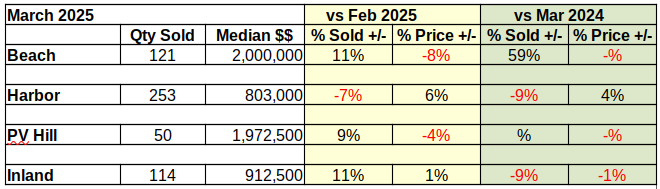
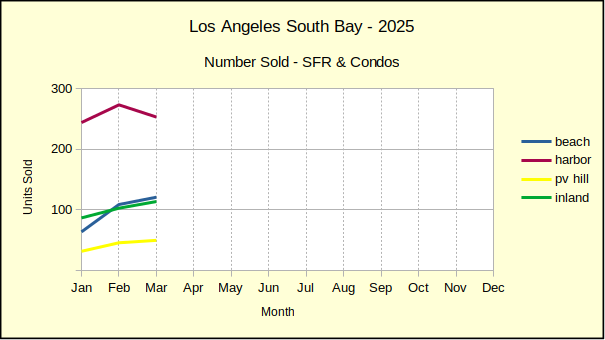
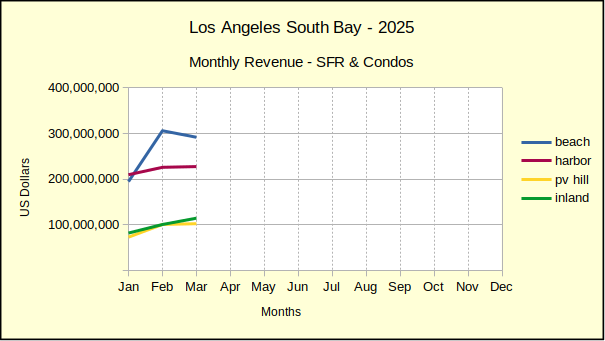
Monthly home sales in the Beach cities climbed 11% above February, while the median price plummeted by 8%. The number investor flight to safety.of homes sold increased from 109 in the prior month to 121 units in March. The median price dropped $180,000, ending the month at $2,000,000.

On a year over year basis, the sales volume was even more insane, with 59% growth over March of 2024. The last time the local market saw sales numbers this high was during the pandemic, when interest rates were at rock bottom. The craziest part of the story—is seeing that with all those sales, the median price for March actually dropped $10,000. The decline was small enough to register as a 0% change.

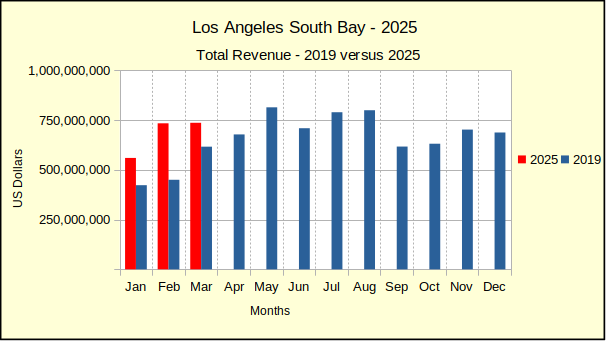
Year to date comparisons to the first three months of last year showed similarly divergent percentages, though not quite as radical. Sales volume for the first quarter of 2025 exceeded 2024 by 43%. For the same period of time, the median price at the Beach rose an astonishing 22%. This compared to low and negative numbers across the rest of the South Bay for both sales volume and median price.

Harbor:

Talk about diverse—the Harbor area did a complete 180º turn on the Beach area. Monthly, the Beach was: volume – up, median – down; the Harbor was volume – down, median – up. The Harbor came in with a 7% drop in number of homes sold, falling to 253 units from 273 last month. The median sale was $803,000, a 6% increase over last month’s $760,000.

The same diversity, or is it perversity, kicked in on the yearly statistics. Compared to March of 2024, this year the Harbor area dropped 9% in the number of homes sold, while the median price of those homes climbed 4%.

First quarter home sales at the Harbor continued to climb, though not as aggressively as the Beach area. The sales volume rose 4%, which is more in line with business on the Hill and for the Inland area. For the same time frame, the median price fell 1%.

Hill:

Month to month sales in Palos Verdes showed a 9% increase, climbing from 46 units in February to 50 in March. While the number of homes sold climbed, March saw a 4% drop in the median price.

Comparing March of 2024 to this March brought 0% change for both the number of homes sold and the median price. Exactly 50 homes sold in both years. The median price actually declined by $10,000, though the change was statistically insignificant.

There was also no change to the sales volume for the first three months of this year. Median price on the Hill rose 11% for the first quarter of 2025.

Inland:

While March brought 11% growth in the number of homes sold compared to February, the Inland area challenged market pressure and registered a 1% increase in the median price. With 114 sales for the month, compared to 103 for last month, the Inland area maintained positive volume. At the same time, the median price improved by $12,500, up from the February median of $900,000.

Annually, March flipped the statistics, with both the sales volume and the median price dropping. Home sales fell by 9%, the same decline the Harbor area experienced. The median price was off 1%, which doesn’t seem like much until compared with the 40% growth since 2019.

Year to date the Inland area showed 6% growth in the number of homes sold compared to the first quarter of 2024. Like the Harbor area, the Inland area delivered a significant drop in the median price, coming in with 0% change.

Beach=Manhattan Beach, Hermosa Beach, Redondo Beach, El Segundo
Harbor=Carson, Long Beach, San Pedro, Wilmington, Harbor City
PV Hill=Palos Verdes Estates, Rancho Palos Verdes, Rolling Hills, Rolling Hills Estates
Inland=Torrance, Lomita, Gardena

Photo by Roger on Unsplash

South Bay Real Estate: Erratic, Inexplicable, Inflationary

Since summer of 2023, South Bay real estate has been erratic, inexplicable and highly inflationary. Both the sales volume and the median price jump up, and then down, and then up again with no apparent rationale. For example, the number homes sold in the Beach cities was up 29% in December, down 40% in January and up 70% in February. Over the same months, the median price in the the Beach cities went up 9%, up 30%, and down 7%. Those are huge jumps, and with contrary indicators.

Some of that crazy action made sense during the pandemic, but post-pandemic, where the economy should be leveling out, all the numbers should be moving in the same direction, consistently.

The number of homes sold should be on the increase constantly until 2027/2028, as sales stabilize following the out-sized impact of the low pandemic-era interest rates. Those low interest rates caused a sizable percentage of future buyers to step up to the plate earlier than they would have normally. Those buyers will not be back in the market for another four to five years, at the earliest.

The median price of those homes should be increasing in line with the Federal Reserve target of 2%. The fact that they are increasing one month and dropping the next indicates a dysfunctional market. The degree to which prices and sales are bouncing around indicates an out-of-control economy.

Why is this a problem? The list price of your house is determined by recent sales. When the recent sales are all over the map, your broker is hard-pressed to get your asking price correct.

Typically, we try to provide some sort of a forecast for the coming months. Unfortunately, the fundamentals are not lining up in any direction right now. Maybe next month.

Beach: Sales Up, Prices Down

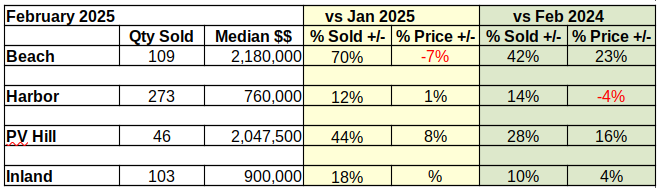
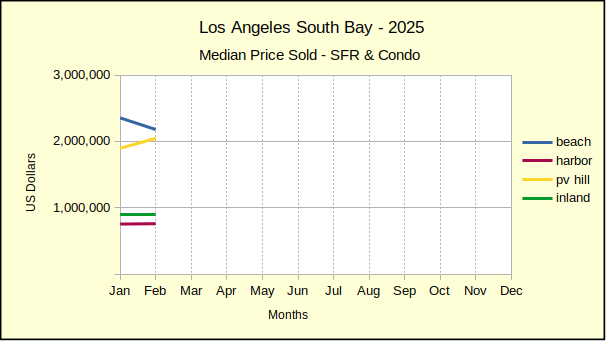
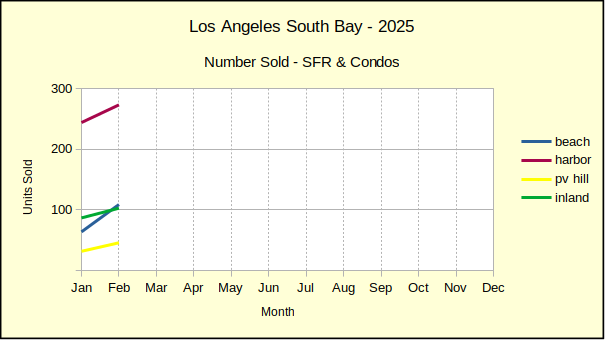
The number of February home sales in the Beach area jumped to 109, 70% above those of January. At the same time the median price dropped 7%, ending at $2,180,000.

Compared to last year, February sales were up 42%, with an annual increase in the median price of 23%.

Year to date, sales of homes rose 34% versus the first two months of 2024. Median prices for the same period increased by 27%.

Harbor: Sales Up, Prices Up

On a monthly basis, sales volume in the Harbor area jumped by 12%, ending with 273 homes sold in February. Median prices for the Harbor climbed 1%, reaching $760,000 for the month.

While year over year sales volume was up by 14% for February, the annual median price at the Harbor dropped 4%. This marks the first annual decline in median price at the Harbor since 2023. Economic volatility has created a lot of wide monthly swings, but the variances annually have been more restrained.

Compared to the first two months of 2024, the number of homes sold increased by 12%, despite negative sales volume in January. Median prices fell by 2% for the same period.

Hill: Sales Up, Prices Up

From January to February sales of home on the Palos Verdes Peninsula increased by 44%, from 32 to 46 units. That jump was accompanied by an 8% growth in the median price, matching the 8% increase of last month. The February median price came in at $2,047,000.

Comparing February sales this year to those of last year shows a 28% rise in the number of homes sold. Likewise, the median price climbed 16% from last February.

Looking at year to date for 2025 versus 2024, sales volume is flat at 78 homes sold for the two month period. In the same time frame, median prices have shot up by 11%, clearly an inflationary statistic.

Inland: Sales Up, Prices Flat

February home sales in the Inland area hit a total of 103 properties, registering an 18% increase in volume over the prior month. The median price for February came in at $900,000, exactly the same as January.

Looking back to last February shows a 10% increase in the number of homes sold, along with a 4% rise in the median price.

Combined home sales for January and February of 2025 surpassed sales of 2024 by 18%. The median price went up by 2% for the same period.

Beach=Manhattan Beach, Hermosa Beach, Redondo Beach, El Segundo
Harbor=Carson, Long Beach, San Pedro, Wilmington, Harbor City
PV Hill=Palos Verdes Estates, Rancho Palos Verdes, Rolling Hills, Rolling Hills Estates
Inland=Torrance, Lomita, Gardena

Photo by Chris Saran at unsplash.com

South Bay High End Market Hits Wall

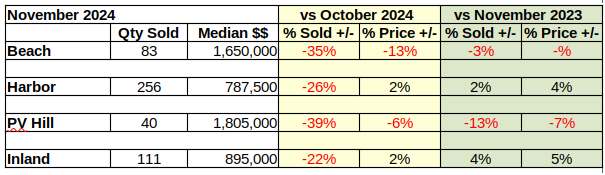
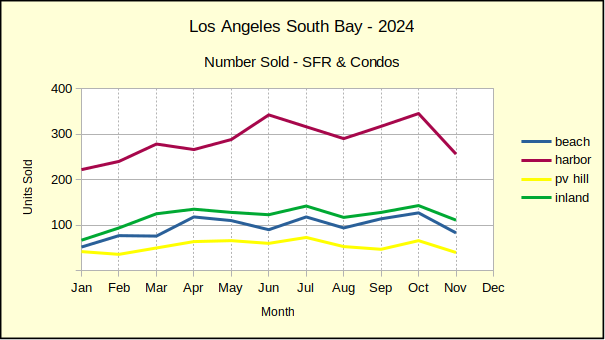
On the heels of an encouraging October real estate market, November saw the South Bay market plummet into the red. Compared to last month the number of homes sold fell by nearly 30%, while the median price collapsed at the Beach and on the Hill. At the same time, the Inland and Harbor areas showed modest growth in median price, posting a 2% gain in both areas.

This was a surprising downturn following across the board sales growth in the October market, accompanied by generally positive price appreciation.

Looking at year over year, same month sales provides a slightly more positive result. Both the Beach and the Hill show the number of homes sold down by 3% and 13% respectively. The Harbor area maintained sales growth of 2% while the Inland area increased by 4%. Both areas were off substantially from the 20-30% increases of October.

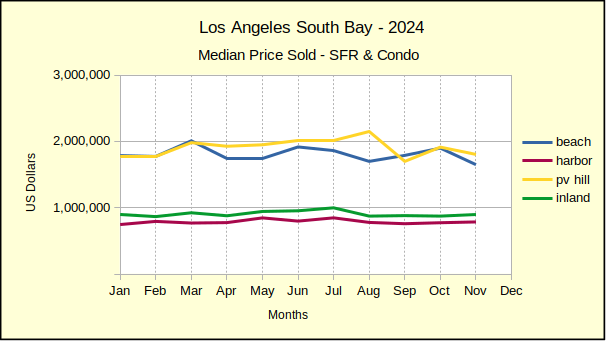
Year over year median prices were equally depressed. The Beach and the Hill, the high end of the South Bay market, both lost ground in the single digits. The Harbor and Inland areas, which make up the bulk of sales in the South Bay, grew at 4% and 5% respectively.

It’s too early to attribute this shift to the election results because most of the transactions closing escrow in November would have been negotiated in October. If anything, the decline reflects nervous anticipation leading up to the election. December sales will provide a much more definitive indication of how the public has reacted to the election results.

For right now we know that current sales volumes are running about 10% below December of 2023. And, we know that December last year was lower than December 2019 by 30%. Back at the end of October conditions seemed to be improving, but today it would seem we are still trying to climb out of the Covid trough.

Beach: Sales Off 35% for November

The number of homes sold in the Beach Cities dropped from 127 in October to 83 in November showing a 35% decline for the month. At the same time the median sales price dropped from $1.9M in October to $1.65M in November for a loss of 13%.

On an annual basis sales volume was off by 3% compared to last November, while the median price was flat.

Year to date, 1,059 Beach homes have been sold compared to 1007 during the first 11 months of 2023. This is a 5% increase in the number of homes sold. The median price rose 7% from $1,675,000 last year to $1,787,500 year to date.

Harbor: Sales Fall 26% in November

Harbor area home sales plunged 26% from October, dropping to 256 units from 345 sold last month. At the same time the median price climbed 2%, to $787,500 from $775,000.

On the flip side, same month, last year sales moved the opposite direction, rising 2% this year compared to 252 homes sold in November of 2023. The median price this November was up 4% over the $760,500 recorded in November of last year.

With only one month remaining in the year, the Harbor area displays modest increases in both the number of homes sold so far this year and the median price of those homes. Annual sales have reached 3,160 to date, 3% higher than last year’s 3,076. Median prices for the year have climbed from $740,000 last year to $780,000 this year.

Hill: Market Drops 39% for the Month

Home sales on the Palos Verde Peninsula dove down 39% from October to November, wiping out all but 1% of last month’s gain. As mentioned in the October issue, during the last quarter of 2023 mortgage interest rates were hitting around 8%, which drove the South Bay market to a standstill. The fact 2024 sales volume is falling below 2023 is a concerning matter. Interest rates are once again pushing up against 8%, which has been an impenetrable barrier in recent years. While the number of homes sold dropped precipitously, the median price came in with only a 6% decline, falling from $1,914,500,in October to $1,805,000 in November.

Comparing November of 2023 to November this year turned up a steep fall again. This year brought a sales volume decrease of 13% accompanied by another 7% drop in the median price.

As 2024 heads for closure, the dramatic swings of earlier in the year are mellowing out. Through November, the 597 sales on the Hill have settled in at just 1% above last year. Similarly, the median price, which has ranged from an increase of 26% to a decrease of 15% throughout the year, is coming in at 3%, or $1,927,500.

Inland: Home Sales Collapse by 22%

November sales of 111 homes in the Inland area totaled a 22% drop from the 143 sold in October, rounding out a total decline of 28% for South Bay real estate this month versus last month. Despite the fall in month to month sales volume, the Inland area enjoyed a 2% increase in median price over October.

Same month last year sales increased by 4%, moving up from 107 units in 2023. At $895,000, the median price for November Inland area homes was up by 5% over the $851,000 of last year.

Looking at year to date sales volume of 1,313 shows a mere 1% increase over January-November of 2023 when 1,302 homes sold. Median price fared higher, with a 3% jump from $867,500 to $895,000 this year.

Beach=Manhattan Beach, Hermosa Beach, Redondo Beach, El Segundo
Harbor=Carson, Long Beach, San Pedro, Wilmington, Harbor City
PV Hill=Palos Verdes Estates, Rancho Palos Verdes, Rolling Hills, Rolling Hills Estates
Inland=Torrance, Lomita, Gardena

Photo by CURTIS HYSTAD on Unsplash

South Bay Real Estate Leveling Off

It looks like the real estate market is finally climbing out of the Covid trough. Each passing month this year has shown red ink, mostly on sales volume, and a lot on median price as well. October brought some relief in that the number of homes sold is up in every area, and median prices are only down in half the South Bay.

The number of South Bay homes changing hands has varied considerably since 2019. Sales staggered briefly after the spring shutdown in 2020, then recovered mid-year as the interest rate continued down. Rock bottom interest rates pulled in buyers and homes flew off the market with bidding wars. In the final quarter of 2022 sales plummeted and the buying spree ended.

YearHomes Sold
20197,100
20208,581
202110,279
20227,616
20236,481
2024proj6,636

If this is indeed the beginning of a normal real estate market again, it’s possible to see reaching the pre-pandemic sales volume in 2025, but more likely in 2026.

The median price is another story. Interest rates were hovering around 3.5% in spring of 2020. The Federal Reserve opened the money spigot to keep the economy flowing while everyone was locked down. For about 15 months mortgage interest rates were below 3%. Historical data sourced from Freddie Mac shows that rates dropped below 4% starting in June of 2019 and lasting until March of 2022. Nearly three years of sub 4% rates makes the current +/-7% a significant deterrent to buying a new home or trading up.

During that period, buyers took advantage of the low rates to boost their offering prices for homes, creating a sellers’ market and bidding wars. The median price sky-rocketed in 2021 and continued through the first of the next year. In summer of 2022, median prices started falling and dropped until late in 2023. Across the board, median prices have been modestly positive since the beginning of 2024.

Certainly it’s all relative, and the market is adjusting, both on the side of higher prices and higher interest rates. But, with today’s median prices roughly 40% above 2019, the number of buyers who can qualify for the necessary loan is way down. A 2024 Q3 estimate from the California Association of Realtors shows only 15% of households in Los Angeles County can afford the median priced home. That compares to 56% in 2012, which leaves a lot of buyers on the sidelines.

The election is over and the incoming administration is clearly pro-corporate. Over the next couple months the dynamics of the shifting markets will become clearer. By the new year we should have a better understanding of the impact to our local real estate. As of October, declines are leveling off and sales are starting to pick up.

Beach: YTD Sales Up 6%, Prices Up 7%

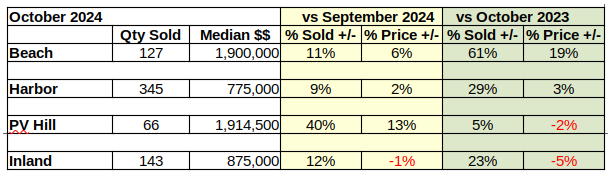
The number of homes sold in the Beach cities increased by 11% in October, rising from 114 in September to 127. The median price of Beach properties went up from $1,790,000 to $1,900,000, a 6% jump in monthly figures.

Annually, October this year showed a whopping 61% increase in sales over October of 2023, climbing to 127 homes this year versus 79 last year. Over the same one year span, the median price rose 19%.

In view of the huge increase, it’s important to note that October of 2023 is the month mortgage interest rates started toying with 8%, which the buying public simply wasn’t accepting. While lenders and the Fed worked to lower rates, real estate was “in the tank” for last quarter of the year. After the beginning of 2025 the year over year percentages should level out.

January through October, the number of homes sold this year hit 976, 6% more than were sold in the same time period of 2023. Median price at the Beach climbed to $1,788,750 for a 7% increase over last year.

Harbor: YTD Sales Up 3%, Prices Up 4%

October sales in the Harbor area came in at 345 homes for a 9% increase over September. The median price was $775,000, up 2% from the prior month.

Looking at year over year for the same month, this October showed a 29% improvement over the 267 homes sold last year. As noted earlier, home sales took a significant drop in the last quarter of 2023 due to mortgage interest rate hikes. The year over year median price was a much more reasonable 3% increase.

For the first ten months of the year, sales volume has gone up by 3%, to a total of 2,904 homes sold. Over the same period, the median price has jumped up 5% to $778,500.

Hill: YTD Sales Up 2%, Prices Up 5%

On the PV Peninsula, October sales outpaced September by 40%, coming in with 66 homes sold versus 47 the preceding month. It’s important to remember that the Palos Verdes market is the smallest of the South Bay, so a handful of transactions can make a huge difference in either, the sales volume or the median price. The steep increase in sales was accompanied by a more modest increase of 13% in median price, ending the month at $1,914,000.

Comparing October to the same month last year reveals a 5% boost to the number of homes sold. On the other hand, the median price took a fall, dropping by 2%.

Year to date, home sales on the Hill have increased 2%, from 544 in 2023 to 557 this year. For the same ten months, the median price went up 5% to $1,938,750.

Inland: YTD Sales Up 1%, Prices Up 2%

Home sales in the Inland area have been stable, with an increase of 12% in the number of transactions, from 128 properties sold in September to 143 in October. A 1% drop in the median price from last month to this brought the median down from $882,500 to $875,000.

Annual sales in October of this year ended 23% higher than October of 2023. The median price, going the opposite direction, fell 5% from $917,000 last year.

Continuing the relatively modest numbers, the Inland area has risen 1% in the number of homes sold year to date, The 1202 sales reported so far, compare to 1195 sold in 2023. Similarly, the median price is up 2%, having risen from $871,250 last year to $891,245 this year.

Beach=Manhattan Beach, Hermosa Beach, Redondo Beach, El Segundo
Harbor=Carson, Long Beach, San Pedro, Wilmington, Harbor City
PV Hill=Palos Verdes Estates, Rancho Palos Verdes, Rolling Hills, Rolling Hills Estates
Inland=Torrance, Lomita, Gardena

Photo by Corey Buckley on Unsplash

South Bay Home Sales Flat on Rising Prices

At the end of the third quarter for the real estate market in the Los Angeles South Bay, 4,958 homes have sold, compared to 4,959 sold during the same period in 2023. Essentially, that is 0% growth. Median prices, however, have climbed over 5%, despite the high interest rates.

Sales activity across the South Bay was mixed, though in a narrow range. The Inland area saw 2% fewer home sales on a year to date basis than last year. At the same time, the Palos Verdes Peninsula gained 2% over 2023. The Beach area was up 1%, while the Harbor area came in flat.

Median prices during the first nine months of the year recovered the losses of the same period in 2023. Last year, median prices fell nearly every month from January through September, only beginning to recover growth in September. This year the median price has shown a strong increase since the beginning, ranging from 4% for the Inland area to 8% for the homes on the Hill. The Beach and Harbor areas rose with 7% and 6% respectively.

It looks like this winter is going to continue the wild ride. The Federal Reserve lowered the prime interest rate by half a point in September. Then, after a positive employment report for September, mortgage lenders raised their advertised rates back up to where they were in mid-August! The national election will undoubtedly have it’s own impact, even here in our relatively placid part of the world.

Among the early market indicators which may give us a hint of where the market is headed, one not commonly discussed is the number of homes which don’t sell. The comparison is established by looking at the number of home listings which are expired, cancelled or withdrawn from the market versus those which closed escrow. During the first three quarters of 2024, out of 6,179 homes on the market, 4,958 of those sold. At the same time, 1,221 or, 20% of the total, failed to sell. These percentages are not significantly different than a normal year.

In a high turn-over market such as that of 2021, at best one might expect as little as 12% to not sell versus a slow-moving market where one might expect as much as 25% to fall off the market unsold. It would be fair to say the local market for real estate is languishing, but it appears to remain afloat despite volatile news in all corners of the world. The next issue of this newsletter will arrive after the national elections. There should be more to talk about then.

Beach: Sales Lag and Prices Leap

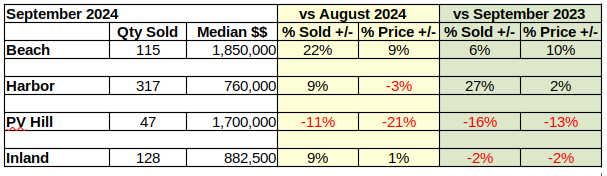
With 114 homes sold in September, the Beach Area sales jumped up 21% above August figures. The median price likewise took a 5% leap to $1,790,000 in monthly sales.

Comparing September 2024 home sales to the same month in 2023 reveals a less dramatic shift. The number of homes sold is 6% greater this year and the median price increased by 7%.

Year to date sales volume of 849 homes at the Beach showed a modest 1% increase over the first nine months of 2023. Monthly variations have been as high as 33% and as low as -27% during the first three quarters making the cumulative 1% value a bit of a surprise. Equally surprising in light of the 1% growth in the number of homes sold, is the 7% increase in median price to $1,787,500 for the same period of time.

Harbor: Sales Slow, Median Prices Up

Monthly sales in the Harbor area totaled 317 units in September, a 9% increase over the number sold in August. At the same time, the median price for Harbor area homes dropped 3% to $760,000.

Looking at year over year sales for the month of September showed a 27% growth in home sales over 2023 and a 2% increase in median price.

During the first three quarters of 2024 2,559 homes were sold in the Harbor area, compared to 2557 last year, registering as a 0% change. The median price for year to date sales came in at $780,000, a 6% increase over the same period in 2023.

Hill: Plenty of Red Ink

August was a particularly busy month in Palos Verdes real estate, so the 11% drop in sales volume for September was somewhat expected. Falling from 53 homes sold to 47 is a short fall, but the marketplace on the Hill is small, so percentages escalate quickly. The median price also took a nosedive from $2,150,000 to $1,700,000, a 21% drop. Interestingly, those prices are the highest and the lowest in PV for 2024.

September of last year was exceptionally strong on the PV Peninsula, both in terms of sales volume and price. As such, the relatively anemic sales of September 2024 brought lots of red ink. The number of homes sold fell by 16%, while the median price came down 13%

Year to date, PV has had five positive months and four negative months. Cumulatively, the Hill has a 2% increase in the number of homes sold, going from 481 last year to 491 this year. During the same nine months, the median price moved up 8% ending at $1,950,000 for the period.

Inland: Mixed Results on YTD Activity

Month to month home sales in the Inland area were modestly positive. With 128 units sold in September, the volume was up 9% from August activity. The median price gained 1%, coming in at $882,500 for the month.

Comparing September of 2023 to this September brings a 2% decline in the number of homes sold. The median price for the same comparison also dropped 2%.

The first nine months of the year arrived with 2% fewer sales than the same period last year. The Inland area was the only part of the South Bay to fall in sales volume or median price so far in 2024. Year to date the median price rose 4% above 2023, to $899,990 the slowest growth of the South Bay areas.

Beach=Manhattan Beach, Hermosa Beach, Redondo Beach, El Segundo
Harbor=Carson, Long Beach, San Pedro, Wilmington, Harbor City
PV Hill=Palos Verdes Estates, Rancho Palos Verdes, Rolling Hills, Rolling Hills Estates
Inland=Torrance, Lomita, Gardena

Photo by Rachel Cook on Unsplash

South Bay Real Estate Bonanza

July brought a bonanza—of sorts—to real estate in the Los Angeles South Bay. Sales volume, which had been falling below last year for three of the last four months jumped up 20%. Granted, July was an unusually slow month in 2023, compared to most years including 2024.

Month over month showed a comparable increase. Total sales volume was up 6% from June to July. The only negative for monthly sales was in the Harbor area where activity was off by 8%.

More importantly, year to date through July, sales volume was up 1% across the South Bay compared to the same period in 2023. With over half the year past already, some growth is a positive sign. This close to November on a presidential election year, one would expect the market to be looking better than it has been.

In fact, The number of homes being sold has still not recovered from the pandemic. Sales this July were 22% fewer than they were in July of 2019! As discussed previously, because the mortgage interest rates were temporarily at rock bottom, about 40% of the homeowners in California currently are “trapped in a mortgage they can’t afford to leave.” This promises to maintain downward pressure on home sales for the better part of a decade. Paradoxically, the reduced inventory is contributing to rising prices.

More homes were being sold in July, and they were being sold for greater prices. Annual increases in the median price were up 15% in entry level neighborhoods. At the Beach and on the Hill median prices didn’t reach quite as high, but were still more than 10% above July of 2023.

Monthly pricing showed the contrast between high end and entry level homes more clearly. In the Beach area the median dropped 3% from June, while on the Peninsula, there was no change in the median price. In contrast, the Harbor and Inland areas rose 6% and 5% respectively over June numbers.

Comparing the first seven months of this year to last year shows inflation continues to plague the real estate economy. Median prices rose in a range between 6% and 9% in the South Bay during the period.

Beach: Highest YTD Sales Volume Increase

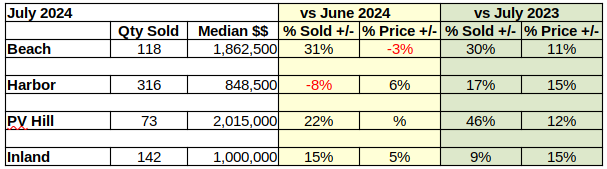
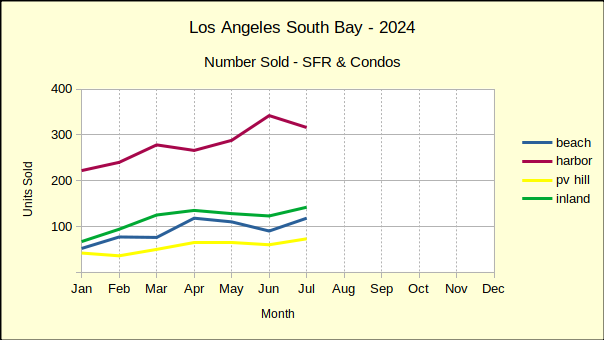
Sales in the Beach cities jumped from 90 homes in June to 118 in July for a massive 31% monthly increase. This was matched by a 30% annual increase over July of 2023. Month to month statistics, as well as same month last year comparisons have shown tremendous variability this year.

The rapid fire changes precipitated by the pandemic, and subsequently by the Federal Reserve in an effort to keep the economy under control, created wild swings in the number of homes sold. At the same time the shifts in median price were less frequent and considerably less wide-ranging.

Today, looking at the year to date summaries for both, sales volume and median price, the numbers have moderated greatly. Sales volume at the Beach measured against last year has ranged from negative 27% to positive 33%. That huge range smoothed out to 6% growth in the year to date view.

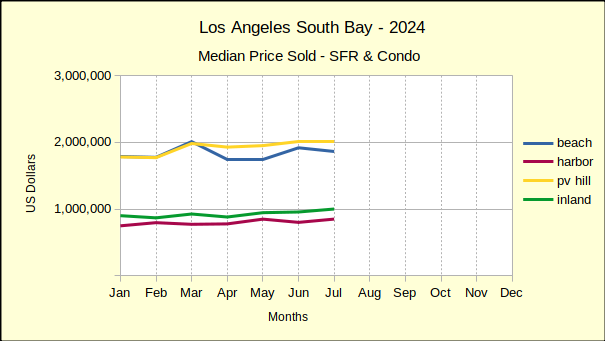
Likewise, the median price, which has been a bouncing ball, declined 3% from June and increased by 11% over July of last year. Comparing the year to date from 2023 to 2024, the median settled in with a 6% increase for the longer term perspective.

Harbor: Highest YTD Median Price Growth

Monthly sales volume in the Harbor area fell 8% to a total of 316 homes sold in July compared to 342 sold in June. Annual sales moved the opposite direction, rising 17% from July of 2023 to July this year. For the first seven months of 2024 sales have fallen 1% compared to the same period last year.

Median prices had fallen 6% in June and have reclaimed that loss with a 6% growth in July. The new median, $848,500, is a 15% improvement over July of 2023. Year to date the median price is up by 9% in the Harbor area over the same seven month period in 2023.

Interestingly, every month this year has been a growth month for the year over year median price at the Harbor. The lowest increase has been 4% in March and again in June. The highest has been 18% in both February and May.

Hill: Highest Median Price In South Bay

Monthly data for the PV Peninsula came in with 73 homes sold for a 22% increase in volume over June. Annually, sales showed a 46% increase over July of 2023, a welcome change from the 24% drop in June vs June numbers. Year to date sales posted a 4% increase in volume over the same seven months in 2023.

PV registered a 12% annual increase in median price to $2,015,000 in July, so far the highest median in the South Bay for 2024. It doesn’t quite reach the $2,300,000 of May, 2023, but is one of the more impressive months in recent years. The monthly increase from June was negligible, but the timing in 2023 coincided with a downward shift in median sales prices. So, the change shows up as a 8% increase in the year to date median.

Inland: Median Price Hits $1,000,000 First Time

Sales volume for the Inland area jumped in July—up 15% month to month for a total of 142 homes sold, and up 9% since July of last year. Being past the halfway point of the year boosts the value of the the year to date statistics which come in at a mere 2% through July.

At the same time, the July median sales price for the Inland cities climbed 15% above July 2023 and hit $1,000,000 for the first time! Last year’s number was pretty run-of-the-mill so lends some import to this year’s improvement. The 2024 year to date median price calculation supports the strength shown by the monthly and annual numbers with a solid 7% increase over 2023.

Why Use Median?

A brief comment on median price and why it’s often used in real estate: Averages are used for a great many things in making comparisons, and for things that change frequently, averages do a great job. Medians, on the other hand, minimize the ‘jerky’ nature of averages and show directional movement better than a lot of up and down action.

A median is exactly the middle of a group of numbers, so that half are higher and half are lower. So the impact of a single outlier number shows less distortion on the longer term trend line of the values. In other words, it’s easier to see what your investment will likely be worth in 10 years.

Most of us don’t buy houses often enough to care about movement over the last 30 days. We’re interested in staying put for 10 years, plus or minus. The median trend will show us the most likely path.

Beach=Manhattan Beach, Hermosa Beach, Redondo Beach, El Segundo
Harbor=Carson, Long Beach, San Pedro, Wilmington, Harbor City
PV Hill=Palos Verdes Estates, Rancho Palos Verdes, Rolling Hills, Rolling Hills Estates
Inland=Torrance, Lomita, Gardena

Photo catalina_from_wayfarers_chapel.jpg by Carl Clark

South Bay Housing Prices Up, Sales Down

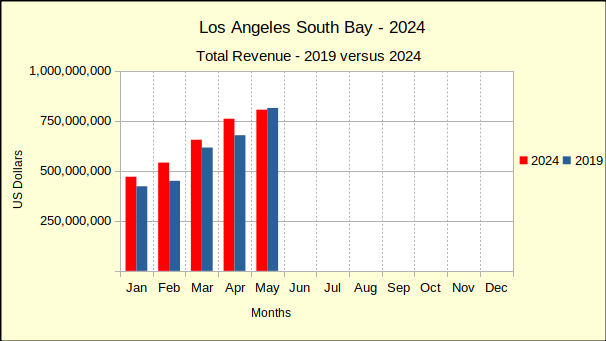
Median prices for real estate around the Los Angeles South Bay have risen over 40% since 2019, the year before the corona-virus pandemic. Comparing the median prices and sales activity for the first half of 2024 shows increases approaching 50% for the five year period in all areas across the South Bay.

Over the same time period, sales volume has plummeted by 22%, falling from 4,022 in 2019 to 3,149 in 2024. The Beach cities have been particularly hard hit with a 34% drop in the number of homes sold during the first six months of the year.

Looking at 2024 versus 2023 shows a similar pattern with median prices up nearly 10% from the first half of last year. The Beach area showed the lowest increases, coming in at 5% above the 2023 median.

Sales volume was off by 2% across the area with the only positive being the Beach at a mere 1% above 2023 numbers. As the 2024 year has progressed, the number of sales has declined in total. Simultaneously, more and more parts of the South Bay have fallen into negative growth.

As of the end of June, 2024 sales figures for all areas were negative in comparison to June of 2023. While the number of homes sold has consistently declined through the first half of the year, median prices have been equally persistent at increasing over last year. Most experts are attributing the increasing prices and decreasing sales to the shift from an ultra-low mortgage interest rate during the pandemic, to a comparatively high rate currently.

When rates were at the lowest, many homeowners took advantage of the opportunity to refinance at the incredible rates. Those folks are now in a position where they would incur a painful increase in monthly living costs if they were to move. That has resulted in about a 40% reduction in the number of homes typically available on the Multiple Listing Services (MLSs).

At the same time, the increased mortgage interest rates have pushed a significant number of potential sellers out of the market because they no longer qualify for the loan they would need to trade up to a larger or newer home. That reduced the available inventory of resale homes even further and became another contributing factor to the bidding wars among the few buyers still in the market.

Beach: Down 18% in Sales May to June

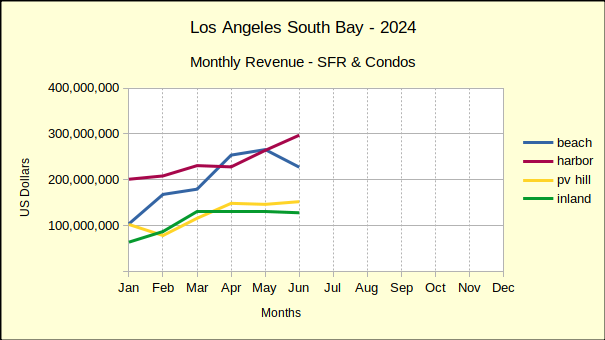
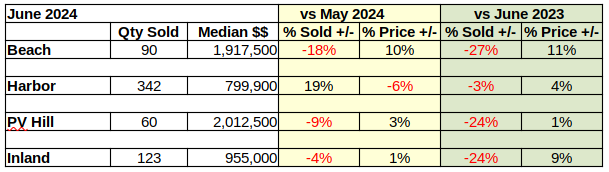
Monthly sales volume fell from 110 units in May to 90 homes in June, for an 18% drop. Median price jumped 10% in one month to end at $1,917,500.

Year over year, the number of homes sold declined from 124 in June of last year to 90 this year for a loss of 27%. Median price for the Beach climbed 11% over the year.

Year to date for the first half of 2024 versus the first six months of 2023 shows a modest increase of 1% in sales volume along with a increase of 5% in median price.

Harbor: June Median Price Off by 6%

The Harbor area was the outlier for June. While month over month sales collapsed and pricing jumped for the other three areas, Harbor sales of 342 homes boosted sales by 19%, coming in well above the 288 homes sold in May. Meanwhile, median price went the other direction, dropping from $848K in May to $799,900 in June, for a decline of 6%.

Year over year statistics went the opposite direction, following the rest of the South Bay. Sales volume fell by 3%, dropping from 124 in 2023 to 90 in June of this year. Meanwhile the median price was up 4% for the year, rising from $772,000 last June to nearly $800,000 this year.

The first six months of 2024 brought a year to date sales drop of 4%. The median price in the same period climbed 9%.

Short term changes, as from month to month, have been unpredictable since the pandemic. Looking at the longer term, there is consistency in the declining sales volume and increasing median price. With 2024 a presidential election year, it will be interesting to see how long this direction holds.

Hill: Year Over Year Sales Fell 24%

With a reputation for wildly shifting statistics, the Palos Verdes Peninsula came in with relatively modest decline of 9% from May sales. Similarly, the increase in median price was very tempered at only 3%.

The sales volume for same month last year was anything but mild. June of 2023 reported 79 homes sold versus 60 homes in June of 2024. That’s a 24% drop in volume from last year. While a fourth of the 2023 sales disappeared, the median price eked out a 1% increase, going from $2,000,000 last June to $2,912,500 in June of 2024.

In what is becoming a familiar trend, the year to date sales volume is down 2%, and the median price for the first six months of the year is up 7%.

Inland: June 2024 Sales Drop 24% From 2023

The Inland area showed the smallest month to month change of the South Bay. The 4% drop in sales volume from 128 homes sold in May to 123 in June was minor. Likewise the 1% increase in median price from $945,000 to $955,000.

Like the Hill, the Inland area had a radical drop in sales from June of 2023 to June of 2024. Falling from 161 homes sold last June to 123 sold this June resulted in a 24% drop in transactions. Median price in the same period rose 9%, from $875,000 to $955,000.

Interestingly, there has been no statistically significant change in the sales volume for the first six months of the 2023 and 2024 years. It actually increased by three units from 669 homes sold in 2023 to 672 homes sold in the first half of 2024. For the same time periods, the median price climbed by 6%.

Beach=Manhattan Beach, Hermosa Beach, Redondo Beach, El Segundo
Harbor=Carson, Long Beach, San Pedro, Wilmington, Harbor City
PV Hill=Palos Verdes Estates, Rancho Palos Verdes, Rolling Hills, Rolling Hills Estates
Inland=Torrance, Lomita, Gardena

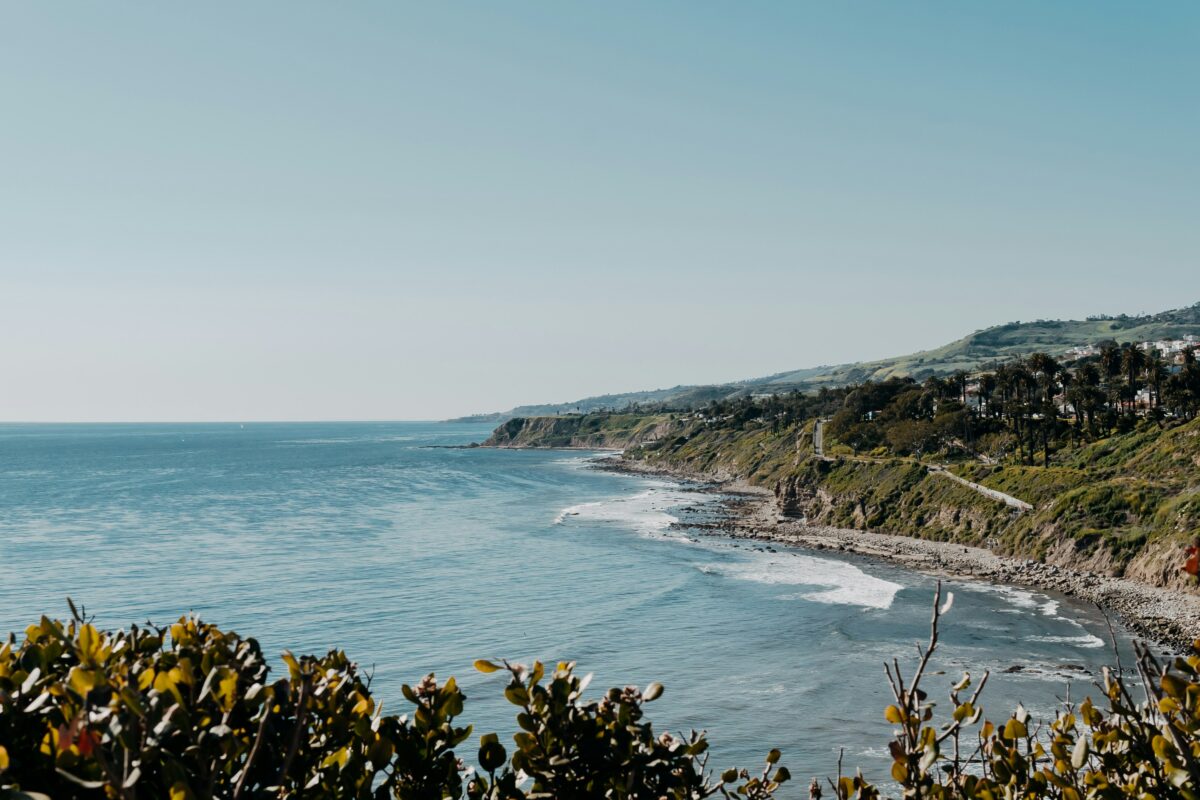
Photo Montemalaga Sunset by Carl Clark

South Bay Median Prices Still Climbing

South Bay median home prices are continuing to climb! May versus April showed increases as high as 9% for the month. Comparing May of this year to last May gave increases as high as 18% for the year. Year to date statistics for the first five months of the year came in with increases as high as 11%. Looking at the same five month period from five years ago shows median prices have climbed by nearly 45%.

Mortgage interest rates have roughly doubled from two years ago. The Federal Reserve Bank kept raising rates, hoping to drive inflation down. Unfortunately, it doesn’t seem to be working in the real estate world.

So far this year the interest rate increases have only modestly slowed purchases in month to month data. The number of homes sold in April was 10% higher than in March. May shows a 2% increase in the number of homes sold compared to April. Year over year sales volume shows a greater impact, with an 8% drop from May of 2023 to May this year. Most of that decline was lost this year as home sales for the year to date are up 1% from last year.

Once again looking back five years shows sales are off by 22% across the board from pre-pandemic sales volume. All while median prices are up 45%! But, there are very few homes on the market, and the shortage of inventory is driving price increases, contrary to the Fed goal of slowing inflation.

So why are there so few homes for sale today compared to 2019? And why are prices climbing in the face of mortgage interest rates that have doubled?

One possible factor: During the pandemic mortgage interest rates were at and below 3%. A significant number of existing mortgages were refinanced during the 18 months of the pandemic. Another 17% of currently existing mortgages were purchases at those rates. In summary, about 50% of the current mortgage market is now holding a note with an interest rate that is a fraction of today’s rates. There is essentially no reason for those folks to ever move.

Since about 80% of California homeowners carry a mortgage, and about half of those have an historically low interest rate, about 40% of homeowners have an incentive to stay where they are now, rather than trade up, as would be normal. Given the financial benefits, those homeowners are not likely to put their home on the market and increase the inventory thereby relieving some of the supply and demand imbalance.

Forty percent is a huge piece of the available housing stock to be removed from the market in a time of a housing shortage. Work-related re-locations would have once smoothed this out, but the “work from home” movement has also contributing to the slowing real estate market. The current outlook is for several years of low inventory, further exacerbating the increase in housing costs.

Eventually the inflation of housing prices will come under control and annual increases will get down to something less than 6%. There’ll be no attempt to “dial back” the inflation and return to a prior point in time. So the short term question is, “How do we adjust to the new reality of higher prices, fewer homeowners, and more renters?”

Beach: Anticipate Fewer Sales & Higher Prices

Monthly statistics have been misleading in recent months in all the areas. May activity at the Beach is a great example of the disparities. Compared to April, 7% fewer homes were sold in May with no change in the median price. Contrast that with the annual numbers where sales in May of this year are down 9% from 2023 but the median prices are up 9%.

By looking at data for the year to date, the sporadic ups and downs can be smoothed a bit. This shows a more complete picture of what the market is doing in comparison to last year. In summary, the first five months of the year show a 10% growth in sales for the Beach cities, accompanied by a 6% increase in the median price.

Early projections for June indicate an annual decline from the same month last year sales of over 15% and a price increase of nearly 20% in the Beach area. If these preliminary estimates hold true, there will be some serious hand-wringing among the financial community.

Harbor: More of the Same

Like the Beach area, month to month statistics for the Harbor area have been very volatile this year. The number of sales in May climbed 8%, after falling 4% in April. May’s median price was up 9% following a 1% increase for April.

Year over year, sales volume was down 15% compared to May of last year, while the median price jumped 18%. This follows the general trend of declining sales and increasing prices. Theoretically, the declining sales will induce sellers to reduce their asking price, which will then translate to a reduction in the current inflation rate.

With the year to date sales volume dropping by 5% the interest rate increases would appear to be working. But the increase in median price by 8% for the first five months of 2024 throws cold water on the idea that inflation in real estate is going away.

More of the same is projected for June with a drop of 15% in sales and an increase of 5.5% in median price.

Hill: Sales Volume and Median Prices Up

Only 66 homes sold on the PV peninsula in May, compared to 64 in April, so the 3% increase in sales volume is not terribly consequential. Likewise the 1% growth in median price from $1.93M to $1.95M.

As mentioned in previous articles, activity levels on the Hill are small, so it only takes a minor change to look statistically important. For example, 65 home sales in May of 2023 versus 66 in May of 2024 is only one more home sold, but represents a 2% growth in volume. Even more so, the $2.3M median price from May of 2023, which is an exceptionally high monthly median price in PV under any circumstances, makes the 15% decline to $1.95M look huge in 2024.

In reality, the May median price is actually higher than the year to date median of $1.93M and higher than all but the March median of $1.98M. January through May sales volume is up 4% and the median price is up 11%, very much like the rest of the South Bay.

June sales are projected to decline slightly with a modestly elevated median price.

Inland: Sales Up and Prices Up

From April to May the number of homes sold in the Inland area declined by 5%, much as the Beach area sales volume transacted. Unlike the Beach and PV, where median prices ended barely positive, the median increased by 7% in the Inland area. That hefty increase mirrored the Harbor area lift of 9% month over month in the median price.

A 6% increase in the volume of homes sold and a 7% rise in the median price from May of 2023 to this May deviated from the other areas. It displayed a stronger than expected sales volume, especially considering the Beach and Harbor areas were deeply negative. At the same time the median price showed a slower increase than either the Beach or the Harbor.

Year to date for the first five months of 2024, the Inland area showed an increase of 8% in the number of homes sold, and a solid 6% increase in the median price. All in all, an investment in one of the inland cities would have been a good performer in May.

That investment is projected to still be sound in June, with a small decrease in the number of homes sold and a similar increase in the median price.

Beach=Manhattan Beach, Hermosa Beach, Redondo Beach, El Segundo
Harbor=Carson, Long Beach, San Pedro, Wilmington, Harbor City
PV Hill=Palos Verdes Estates, Rancho Palos Verdes, Rolling Hills, Rolling Hills Estates
Inland=Torrance, Lomita, Gardena

Photo by Tim Cook on Unsplash

South Bay Homes – Fewer Sales, Higher Prices

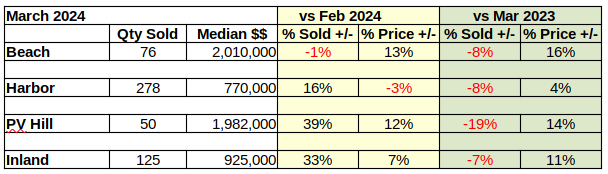
In the first quarter of 2021 buyers and sellers were taking advantage of the artificially low interest rates. Sales were robust and the demand pushed prices up along with the increase in sales volume. By first quarter 2022 sales volume was waning, but sellers were still attached to the higher prices so we saw sales dropping off dramatically. The first three months of 2023 gave us even deeper cuts in the number of South Bay homes sold and brought some corresponding declines in median prices. Today, looking at the South Bay market for the first quarter of 2024, prices are still “sticky” with sellers hoping to hang onto the gains from the Covid years.

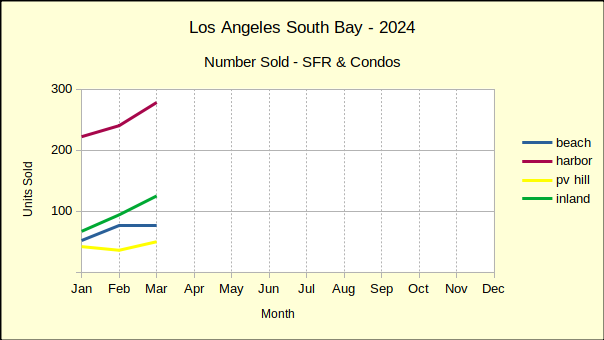
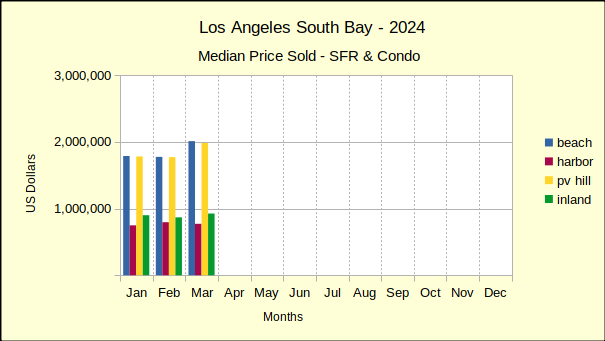
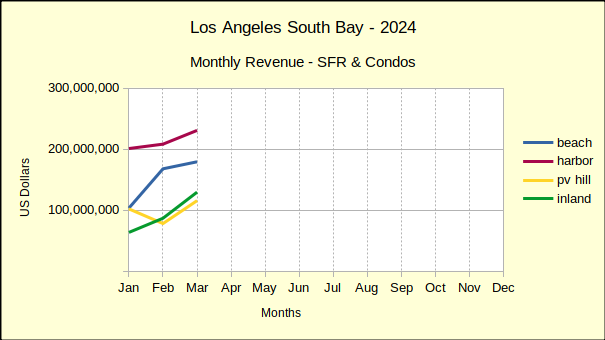
It’s not working real well. January gave sellers hope with a strong growth in sales volume and modest increases in median price. February showed returning median price increases and buyers backing off again in response. March is back to the drawing boards as buyers have balked at the price increases in the face of continuing elevated interest rates.

This is coupled with news trickling out of the Federal Reserve Board about how mortgage interest rates are probably not going to see the three rate decreases predicted at the beginning of the year. The latest announcement confirmed that if rate decreases come at all, it won’t be until late in the year and it won’t be significant.

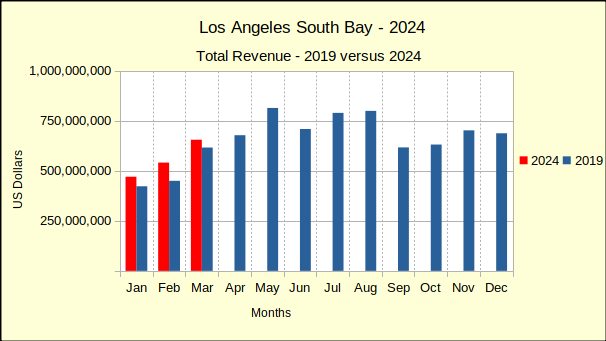
To gain perspective on the impact to the real estate market, it must be noted that the number of South Bay homes sold during the first quarter of 2024 is nearly identical to last year, and is still 19% lower than the first quarter of 2019, the last year of normal business before the pandemic. At the same time the median price of those homes is up almost 10% over last year and is 40% higher than it was in 2019.

Somehow a 40% increase in cost within five years, with a negative demand, seems to be a violation of general economic principles. It appears the post-pandemic adjustment back to normality has digressed somewhere along the path. Of course, all this has been further impacted by the fact 2024 is a presidential election year, and simultaneously the world is in extreme turmoil both economically and physically.

Month by month performance has been unusually erratic for quite some time. So far this year the comparison of this month to the same month last year is the most stable view of the real estate market. According to that view, the number of homes sold has gradually slid into negative territory. January kicked off the year with a blanket increase in the sales volume. February flipped that showing for about half the South Bay. which slid below the sales of last February. March has furthered that negative sales volume to all areas of the South Bay.

Median prices are managing to stay above those of 2023. With sales down across the area and mortgage interest rates stubbornly increasing, that may be changing soon.

Beach: Home Sales Erratic

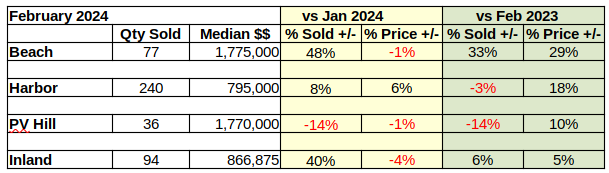
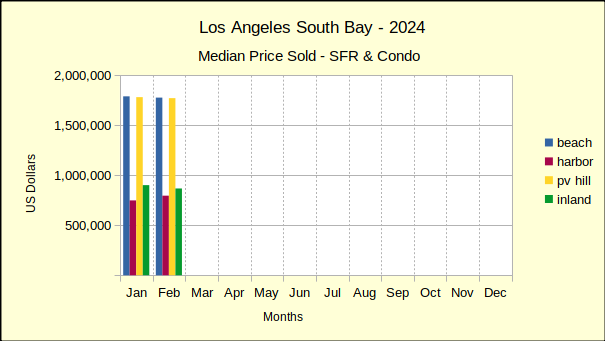
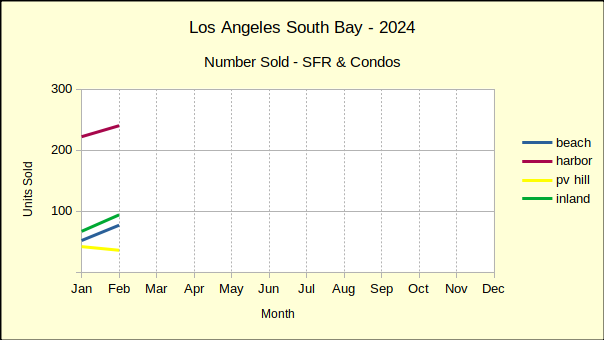
The Beach cities truly exemplified the erratic nature of month over month statistics during the first quarter. Compared to the prior month, sales in January were down 46%, in February up 48% and in March down 1%. Using the same metrics, monthly median prices were up 13%, down 1% and up 13%.

Looking at the same three months in a year over year method, the statistical movement is much less dramatic. Compared to the same month last year, January sales volume was up 30%, February up 33% and in a surprise drop, March was down 8%. By the same token, median prices were up 7%, up 29% and up 16%.

Disconcertingly, it’s been two years since the pandemic ended and the market is still seeing double digit movement monthly in both volume and pricing. This lack of stability results from several different influences on the real estate market. Among them the continued increase in mortgage interest rates, a corresponding relaxation of qualification requirements by lenders, a public perception of good economic conditions and a continued shortage of homes on the market.

Year to date sales volume for homes at the Beach has increased 13% while median prices have risen by 7% over 2023. Compared to 2019, sales are off by 35% with median prices 43% higher.

Harbor: Up, Then Down, Then Up

Month to month activity for the first quarter in the Harbor area has followed an equally irrational pattern to that of the Beach. January saw sales and prices drop by 13% and 4% respectively. Then February brought increases in both numbers, volume going up 8% and the median price by 6%. March came in mixed with sales volume up 16% while the median slipped by 3%. Annually, homes in the Harbor area started the year on a positive note with 9% growth in number of homes sold and an accompanying 7% growth in median price. February saw sales decline 3% with an increase in median price of 18%. Sales volume continued to fall in March, decreasing by 8%, albeit with a 4% increase in median price.

Year to date for the first quarter shows the number of homes sold declined by 2%, while the median price increased by 10%. Compared to 2019, sales are off by 16% with median prices 43% higher.

Hill: Sales and Prices Up; Sorta

After two months of negative sales volume and falling median prices, home sales on the Hill perked up in March. Volume was up 39% with 50 properties sold and median prices took a 12% jump to $1.982M. As mentioned in the past, properties on the Palos Verdes peninsula, much like those in the Beach cities, represent a smaller segment of the marketplace and often one or two outsize transactions will create a major shift in the statistics.

Of course, that “perkiness” is relative. While the number of homes sold was 39% higher than February, it was still 19% lower than March of 2023 and 25% below March of 2019, the last year prior to the upsets of the corona virus pandemic.

The 19% drop in sales was accompanied by a 14% increase in median price, a contradiction seen around the South Bay and generally across the State. The typically accepted explanation is that many home owners took advantage of the low mortgage interest rates offered during the pandemic. Those people are now unwilling to take on a new mortgage with an interest rate two to three times higher than they are currently paying. This is leaving a much smaller selection of available homes and has created an inventory shortage which encourages competitive bidding among the few buyers active in the market.

The first quarter of the year brought a 3% decline in homes sold on the Hill and an 8% increase in median price. Compared to the first three months of 2019, sales are currently off by 11% and the median is up 36%.

Inland: One Good March

The number of homes sold in the Inland area for March jumped by 33% to 125 closed escrows. Median prices increased a more modest 7% to $925K. Like the Harbor area, there is a comparatively large number homes in the Inland area and they offer a diverse range of prices. As an example, the low sale for this March was $371K while the high was $2.525M. Mathematics is a great tool for analyzing trends in real estate, but if one is planning to buy or sell in this environment, you should call a professional rather than simply applying these statistics.

Compared to the same month last year, March sales volume was down 7%, while the median price was up 11%. Year to date, the sales volume for the Inland area was unchanged, and the median price was up 8%. Similarly, comparing to 2019, sales were down 12% and prices up 40%

As discussed earlier, there’s a tendency for buyer resistance to the combination of higher prices and higher interest rates. Three months into the year, that resistance seems to be growing. Since the most recent Federal Reserve announcement, mortgage interest rates have climbed about .375% (3/8ths of a point). Looking at the statistical trend in conjunction with the increasing interest rate, we anticipate continued slippage in volume and more declines in median price throughout the South Bay.

Beach=Manhattan Beach, Hermosa Beach, Redondo Beach, El Segundo
Harbor=Carson, Long Beach, San Pedro, Wilmington, Harbor City
PV Hill=Palos Verdes Estates, Rancho Palos Verdes, Rolling Hills, Rolling Hills Estates
Inland=Torrance, Lomita, Gardena

Photo of the San Pedro coast by Marius Christensen on Unsplash

Mortgage Interest Rates Still Climbing

In a normal year, the interest rate for a conventional mortgage loan would be lower than the rate quoted for a “high balance” loan, which would be slightly lower than a “jumbo” mortgage. (Here in Los Angeles jumbo is more common than not.) The theory behind the differing rates is one of risk management. Lenders generally consider larger loans to be more risky, thus jumbo costs more.

Guess what! It’s not a normal year. It’s a Presidential Election Year. In addition to the political strife, our nation is closely involved in a couple of economy-disrupting wars in other parts of the globe.

The end result is jumbo loans with fixed interest rates that are as low or lower than conventional loans. Despite headlines touting strength in the economy, interest rates have increased by approximately .5% since the first of the year. The most recent announcements from the Federal Reserve System are hinting that anticipated rate reductions aren’t happening at all in the first half of 2024, and the number of potential reductions is expected to be less than previously expected.

Last year saw median prices in the South Bay falling below 2022 prices through July. In August of last year price declines began to abate. By December of 2023 prices had started to stabilize. The new year continued that trend with only one negative median price result in January. Improving on that, February showed solid growth in prices across the South Bay. The real estate market seems to be reacting to what is touted as an improving economy.

However, compared to last February, sales volume this February was a mixed bag with overall positive growth of 2% despite declines of 3% in the Harbor area and 14% on the Hill. These weaker sales figures follow a strong growth in the number of homes sold in January versus the same month in 2023.

Recent month to month history has shown that a decline in sales volume is typically followed by a decline in median price. This “tit for tat” resonance indicates a market where buyers are at the edge of their ability to buy and sellers are feeling the resistance. Indeed, following the upward movement of mortgage interest rate activity for the first two months of the year leads to the conclusion sales volume will drop, followed by more substantial price decreases in coming months.

Beach: Sales and Prices SeeSaw

On a month to month basis, the Beach area has seen serious ups and downs in the number of homes sold and in the median sales price. January started with a massive 46% drop in sales from December, then February showed up with a 48% increase in sales volume. By way of contrast, Palos Verdes sales were down 16% and down 14% for the same months. The median price for Beach homes slipped 1% in February versus a 13% increase in January.

February sales volume versus February of 2023 was also steeply higher at 33%, the largest increase of the South Bay areas. At $1.175M the median price was up 29% over the same month last year. This is a somewhat surprising median price increase in light of other annual increases around the South Bay falling in the range of 5-18%.

Looking at year to date for the first two months of 2024, the Beach area had positive sales volume of 32% with a median price increase of 17%.

Harbor: More Up and Down

Responding to the volatility of the economy, the Harbor area flipped from negative numbers in January to positive in February. The number of homes sold was up by 8% over the prior month, while the median price of those homes increased 6%. The largest of the South Bay areas, the Harbor area typically has less variability in both sales and prices than the other areas.

Annual figures, looking at change from one year to the next in the same month, is usually a predictor of long term direction. February home sales in the Harbor area seem to be close to the bottom of market. Volume dropped by 3% from 2023, the smallest annual decline since the end of the pandemic.

At the same time, the median price rose 18% above that of February 2023. It should be noted that the median price in the Harbor last February was exceptionally low at $675K. In contrast, the $795K for this year appears to be on the high side and should be expected to moderate as the year goes on.

Year to date, the number of homes sold has increased by 2% over 2023. The median price has gone up 12%.

Hill: Numbers Continue to Fall

Real estate on the Palos Verdes Peninsula was off more this month than last. Month to month sales volume dropped by 14%. Median price, which was flat last month, has fallen by 1% this month. This kind of back and forth jockeying in price and volume looks jerky in the month to month statistics.

When viewed against the backdrop of annual data one can more readily see the direction. Annually, residential sales dropped by 14%, roughly the average of the past few months. While sales volume was dropping, the annual median price rose a surprising 10%.

Combining January and February for year over year numbers shows the number of homes sold increasing by 11% and the median price increasing by 9%

Inland: A Mixed Bag for Sales and Prices

Like the Beach cities, the Inland area enjoyed a huge surge in the number of homes sold for February, after suffering a large drop in sales January. Volume was up by 40% for the month. Median price dropped 4% after an 11% jump last month. So far this year the market has been very unpredictable.

As mentioned early, the “same month, last year” perspective is starting to level out. Residential sales volume for February of 2024 increased by 6% compared to 2023. The median price was up 5% over for the same period. The annual percentage of change seems almost stable by comparison the the monthly.

Year to date, Inland sales have increased 7% while the median price has declined by 1%. So far in 2024, only the Inland median price has declined from the first two months of last year.

Beach=Manhattan Beach, Hermosa Beach, Redondo Beach, El Segundo

Harbor=Carson, Long Beach, San Pedro, Wilmington, Harbor City

PV Hill=Palos Verdes Estates, Rancho Palos Verdes, Rolling Hills, Rolling Hills Estates

Inland=Torrance, Lomita, Gardena

Photo by Matt Burt on Unsplash
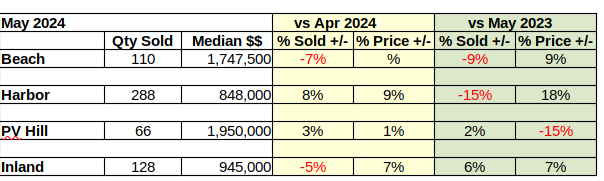
January Home Sales Down, Prices Up

Across the Los Angeles South Bay the number of homes sold in January was down compared to December—way down. For the same time period median prices are mixed with most sales either flat or down.

Looking at sales volume in January versus January of last year, shows big increases in activity. However, that serves more to show how slow the real estate market was at the beginning of 2023, than how good it is today. Median prices were likewise up for most areas when compared to the same month last year.

From a historical perspective, looking back at 2019, still the most recent “normal” business year for real estate, we see sales volume overall remains 21% below that benchmark. Median prices, which shot up during the pandemic have stubbornly stayed up. As of January, median prices range from 25-30% above the 2% inflation factor the Federal Reserve targets.

The combination of inflated prices and mortgage interest rates testing the 7% level has created a stagnant market place. Typically a presidential election year would bring rosy news about a growing economy and low interest rates. At this point there’s only one month of data, not enough to make any forecasts, but 2024 is off to a slow start.

Beach: Sales Off 46%

Month to month sales volume in the Beach cities collapsed by 46% in January. After back to back increases in the number of homes sold for November and December, the huge drop was unexpected. Juxtaposed against the 13% increase in median price, it demonstrates the current market dynamic.

The only actual buyers are people who have no choice but to move, despite the low inventory and high interest rates. At the same time, most sellers are stalling because they don’t want to be sitting on the market for weeks. And, because most sellers are also buyers, they’re waiting for a better market with more homes available and lower interest rates for their replacement purchase. As a result, the number of available homes listed on the MLS is further depressed.

This has brought about a rare phenomenon, the “off-market” sale. Both buyers and sellers are actively looking for deals that can be consummated without the competitive environment of the Multiple Listing Service (MLS). Buyers love the fact there are no bidding wars. Sellers are glad to sell at asking price without endless open houses and dozens of showings. The properties usually end up on the MLS as history, but not as competition. How long this trend will last depends on the economy over the next few months.

The market at the Beach has clearly improved since last year. Sales from January of 2024 have climbed 30% compared to January of 2023. At the same time, median price has moved up 7%. Of course, as mentioned earlier, last January was far from a good market in real estate.

Given the turmoil of recent years, one is compelled to look back at 2019, before the pandemic with it’s rock-bottom interest rates and sky-rocketing prices. Using that metric, January sales this year fell 34% below January of 2019. Median price this January was 43% higher than it was in January of 2019. Clearly “normal” is still a long way off.

Harbor: Sales Off 13%

Month to month statistics from the Harbor area demonstrate a truism. Pointing the way toward stability in the market, many of January’s home sales came with a reduced price. The median price dropped 4%, rather than increasing as it did in the Beach cities. Those price reductions appealed to buyers and the number of transactions increased considerably. Correspondingly, the sales volume only dropped 13% as opposed to a 46% drop at the Beach.

Harbor area sales for January 2024 ended with 9% more transactions than the same month lin 2023 in an unsurprising response to the market collapse of last winter. Also on the positive side, median prices for Harbor area homes increased by 7%.

Pre-pandemic residential sales for January 2024 was mixed in comparison to January of 2019. Sales volume was off, with 16% fewer homes sold in 2024. At the same time, median prices were up 44%.

Hill: Sales Off 16%

November and December of last year looked like a bad thing was turning good, and then January 2024 came along. Home sales on the Hill suffered less than at the Beach or Inland, but a 16% drop in sales volume in an already moribund market hurt. Median prices on the Hill hit that “sweet spot” with no change up or down.

Compared to January of 2023 the number of home sales on the Hill went stratospheric climbing 50% for the month. Of course, having read this far you know last winter was a low spot in the market. Combine that with the comparatively small number of sales on the Palos Verdes Peninsula and it’s easy to have outsize percentages. While sales volume was up 50%, median prices climbed a more modest 8%.

January 2024 versus January 2019 in home sales on the Hill showed an solid improvement. The number of homes sold increased by 27%, in contrast to falling sales in the Harbor and Beach areas. With the number of home sales up, a 37% increase in the median price is a welcome addition.

Inland: Sales Off 36%

Home sales in the Inland area closely followed those at the Beach in January. Similarly, the month ended with a calamitous 36% drop in the number of homes sold—down to 67 homes from over 100 in both November and December. Likewise, the median price came in with an 11% increase, slightly less than at the Beach. This shows the effect of “sticky prices” where a lot of sales don’t happen because the sellers are resistant to lower offers and buyers are balking at higher prices.

On a year over year basis, January 2024 showed 8% growth in the number of sales compared to last January. Median prices continued following the long downward slide of 2023 and dropped another 6%.

Comparing the Inland sales to 2019, the most recent stable year, the number of homes sold has dropped by 39% leaving a lot of room for recovery. The median price has climbed 40% over that five years, roughly 27% greater than the “ideal inflation” sought by the Federal Reserve.

Beach=Manhattan Beach, Hermosa Beach, Redondo Beach, El Segundo

Harbor=Carson, Long Beach, San Pedro, Wilmington, Harbor City

PV Hill=Palos Verdes Estates, Rancho Palos Verdes, Rolling Hills, Rolling Hills Estates

Inland=Torrance, Lomita, Gardena

Photo by T Narr on Unsplash
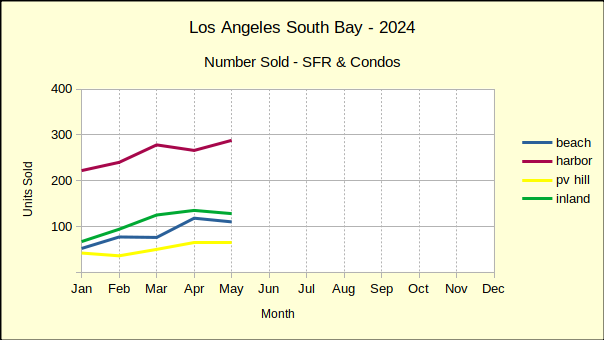
2023 South Bay Real Estate: Fail

By every measure South Bay real estate failed last year. The volume was down from the prior year in every residential area, the median price fell from 2022 heights everywhere, and the double whammy of crashing sales and falling prices brought the total revenue down from 2022. Judging from early reports the same is true across most of the state.

Part of the story doesn’t read so poorly though. As we look back across the year, the second of half of 2023 was far better than the first half of the year. This in two respects: first, the month-over-month statistics for sales volume have improved. The median price is still falling, but that’s to be expected if we’re going to see a sales volume increase concurrent with continued high interest rates. The market is going to demand that some of the “overly enthusiastic” price increases come back down.

Second, the year-over-year decline in median price is slowing—not reversing—slowing. Roughly speaking, the number of homes sold for less than 2022 prices improved from 83% in the first half of the year to 45% in the second half of 2023. That signifies an approaching balance in the market. Buyers are still holding back, but some sellers are coming forth to meet them.

2024 South Bay Real Estate: Better Days Ahead

We expect to see continued slippage in the median price, accompanied by increased sales volume. The Los Angeles South Bay is somewhat insulated from the vagaries of national and international events, but 2024 is facing an active political climate. The continuing wars around the planet would be enough to rattle economic markets here. This year sellers and buyers also have to factor in a contentious national election.

While the Federal Reserve System is officially apolitical, history has shown a tendency for improved economic conditions during election years. The final quarter of 2023 saw a softening of the wild swings in home sales volume and pricing. With less than 10 months until the presidential elections we anticipate continued easing of interest rates and increased sales activity. Median prices have fallen by about 2% across the South Bay in 2023 and probably won’t drop a lot more in 2024.

Sales volume fell by 15% across the South Bay in 2023. Nearly all of that drop was in the first half of the year. The new year is expected to be positive with growth in sales across the board.

Beach: Strong Sales On Weak Prices

Comparing December to November, the number of homes sold at the Beach was up 13%. That increase in sales is on top of a 9% increase in November, a dramatic turnaround from the 27% drop in October. On the other hand, the month to month median price fell 5% in December.

December of 2023 was similarly mixed when compared to December of 2022. Year over year saw sales volume increase a staggering 39%. Looking back shows December of last year as the absolute slowest month of the year for home sales at the Beach. The median price plummeting by 10% certainly helped generate those December 2023 sales.

Year to date numbers, comparing all 12 months, showed the number of home sales off by 11%. At the same time the median price was down 4% for the year. Much of the annual decline in sales volume occurred in the first half of 2023, when monthly drops of 25%-35% put the brakes on prices. Beach area median prices have taken steep falls since February 2023. It may take a couple more months before the first stimulating news on the interest rate front, but it would appear we’re looking at the “bottom of the market” now. Regardless of whether you’re a buyer or a seller, this is time to reassess your options.

Harbor: Positive Across the Board

December versus November of 2023 saw sales volume go up 1%. During that time the median price went up 2%. Harbor area homes sales dropped precipitously through the third quarter when they suddenly found strength and were positve in the single digits for the last quarter. Monthly declines in median price have been the order until the final quarter when median prices appear to have leveled out.

Looking from the annual perspective, home sales in December 2023 were up 3% over the last month of 2022. Using the same comparison, median prices were up 13%. This suggests the Harbor area may already be seeing improved stability.

Summarizing 2022 versus 2023 for the Harbor area, overall home sales volume dropped 17% for the year. Looking from a longer term perspective, sales have fallen 26% from the ‘pre-Covid benchmark year’ of 2019. From 2022 to 2023 the median price fell 2%. Again over the longer term, median prices in the Harbor area are up 31% over 2019.

Hill: Median Price Down – Sales Up

December home sales increased on the Hill by 9% over November levels. For the same mnthly period, median prices were down 9%. This pattern is expected to shift over the first quarter of 2024 as prices stabilize and interest rates decline to allow more potential purchasers to enter the market.

Compared to December of 2022, December 2023 came in with sales of 22% more homes and a median price increase of 5%. A solid year over year growth for the Hill.

Taking a step back and looking at the full year, sales volume fell 17% from 2022. At the same time, median price fell only 1%.

Inland: Sales and Prices Still Sliding

The last month of the year brought no relief for the Inland area. The number of homes sold continued to decline with sales down 2% compared to November. The median price was down for the second month, this time 5% for the month.

Looking at the same month last year, gives year over year sales volume down 2%,and a median price that’s down 2%. The final quarter of the year has been a rough adjustment period for the Inland area.

In the broader year over year view, the Inland area again fell, with sales volume down 11%. Median price was flat for the period with a tendency toward negative. It’s a transitional period which should resolve into a firmer picture by the spring of the year.

Beach=Manhattan Beach, Hermosa Beach, Redondo Beach, El Segundo
Harbor=Carson, Long Beach, San Pedro, Wilmington, Harbor City
PV Hill=Palos Verdes Estates, Rancho Palos Verdes, Rolling Hills, Rolling Hills Estates
Inland=Torrance, Lomita, Gardena

Photo by frank mckenna on Unsplash
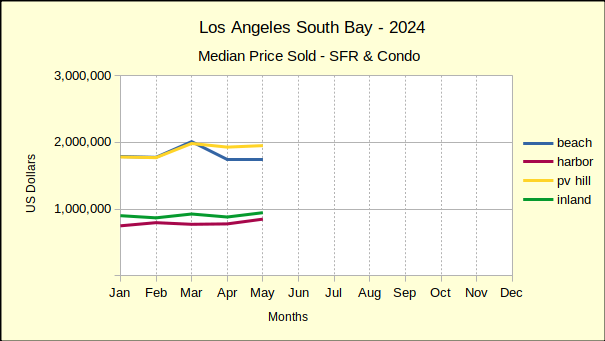
Palos Verdes Homes Top the South Bay Market

Home sales on the Palos Verdes Peninsula chalked up an impressive set of statistics in October. Comparing the October 2023 sales to October of last year showed a stunning 26% increase in sales volume beside an equally impressive 11% increase in median price. At the opposite end of the spectrum the Beach Cities October sales volume fell 19% from 2022, while the median price dropped 14%.

Elsewhere across the Los Angeles South Bay volume and prices were mixed with the general trend leaning toward decreased number of homes sold and prices struggling to stay level with last month while often slipping below.

Year To Date Sales Continue to Drop

In between the highs and the lows real estate activity in the South Bay has been mixed for the months of August through October. While many commentators are cautiously hopeful, it must be noted that year to date comparisons continue to show significant declines in the number of homes sold, with an average drop of 18% from 2022 for the first 10 months of the year. Likewise, median prices are falling for the January through October time frame. For example, median prices on the Hill were up in October, but have fallen 4% year to date compared to last year. Similarly the Beach area median is down 3% and the Harbor area is off 2%.

Sales volume is clearly down. By this time in 2022 sales were at 6700 units versus 5500 this year. Many buyers have been “priced out of the market” and many sellers are resisting the idea of “prices going backward.” The result has been a lot of deals not being made.

Year to date, the deals that have been consummated are still generally at median prices above last year, however the most recent three months have shown at least half of sold homes required price reductions to make the sale. With winter setting in, we expect continued reductions in both the volume of sales and in the prices of sold homes.

Home Sales at the Beach Hit a Wall

Throughout the year real estate in the Beach Cities has maintained spotty growth. Sometimes median prices improved, sometimes sales volume. But, October brought a wall of red ink for the Beach. Month over month sales volume plummeted by 27%, while the median price dropped 5% from September when it was flat at $1.7M.

Year over year transaction volume dropped 19% from September of 2022. The median price fell 14% for the same period.

Looking at the year to date statistics showed more declines with sales volume for the first 10 months of 2023 coming in 16% below that of 2022. At the same time, the median price was off by 3%.

In prior downturns the Beach area has been among the last to respond to market negativity and one of the first to recover. If the pattern repeats, sales at the Beach will continue to show predominately negative numbers for the late fall and winter months. Most chroniclers project a return to positive market conditions in late 2025 or early 2026 in general.

Harbor Volume and Prices Turn Upward

Home sales in the Harbor area moved from all negative last month to mostly positive this month. Sales volume on a monthly basis jumped from 24% down in September to a 7% increase in October. Similarly, the month to month median price went from -1% to +1% in October.

Annually, the number of homes sold in the Harbor area increased by 6%, a significant change from having fallen 26% in September. The median price came in at $750K, up by 7%.

That’s only the second time this year the Harbor area median price has come up into the positive range when compared to 2022. Overall, the year to date median sits at $739K, 2% below last year’s number of $756K. Sales volume for the Harbor is off 20% year to date. The number of homes sold for the first 10 months is 2824, compared to 3535 in 2022.

Palos Verdes Homes Star in October Sales

Home sales on the Hill came in at 63 homes sold with a median price of just under $2M. Month over month that represented a 13% growth in sales volume and no measurable change in the median price.

On an annual basis October sales were up 26% over the same month in 2022. This year’s median price was up by 11% over last October.

While these numbers reflect impressive growth it’s important to remember that the number of transactions on the Palos Verdes peninsula is quite small, which results in some dramatic percentile shifts. For example, the annual percentage of change in the median price so far this year has ranged from a low of -29% to a high of 17%. By comparison, the Harbor area where monthly transactions number in the hundreds, has an annual range from a low of -11% to a high of 7%.

On a year to date basis, the Hill showed a more common face with the January through October sales volume down by 20% from 2022. During the same time frame median prices fell by 4%.

Inland Area Sales Volume Down, Prices Up

In a surprising turn of events, the Inland area has shown an increased median price for both the monthly and for the annual sales figures. The median price came in at $917K this October, which was 2% above the September median. On an annual basis, the median was up by 7% over the $860K of October 2022.

With 116 units sold for the month of October this year, the sales volume was 11% lower than it was this September. The monthly decline was even greater than the drop of 9% for the year over year comparison to last October.

Year to date, the Inland area has outperformed the balance of the South Bay on median price and on sales volume. For January through October there is no discernible change to the median price from 2022 to 2023. In the same time frame the sales dropped by 14%, the smallest decline of the local areas.

Beach=Manhattan Beach, Hermosa Beach, Redondo Beach, El Segundo
Harbor=Carson, Long Beach, San Pedro, Wilmington, Harbor City
PV Hill=Palos Verdes Estates, Rancho Palos Verdes, Rolling Hills, Rolling Hills Estates
Inland=Torrance, Lomita, Gardena

Photo by Julianne Takes Photos on Unsplash
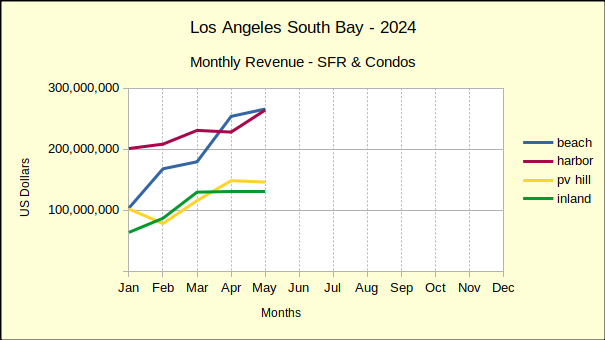
Local Real Estate Meets the Inflation Fight

In August the South Bay real estate market showed some slowing of what has seemed a continuing slide into negative numbers. Closed transactions showed a partial recovery from the July report of declining sales and declining values, across both the past month and the past year.

August showed positive growth over July in sales volume except for transactions on PV Hill. Median prices compared to July were down except at the Harbor.

Annual statistics were similarly mixed with notable increases in sales at the Beach and Inland areas. Median prices compared to August of last year with modest increases in the Beach Cities and Harbor Area.

Beach Cities Show Strength in August

Sales volume at the Beach seemed surprisingly strong, however a look back in history reveals weaker than normal sales in July of this year and August of last year. The 127 units closed in August was much more in line with expectations, than the 91 sold in July or the 103 sold in August of 2022. Sales in a normal year would come in at about 125-135 units, showing that the Beach Cities are currently close to a normal number of transactions for the month.

Median prices came in negative compared to July, though less than a 1% drop. Last year’s weak sales led to an increase of 2% in median price this August, despite an overall downtrend for the year. Hypothetically, assuming the Federal Reserve policy of 2% growth, median price at the Beach should have been about $1.62M in August. As the market stabilizes from the pandemic, the median has steadily dropped from a high of $1.76M in April to the August actual of $1.67M..

Year to date transactions showed a continuing decline in sales volume (-19%) and median price (-4%) versus 2022. Likewise, sales volume was off 31% compared to the baseline year 2019. Median price is still coming in positive compared to the baseline, up 28% from 2019.

August Harbor Area Sales Climb

Looking at August versus July of this year shows Harbor area sales volume up a healthy 22%. While the month over month numbers are positive, sales are off 8% compared to the same month last year. For perspective, note that in 2019, the last normal year of business, there were 436 homes sold compared to 328 this August. Using that reference point, monthly sales are off by 25%.

Median price for last month was $751K, up 1% from July and up 4% over August of last year. Going back to 2019, the median was $575K, giving the current median price an increase of 32% over our baseline year. At the same time, the high median for this year was in June at $772K, and the lowest was $675K in February.

Year to date, the number of homes sold at the Harbor is down 22% from last year and likewise 22% from 2019.That decline in sales volume is driven by the increased median price which is up 32% compared to the first eight months of 2019. Being generally an entry level market, the Harbor area has shown a drop in sales every month of this year. Likewise, the year over year median price has dropped every month until August.

Palos Verdes Volume and Prices Drop

Sales and median prices were mixed everywhere in South Bay except for the PV Hill. All the statistics for August went down on the Hill. Month over month saw a drop in sales of 2% and decline in median price of 6%. Both are modest changes by comparison to most of the South Bay, but are indicative of the direction of the market in general.

Looking at August of last year compared to August of 2023 shows a dramatic decline of 36% in sales volume. Closed escrows dropped from 77 units last year to 49 this year. Annually, median prices dropped 6%, the largest drop of the four areas.

It’s important to note that in 2019, which being the most recent ‘normal’ year of business, August saw 90 units sold on the Palos Verdes peninsula. Monthly sales volume has dropped off by nearly 50% from the reference year.

Year to date through August shows sales volume down 25% from last year, with median prices falling by 10% over the eight month period. Comparing to 2019 year to date volume is off 21%, while median price comes in at 32% above the 2019 figure.

The disparity created during the pandemic is gradually leveling out as the year goes on. Palos Verdes median prices have fallen six out of eight months this year. The same has been true of the balance of homes sold in the South Bay.

Sales Up, Prices Down for Inland Area

From July to August transactions in the Inland area climbed 15%. Simultaneously, median prices fell by 2% for the month. January kicked off the year with a 16% increase in the median price. February saw that pricing promptly reverse and fall 14%. Since then sales volume has gradually dropped each month and median prices have shifted into a pattern of decline.

Year over year pricing numbers are nearly identical with a 15% jump in median price for January, followed by dropping prices every month since. Similarly, most of 2023 has seen falling sales for homes in the Inland area. So far, August has been the only month with growth in closed transactions.

Year to date statistics compared to 2022 have been much the same with the number of homes sold dropping by 17% and the median price down 2%. In keeping with the rest of the South Bay, comparisons to 2019 reflect sales falling 18% while the median price remains 32% above what it was before the pandemic.

Where Is the Real Estate Market Going?

The number of homes being sold has consistently fallen this year. Likewise, the median price of sold homes has generally been falling since the beginning of the year. The driver behind this has clearly been mortgage interest rates rising from under 3% to over 7% in a matter of months. The Federal Reserve managers have been very upfront about continuing these rates into the foreseeable future.

Most estimates state that about one third of potential buyers can no longer afford to continue with their purchase plans. We see a continued decline in the median price, as sellers find it impossible to sell at the price points reached during the pandemic. When ‘’time on market’ increases without a sale, sellers who ‘must sell’ will gradually lower prices.

Polls are showing those who aren’t compelled to sell are finding it hard to let go of mortgage interest rates below 5%. This reluctance, combined with the sliding median prices, will contribute to more stagnation in the market.

Photo by Carl Clark

Price Declines Forecast Through 2025

Median Home Prices Falling

Year to date through July, the gross revenue for South Bay is a mere 3% above that of 2019. At the same time, sales volume, the number of homes sold, is 23% below the sales of 2019. By most standards, 2019 was the pinnacle of real estate business prior to the turbulent years of the Covid pandemic.

Many sources compare current business to that of the pandemic years, partially because it’s easy and partially because the “numbers look better.“ Undeniably, the statistics do look more favorable, however, this analysis takes comparisons beyond the normal “last month” and “same month last year” to include 2023 versus 2019. This allows our readers to see 2023 in a historical context and to more readily recognize the unfolding recession.

While median prices are still above those of 2019 right now, we project the median prices will also drop below the 2019 level before this recession ends. On a month to month basis, prices are falling approximately half the time. On a year to year basis, 2023 prices have dropped below 2022 medians 82% of the time. Median prices for June and July of 2023 fell below 2022 in all four areas both months. Buyers and sellers should anticipate the bottom of the recession in late 2024, or possibly 2025. Normal growth should return in 2026.

The July report from the Federal Reserve Bank (Fed) notes that inflation is expected to continue above the target of 2% through 2025. Accordingly, the Fed efforts to “restrain” the economy (meaning increase interest rates) will continue into 2025. The report indicates that while housing costs are slowing, they continue to increase at inflationary levels, necessitating further reduction.

In the meantime, buyers who are financially able should plan to acquire desirable properties at substantially better prices than will be available after recovery begins. Sellers who anticipate a need to sell before the economic turn-around, should look toward selling sooner rather than later, to minimize the impact of the down-trending market.

Beach Cities Summer Market Fizzles

From June to July the number of homes sold in the Beach Cities fell 27% and those sold for a median price of 2% less. Some of the decline in sales is attributable to fewer homes available, as sellers hold properties off the market in hopes of improving conditions. Even more is a result of buyers who have lost significant purchasing power as mortgage interest rates have rocketed to over 7%.

Compared to July of 2022, the number of homes sold this July dropped 22% with a decline in median price of 4%. This set of statistics is somewhat deceptive in that last July the real estate market was still in the early stages of the downturn. As the current year progresses, year over year figures will demonstrate the slide more clearly.

Comparing the first seven months of 2023 to both 2022 and 2019 (the most recent year of business not impacted by the pandemic) shows the drift of sales and prices. The number of homes sold fell 24% from 2022 (802 homes) to 2023 (607 homes), while it was down 35% from 2019 (930 homes). The Fed dropped mortgage interest rates to essentially zero during the pandemic to keep the general economy afloat, which resulted in rapid price escalation which ultimately made purchasing a home unaffordable for about 25% of potential buyers. Then to control the resulting inflation, the interest rates jumped up around the 7% mark, which further slowed the real estate market by “pricing out” another 10-15% of buyers. With fewer buyers and stagnating prices, sellers are reacting by pulling property off the market and delaying planned sales.

Median prices fell 4% from 2022 and are still 28% above the median price of Beach Cities homes in 2019.

Harbor Area Sales Volume Plummets

Sales volume in the Harbor area has held up better than the Beach, possibly because median price has taken a greater hit. On a monthly basis, 24% fewer homes were sold (269 in July versus 353 in June). Comparing July of 2023 to July of last year, only 18% fewer closed escrow (269 versus 329).

Generally being an entry level market, the Harbor area tends to react faster to changes in market condition. More upscale neighborhoods frequently “stick to the price” for a longer period of time when markets are declining. Month to month median price dropped 4% in July to $565K. For July of 2022 versus July of 2023, the median fell 5%, from $780K to $740K.

Year to date through July, sales volume was off 24% from last year. Median price was down 4% when compared to the same period in 2022. Looking back to 2019, the number of homes sold during the first seven months of 2023 dropped by 21%. Median price for the same time frame shows up at 32% higher than 2019. Given the median price dropped 4% over the past month (from $772K to $740K), it’s reasonable to project the Harbor area median will end the year near $600K, as it was in 2019.

PV Hill Shows Volatility

Month over month, the number of homes sold on the PV Hill fell from 79 units in June to 50 in July, a decline of 37%. At the same time, the median price dropped 10%, ending the month at $1.8M. This despite a high sale of $12.5M, up from the high of $10M in June.

Year to year, July volume dropped 6% from 53 units in 2022, while median price plummeted 18%, from last year’s $2.2M. Palos Verdes is a unique community with large homes on large lots, many of them highly custom. Combined with the small overall number of homes, these properties truly need to be assessed on an individual basis for realistic projections.

Comparing cumulative sales data for January through July, volume is down 23% and median price is down 17% versus last year. Going back to the stable year of 2019, the number of sales is down 16% while the median is up 34%.

Interestingly, if the Fed’s annual 2% inflation target is added to the years between 2019 and 2023, the median on the Hill would be $1.5M today, instead of $1.8M. Under those circumstances, it would only take a decline of $300K to erase all gain from the past three years. Not a comforting thought for anyone who purchased recently.

Inland Cities Most Stable

The Inland area typifies a classic “middle of the road” performance in the real estate world. Generally the homes are everyday family properties, the sales trends are at the middle of the current South Bay market, and everything seems to happen with minimum drama. So there is little surprise at the minimalist 19% decline in monthly sales volume, the lowest of the South Bay. Likewise there is no shock the Inland cities came in with the lowest monthly price decline, a mere 1% below June.

Similarly, the annual sales volume showed July of 2023 only 14% below last July and the median price just 1% below the same month a year ago.

Year to date for the first seven months of 2023 compared to 2022 looks much the same. The number of homes sold dropped by 22%, 799 in 2023 versus 1021 last year. The median price fell 2% to $868K from $883K. Looking back to the 2019 sales volume for the same time period, the Inland area is off by 18% for the current year. Much like the rest of the South Bay, the median price in 2023 ($868K) remains above that of 2019 ($662K) by 31%.

Photo by Alexander Simonsen on Unsplash