With the foreclosure moratorium ending, the only thing keeping many homeowners in their homes is a forbearance plan. Once those end, the effects on the market could be drastic. The good thing is that it’s easy to predict when that will happen, since forbearance plans have a designated end date. Many of them have already ended in the past two months, but we will continue to see more ending throughout the rest of the year.
One of the effects of a large increase in foreclosures or forced sales is plain to see, and that is an increase in inventory. With inventory being so low right now, one could be forgiven for thinking that’s what the market needs. But it most certainly is not. Let’s take a look at the reasons demand is so high right now: low interest rates, and the fear-of-missing-out (FOMO) mentality that buyers have when inventory is low. Interest rates are going back up now, so that’s no longer an incentive to buy. If inventory increases drastically, FOMO won’t be a factor either. Foreclosures and forced sales will remove all incentive to purchase while increasing inventory considerably, causing a full swing in the market. But that’s not all. People living in foreclosed-on homes aren’t just statistics; they are actual people, and their increased economic struggles will only make it more difficult to reach a recovery point in the recession.
Gov. Gavin Newsom recently signed two housing bills into law, SB 9 and SB 10. SB 9 modifies areas zoned for 1 unit to also allow duplexes. However, it isn’t without restrictions — it also limits the construction that would convert a single home into a duplex to homes that have not been rented out in the past 3 years, and only allows 25% of the external walls to be demolished if it is a conversion and not a new construction. SB 10 is aimed at helping local governments to streamline processes for allowing up to ten units on lots formerly zoned for SFRs, but only if the lot is over 8000 square feet.
One region in which these bills were highly contentious is Long Beach, which has 59,803 single-family lots. But the laws aren’t likely to change things as much as people think, especially SB 10. Only 4,609 are eligible for the provisions under SB 10, due to the lot size restriction. Moreover, the City of Long Beach is under no obligation to allow up to ten units at all — the bill merely streamlines the approval process, should they choose to. A significantly larger number of units could be affected by SB 9, but city officials expect that between 17000 and 28000 units would be ineligible due to the rental restrictions, and there’s no guarantee that the eligible units would be converted. In addition, ADUs are already allowed, and the biggest difference between an SFR-plus-ADU combination and a duplex is the size of the units.
There are a plethora of articles about what to do before buying a home, especially for first-time homebuyers. But has anyone ever told you what you shouldn’t do? Of course, some of these are just a different way of writing the same things you’ve heard before. But others are advice you may not have been provided.
The biggest mistake to avoid is financing a big-cost item, such as a car, immediately before looking to get a home loan. Lenders will see that, and they’ll know you’ve just taken out a loan and will have debts to pay. That doesn’t look good for your credit score or your debt-to-income ratio. Similarly, avoid maxing out your credit card debt, even if it’s on many smaller items. It doesn’t even matter if your limit is low; what lenders look at is the percentage of your limit that is used. Another thing that may make lenders look more closely is a change of jobs. If you’ve simply moved from one company to another in the same occupation, you’re fine. But if you switched career paths or lost your job entirely, that looks like instability. All this advice continues to be relevant throughout the purchasing process — don’t make any big financial decisions until the transaction has closed.
Some other mistakes relate more specifically to real estate and not simple economic decisions. Many buyers neglect to get a preapproval before they start looking, thinking it’s a long process that they don’t want to get involved in before they find something. Yes, it does take time, but if you wait, that house you found may not be available anymore by the time the process is finished. Not only is this something sellers look for, preapproval will help you figure out what you can afford. It makes the search a lot easier if done ahead of time. Don’t try to expedite the process by just going to the first lender you find, though. The rates quoted in the news are always averages. Not every lender is going to have the same rates, and the rate isn’t the same for every situation. And contrary to popular belief, your personal bank doesn’t owe you the best rates just for being their customer. Once you know what you can afford, figure out how much your down payment is going to be. Don’t make the mistake of thinking it has to be 20% or more. That is frequently a good idea, since it avoids private mortgage insurance, but it’s still possible that paying the PMI and putting less down is a better financial decision for you. Plus, it’s almost never a good idea to put off buying solely because you can’t afford to put down 20%.
The 2021 housing market has experienced heavy competition from buyers, with most sellers receiving multiple high-priced offers. The peak was back in April, with nearly three-quarters — 74.3% — of listings generating at least two offers. While the numbers have been dropping off, with July’s percentage at 62.1%, it wasn’t until August that it fell just slightly below the prior year’s percentage for the month, at 58.8%.
The percentage is still over half, but that’s generally pretty normal. The current numbers are to be expected as far as seasonal variation. What’s even more indicative of a return to normality is the drop in number of offers and speed of sale. Agents are noticing decreases from 25-30 offers to 5-7 offers. In addition, a bit fewer offers are above asking price.
That’s just national averages, though. There are still some highly competitive markets, and the most competitive ones are actually becoming more so. 8 of the 10 most competitive markets actually had an increase in bidding wars between July and August.
A significant number of homes don’t have a basement at all, but there are more distinctions than simply whether or not there is one. There are actually three different methods of basement construction, and which method is used could affect durability and maintenance requirements. The three types of construction are concrete, block masonry, and precast panels.
Concrete basements are the most common and certainly have some advantages over the other types, but also have some disadvantages. Concrete basements are the most resilient, so are very unlikely to cave in. They are also fireproof. Though they are water resistant, they’re not entirely waterproof so it’s important to maintain the humidity levels and check for mold or mildew. A concrete basement will improve a home’s property value.
The least expensive type of construction is block masonry, composed of connected cinder blocks or masonry units. Unfortunately, that also means it has the fewest advantages. One thing it definitely has going for it is that it’s by far the most waterproof construction. Block masonry is still highly resilient, but for full durability it needs to be reinforced with steel rebar.
Precast panel basements, actually made in another location before being transported to the construction site, share some qualities of both the other types. Like block masonry, precast panels are waterproof, but like concrete basements, they require maintenance to stay that way. Precast panel basements can be susceptible to pest infestations, but this can be prevented with boric acid treatment. Fortunately, the individual panels don’t have any issues with resilience; it’s only the joints that need to be maintained.
Title insurance is one of those additional costs of purchasing a home that, unlike many other fees, is actually optional. Most people don’t want to deal with additional fees and ignore title insurance. That’s not necessarily a good idea. If you can afford to pay the fee, it’s a good investment.
There aren’t very many options available for homebuyer protection, and title insurance is one of the best. Title insurers have the best access to records and most experience detecting problems of any form of homeowner protection. Fraud is on the rise in the electronic age, and title insurance protects the homeowner from both fraudulent claims and losses. You may also not realize that title insurance, unlike most forms of insurance, is just a one-time charge. You won’t be saddled with monthly or annual payments.
There are many similarities and also many differences between the current recession and the Great Recession of 2008. Two of the core similarities — and the ones that define a housing bubble — are that prices are accelerating faster than purchasing power, and that there are changes in consumer values. While legislation and shifting values have addressed some of the issues that contributed to the Great Recession, most notably subprime lending, ultimately the crisis was a relatively natural economic response to the events that triggered it and followed a normal boom-bust-rebound cycle. The 2020 recession is somewhat of a reflection of this, though the specifics differ. The economy was already headed towards a natural downturn in the cycle, but the process was sped up by the COVID pandemic.
That’s where the similarities end, though. While nearly everything is ultimately tied to the economy in some way, it’s the pandemic, more so than economic conditions, that prompted valuation changes. Preference for larger homes and home entertainment, rather than homes closer to work and out-of-home entertainment, will probably continue as long as work-from-home remains a common practice, which will likely last a while. It’s true that people are leaving large cities and moving to cheaper areas, but this is more so out of necessity than desire. Peoples’ tastes have actually become more expensive, even if their wallet isn’t any larger. An economic downturn wouldn’t prompt this behavior. The only reason this isn’t currently sustainable is that the market hasn’t recovered yet. Once it does, probably around 2024-2025, it’s likely that the bubble will slowly deflate rather than explode.
I’m sure some of you haven’t heard of the term bioprinting. It’s a relatively new concept, combining stem cell research with 3D printing to print biological matter. Earlier this year, ribeye steak was printed using this method in Israel. The latest development out of Japan is a more complex cut of meat — Wagyu beef, known for its intricate fat marbling. The team at Osaka University has managed to perfectly replicate the look of Wagyu beef using 3D printed muscle and fat tissues, and their new methods provide a more accurate texture.
There’s still more research to be done, though. Though it certainly looks and feels like Wagyu beef, no one actually knows whether or not it tastes like Wagyu beef, or is even edible at all. More studies will be needed before the regulatory agencies in Japan will greenlight testing the cooking and consumption of bioprinted meat. In addition, the goal of sustainability is a long ways off with the cost of production being so high.
Fannie Mae keeps track of the Home Purchase Sentiment Index, or HPSI, each month. From July to August, the change in total value was negligible, from 75.8 to to 75.7, though it’s down 1.8 year-over-year. But the HPSI is a composite of six different categories, and none of them were without change. Three categories increased and three decreased.
Notable changes were an increase in those who believe it’s a good time to buy and a decrease in those who expect home prices to increase over the next 12 months. While the number who think it’s a good time to buy is still not a majority, it’s approaching a third at 32%. In July, only a bit less than half — 46% of respondents — expected home prices to increase. In August, this dropped to 40%. Only 24% of respondents believe home prices will decrease.
The Federal Housing Finance Agency (FHFA) established the First Look Program back in 2009, aimed at promoting neighborhood stability by facilitating occupation of real estate owned (REO) properties by owners. The program created a special time period during which prospective owner occupants, public entities, and nonprofits would have exclusive rights to purchase properties owned by Fannie Mae or Freddie Mac, before investors would have access. Until now, this time period was 20 days. On September 1st, the FHFA extended this period to 30 days. They deemed this move essential during a period of low supply, to reduce the level of competition prospective owner occupants have to contend with.
In July, the Pew Research Center conducted a survey that asked the following question: Would you prefer a community where homes are larger, farther apart, and farther from amenities, or smaller, closer together, and closer to amenities. The answer was 60% for the former and 39% for the latter. When they conducted a similar survey in 2019, before the pandemic, the numbers were significantly closer: 53% to 47%.
Because each of the two responses involves three separate categories, it may be difficult to tease apart which one respondents were most focused on, or if they were considering all of them equally. The survey didn’t ask that question, and it’s unclear why the three separate factors were lumped into one question. Still, we may be able to guess what changed since the pandemic. It’s already established that the advent of work-from-home has caused an increase in desirability of larger homes, with room for a home office, larger kitchen space, and additional personal entertainment space. For a time, lockdowns and increased reliance on delivery services also meant that people weren’t really going to stores or restaurants anyway, so they didn’t care how far they were. It’s possible that social distancing has conditioned people to want their homes farther apart as well, but this seems either unlikely or a negligible factor.
For a few decades, the average period of time that a family stays in their home before selling has hovered around six years. However, in recent years, this number has climbed up to around nine years. Why the increase, and what does this mean for the housing market?
There could be multiple factors contributing to the increase, but a couple are fairly easily understood. The market crash in the late 2000s led to a price decrease, which encouraged sellers to wait longer for home values to go back up. Even once prices starting increasing again, not everyone was confident in the stability of the market or their own personal economic stability. Another reason is that the largest market group is currently Millennials, who have a relatively low homeownership rate, in no small part due to various economic factors largely outside their control. Not being homeowners, they aren’t able to sell, so they have no impact on the average length of homeownership.
Average length of homeownership is an interesting statistic to follow, but since it hasn’t changed in so long, it’s not entirely clear what the impact could be. One could guess that it would have a negative impact on available inventory. This could be a problem for anyone looking to buy, but also could further contribute to increasing average length of homeownership for people who don’t actually want to stay in their current homes, but have no option.
Credit information is valuable to hackers looking to open accounts in someone else’s name. If you don’t need to access your credit report yourself in the near future, one action you can take to avoid this is a credit freeze. Not everyone is aware that any consumer is allowed to freeze their own credit reports, and potentially their dependents’ credit reports. And it’s now easier than ever, since it recently became free to do, as opposed to incurring a fee.
The process doesn’t take long to do, and is easy to reverse if needed. Any of the major credit bureaus — Equifax, Experian, and Trans Union — must freeze your credit if requested within one business day. Unfreezing your credit if necessary only takes up to an hour, but you’ll need to contact all three major credit bureaus rather than just one.
The US Senate has now passed a bipartisan bill aimed at improving infrastructure. The bill details budget investments for repairs, updating, new construction, and weatherproofing. Much of the money is aimed at roads and bridges, and various different budget plans all focus on clean environmental efforts, such as clean water, clean energy, and electric vehicle chargers. The bill doesn’t have many provisions that explicitly focus on housing, but improving infrastructure will have an indirect impact.
The most significant impact on the housing industry will be in job creation. While some of the positions that are being funded already exist, others don’t and will need to be created. This means more people will need to be hired. The slow recovery of the job market is the primary reason our recovery from the recession has been so drawn out. The infrastructure bill will hopefully not only establish a better infrastructure for the future, but also create more jobs now to speed up recovery. With a recovery of the job market, housing market stability will soon follow.
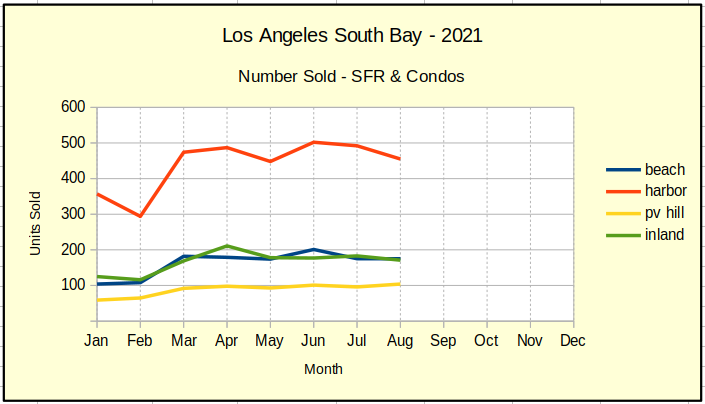
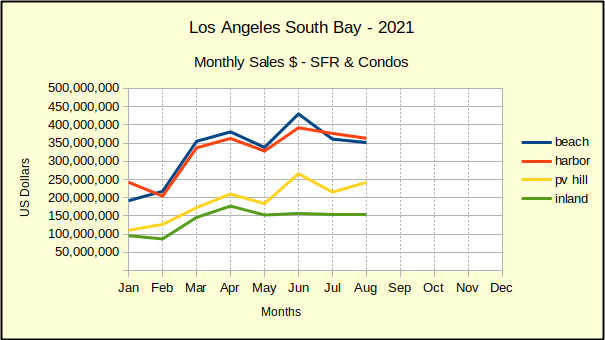
Back in 2019 the first eight months of the year saw 5,706 homes sold. During the same period in 2020, in the early response to Covid-19, sales dropped off by 12% to 5,003. As the market came out of the Covid doldrums in 2021, sales took a dramatic 57% jump. It’s most easily seen looking at the sales volume for the Harbor area in March on the chart below.
Part of that jump was the approximately 700 sales which didn’t happen in 2020. We don’t know how many of those “deferred” transactions have jumped back into the market. As of August the South Bay sales were at 6845, a 20% increase over the 2019 sales for this point in the year.
Seeing that a huge part of the March increase came in Harbor home sales tells part of the tale. The biggest piece of that market in recent months has been entry level or first time home buyers. Closely following are investors in small income properties.
Stories from the street imply that the growth in ADU additions and conversions has had an out size impact on that market as well. Both homeowners and landlords benefit from having additional living spaces.
For right now, the pandemic appears to be fading, which would tend to boost sales. Similarly, the low mortgage interest rates continue to support the market. At the same time we’re moving into fall and winter, when sales typically slow. August showed just a hint of a seasonal downward movement. September should be a directional indicator.
Sales Prices Up
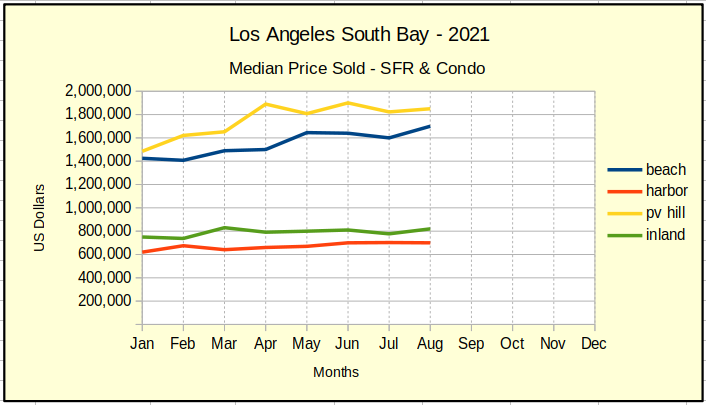
That jump in sales volume was accompanied by a bigger jump in the median price of the homes selling. Pent up demand and low interest rates combined to create bidding wars and drive median prices up. As of the end of August, the median price of a home at the Beach was $1.7M. That number was $1.5M in 2019 and $1.4M in 2020.
Median prices on Palos Verdes trended about the same at roughly $100K more per unit.The Inland cities and the Harbor area both showed mosest increases in the $50K neighborhood.
Area Sales Dollars Slowing
The monthly sales value of homes sold across the Los Angeles South Bay for August declined in all areas except the Palos Verdes Peninsula.
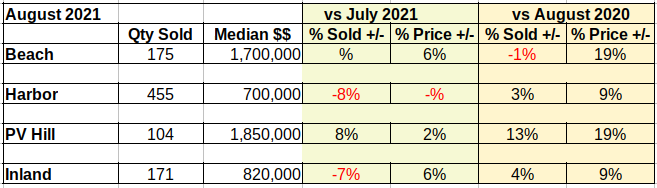
Compared to July, the number of sales on the Hill increased 8% in August, with a 2% increase in median price. That translated into a $150M increase in monthly sales since the first of the year.
Activity in the Inland cities has been stable for three months already, having risen about $50K per month since the first of January.
Monthly sales at the Beach and in the Harbor area pulled back for a second month in succession. Looking at the blue line for the Beach, we see a sharp drop in July which softened considerably in August. The Harbor area shows a steady decline over the same period.
As of August monthly sales totaled ~$150M higher than the beginning of the year at the Beach. During the same period monthly sales totals were up ~100M. As we move into the fall and winter season these numbers should slow somewhat.
Statistics – by Month, by Year
Interestingly, the number of homes sold in the Beach cities was unchanged from July, while the median price increased 6% at the same time.
There were 175 homes sold in both months. So how did Beach homes grow from a median price of $1.6M to a median price of $1.7M in one month? In July, 27 of those properties sold below $1M. In August, only 20 sales closed escrow for under $1M. The entire market simply moved up, pushing the median price up $100K in one month.
On a month to month basis, prices are holding or increasing across the board. At the same time we’re seeing slowing or flat sales everwhere but Palos Verdes. Continued slowing for the season is to be expected.
There’s still a lot of buyer traffic at open houses, but sales volume is slowing and buyers are showing price resistance. There’s also some chatter out there about what’s beginning to look like inflation in the real estate market. My crystal ball is showing a slow steady ride through the next month. It’s all cloudy after that.
Many renters feel like they will always be stuck renting. For some of them, that may unfortunately be true. But for those who are able to afford to buy but are afraid of mortgage debt, you may actually be better off buying a home. It’s true that sale prices are still increasing, but so are rent prices, which hit new highs in July in 40 of the 50 largest metro areas. The median rental price in the US is $1607 as of last month. The median mortgage payment for a starter home is about 15.5% less than that.
Of course, there are many factors that can adjust these numbers. Rent prices and home prices both vary depending where you live. It may not be easy to find a starter home in some neighborhoods. In areas with rent control, your rent may be relatively low if you’ve been in the same place for a while. Mortgage payments depend on your down payment as well as the home’s price. If you’re a renter, it’s not a guarantee that you should go out and look for a home right now, but you certainly shouldn’t dismiss the idea.
When budgeting monthly costs, homeowners generally take into account mortgages, real estate taxes, and homeowner’s insurance. Unfortunately, they all too often forget about maintenance and repair costs. It’s a good idea to set aside 1-3% of the home’s value for repairs and maintenance. You may not always know when you need repairs, but you do need to be prepared to pay for them.
Regular maintenance can also help lower the costs of repairs. Major repairs are less likely to be necessary if you can catch problems before they get too big, and you’ll probably end up paying more for even a single major repair than for regular maintenance and minor repairs across the year. A few things you should do every month are check HVAC filters, look for water leaks, check the vent hood in your kitchen, ensure carbon monoxide and smoke detectors are operational, and look for cracks in the foundation. All of these can be done yourself, and if there’s no issue, you don’t need to pay anything.
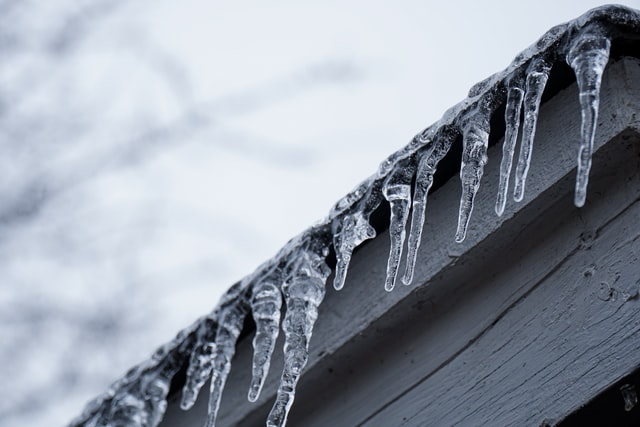
Here in California, we don’t have much in the way of seasons, but there are still certainly cold or rainy areas of the state. If your area freezes in the winter, look for ice dams on the roof, inspect for gaps under doors and windows, and consider protecting your AC unit from snow and ice if necessary. Your windows and doors should also be inspected during the spring, if your area gets a lot of rain. You should also get your HVAC and roof professionally inspected. Take care of any clogged gutters as well.
Our recovery from the 2020 recession has been described as a K-shaped recovery. Generally speaking, this means that the recovery occurred at starkly different paces for different segments of the population. More specifically for 2020-2021, while wealth decreased for many groups, it actually increased for those who were largely unaffected by the circumstances of the recession — in this case, primarily job losses and lockdowns. Many of those who were able to keep their jobs and continue to work from home during lockdowns enjoyed their reduced daily spending and lower mortgage rates.
This led to a increase in demand across the board, but notably in one sector of the market: vacation homes. Those who were affluent enough to possibly purchase an additional home were encouraged to do so by low mortgage rates and increased savings, and higher-income jobs are actually more likely to be able to be done from home. In California, the trend was first made obvious in October 2020, which saw a 120% increase in second-home demand from the prior year. The trend continued, though, demand for second homes increased 178% between April 2020 and April 2021. Rising prices dampened the effect, but it only slowed when lenders tightened restrictions on mortgages for second homes and lockdowns ceased being much of a factor.
Much of California, especially Central and Northern California, is experiencing a major drought much like the one from 2012-2016. Temperatures are going up and precipitation is going down. While water usage is still below 2013 levels due to lasting changes in water use habits from the last drought, conditions aren’t currently improving. It’s not precipitation levels that directly affect how much water a community receives, though. Some of the communities struggling the most actually have more rainfall than others but are lacking the infrastructure to account for drought conditions, and possibly the money to build said infrastructure.
Speaking of building, the drought is also affecting home construction. At a time when lumber prices are just starting to slip back down, a new threat emerges. And this one hits even the wealthiest of construction companies, who didn’t necessarily mind high lumber prices. Under drought conditions, some areas have placed restrictions on new construction to ensure that they meet water availability standards, and several areas simply never will meet the standards. The city of Marin is considering a move that would effectively ban all new construction for a time — temporarily banning all new water hookups. The legislation isn’t aimed directly at builders, but of course, all new constructions do require water hookups.
On average, the smaller a home, the less expensive it will be. So you’d think that buying a tiny home — one under 600 square feet — is going to save you a lot of money. Well, that’s only true if you’re looking at just the total purchase price, which is $52,000 on average. That’s 87% less than the average price of a typical home. However, most tiny homes are actually significantly smaller than 600 square feet, averaging only 225 square feet. This makes them about 62% more expensive per square foot than your typical home.
Of course, price per square foot only matters if you actually need the square footage. But at only 225 square feet, you probably do. For comparison, the typical bedroom is about 132 square feet — more than half the size of an average tiny home. Even the smallest of kitchens is usually just over 100 square feet. That leaves absolutely no room for storage, and you’re going to need to do your laundry at a laundromat. Many tiny homes are also completely off-grid and may even lack a sewage system and utilities. Not only is this highly inconvenient, the expenses can rack up, and they’re costs you aren’t likely to be able to easily recover by selling the home later.