Everyone knows college is expensive. Tuition costs aren’t the only reason. Room and board can also be rather expensive. In fact, it’s quite possible that it would be more than the mortgage payment on a new house. That means it may actually be financially beneficial to just purchase a house for your college kid, instead of sending them to the dorms or campus apartments.
Of course, this depends on multiple factors. Of course you’ll need to take into account the actual cost of room and board as well as expected mortgage payment for the property, but there are other financial considerations as well. You’ll need to be able to afford a down payment, first of all. Are you able to turn it into a profit opportunity by renting out some of the rooms? If so, do you need to hire a property manager? Once your kid graduates, are you going to keep the house for them, sell it, or continue to rent it out?
There are additional considerations that aren’t necessarily even financial. How far away from your kid do you want to live? Maybe you should consider moving with them, if that’s a possibility for you. Is giving your kid the responsibility of owning a house a good learning opportunity for them, or is it just going to result in disaster? Are you sure that they will continue at this school, or is it likely they’ll either drop out or transfer? This option certainly isn’t for every family, but it’s a strategy that most families don’t consider.
If your home is a bit on the smaller side, it may start to feel cramped once you get all your furnishings and decorations in. You also can’t forget to leave space open for people to walk though. There are a few solutions that can help you make the most of your space without hyper-focusing on space efficiency.
The first is a huge one — decorative storage space. This serves dual purposes by getting clutter off the ground and into a more compact area, without sacrificing aesthetic. You can find both functional and appealing furniture such as ottomans or coffee tables that feature hidden drawers to store things such as the TV remote, coasters, or a few books. Speaking of books, that doesn’t have to be the sole purpose of a bookshelf; it can be used to store any manner of items.
You shouldn’t exclusively focus on ground-level decoration, though. Decorate vertically to save room for foot traffic. These can be things such as paintings, photos, or tapestries, but they can also be functional, such as wall-mounted cabinets, or bookshelves that are tall rather than wide.
Another thing you can change to make your home feel larger doesn’t actually affect your space at all: color. Lighter colors give an illusion of airiness that can make even a small space seem less cramped. Painting every room white or beige, or even light blue or yellow, may not be the best idea unless you don’t have very many rooms. But you can still achieve the same effect by using furniture or décor in lighter colors.
Mortgage delinquency rate reached its lowest level since before the recession in June of 2021, at 4.37%. This is down from 7.6% in June of 2020, approximately a 42% decrease. The significant decrease can be attributed to both fewer new delinquencies as well as more mortgage holders catching up on payments.
That’s where the good part ends, though. A delinquency of over 90 days is considered a serious delinquency, and this category accounts for 3.2% of homeowners, or 1.55 million. This is a rather significant proportion given a total delinquency rate of 4.37%. And when forbearance programs end — which is slated to happen very soon, on September 30th — it’s likely that about two-thirds of these will still be behind on payments.
While everyone agrees the pandemic and recession were terrible events, there’s at least one good thing that came out of them: People are paying more attention to their credit. The sudden loss of jobs made consumers realize that in the event of a huge financial crisis, they’re going to be heavily reliant on credit. It also didn’t hurt that the government and media were both more focused on helping people learn to understand and utilize their credit better. As a result, the average FICO score increased by 8 points over the past year, up to 716.
There are a few ways of improving your credit score that people surely have been taking more advantage of. During lockdowns, some people had fewer expenses, allowing them to instead use their money to ensure that they made payments on time instead of letting them become late or missed payments. The stimulus bills also helped, letting people pay down existing debt in addition to not accruing additional debt. To top it off, the percent of hard credit inquiries, which temporarily decrease credit score, has decreased by 12.1%. A large part of this is because fewer new lines of credit are being opened, since a hard credit inquiry is required to open one.
Builder confidence plummeted in April 2020 after the start of the pandemic and recession. As time went on, they slowly regained confidence since demand was high. But demand was too high, and lumber prices accelerated upward, causing builders to hesitate again. Builder confidence is below the levels from the start of 2021, though higher than it was in mid-2020.
Now, lumber prices are starting to fall back down. But the reason for that is decreasing demand and rising interest rates, the exact opposite of what caused prices to rise in the first place. With demand decreasing and prices now on a downturn, builders still aren’t sure whether it’s a good or bad time to buy lumber. They’re expecting more vacancies, which means less need for new construction.
While mortgage rates are certainly not high, we can no longer safely call them low. The average rate for a 30-year fixed conforming loan is considered low when it’s below 3%. They’ve been slowly increasing. In the first half of August, it barely qualified at 2.99%. Now, the number sits at 3.06%.
As a result of increasing mortgage rates, demand for refinances has also decreased, dropping by 5% as soon as the rate passed 3%. Applications for purchase loans are less sensitive than refinance applications, and dropped only 1%. Despite the decreases in number of mortgage applications, the total dollar volume is still high, as a result of high prices fueled by heavy competition.
Most people want to buy a home that’s move-in ready, but if you don’t mind buying fixers, there are a couple of finance options for you. This doesn’t mean just anyone can renovate a fixer — there’s a lot that goes into it, and you need to make sure you have the know-how or the money to pay someone who does. It can be expensive, and the payout is in the return on investment. If that’s much later down the line because you also plan to live there, that’s okay if you have the money, but it’s important to keep that in mind.
If you don’t have the money, you still need at least a decent credit score. There are two kinds of mortgages designed with home renovation in mind. The 203k Mortgage, one type of FHA loan, is meant for a vast array of different construction projects. In order to secure one, though, you’ll need a credit score of at least 580. Fannie Mae has a loan type specific to renovations, called the HomeStyle Renovation Loan. The max borrow amount is 50% of the total value of the home, and it’s possible to borrow against projected equity. It requires that the renovation be completed within 12 months, and necessitates a credit score of 680 or higher.
If you’re struggling in the current competitive market, you may want to consider buying a new construction home. This isn’t going to be for everyone — new constructions are often more expensive and also come with additional up front costs, since it usually requires a 3% building deposit. Not to mention if you’re not hurting for money, competitive markets are going to be less of a problem for you. Still, if you play your cards right, a new construction home could be a great deal for you without much hassle, and is a much better investment later down the line as well.
Don’t be afraid to negotiate on a new construction home. It’s true that in a competitive market, you may be inclined to bid high to get the best chance at your offer being accepted. New construction is a much smaller market, and your chances are still good even if you bid lower. Alternatively, many new construction negotiations revolve around not price adjustments, but rather the construction materials and appliances. You still want to get ahead of the competition, though; builders aren’t as willing to make drastic changes if they’ve already sold multiple similar homes in the same neighborhood with their default materials.
Everyone wants their bathroom to be a place of comfort with a calm atmosphere. If you’re planning to renovate your bathroom before selling, or just want your guests to feel at home, consider current trends in bathroom design.
There are a few trends popping up recently. The new thing for sinks is the floating vanity. It’s not actually floating — it just may look like it is, since it’s sitting on top of a raised shelf instead of a large cabinet or a tall pillar. Thematically, nature is in. Botanical wallpaper, colorful flowers, bright leaves. And for those of you who want your bathroom to be your own private sanctum, and aren’t planning to show it to others, you can customize floor or shower tiles with your own prints.
Sellers do a lot of things to get their homes ready to show. Tidying messes, repainting walls, fixing deferred maintenance, getting their homes professionally cleaned, hiring photographers or videographers, and sometimes staging their home. What many of them forget to think about is the outside of their home. This is a huge mistake, as the outside is the first part of the home a prospective buyer will see when they arrive.
The first thing you should do is clear the area of objects lying around such as tools or toys, so that you have a clear space to work with. If you have a garden, remember to tend to it by removing weeds and pruning plants, or even getting fresh new plants. Be sure to replace mulch as well. If you have a lawn or shrubs, make sure they’re trimmed. Make sure your sprinklers are working and angled properly as well. Clean out your pool if you have one. Once everything is cleaned up, make sure to sweep any clippings and debris and wash down the driveway and walkways.
There are three primary ways to resolve disputes in business transactions, including real estate transactions: arbitration, mediation, and litigation. Arbitration involves no court activity at all except in choosing a neutral third party, and in fact courts must abide by arbitration even if the decision is erroneous. Mediation is similar to arbitration in that the initial decision is not made by the courts, but it allows to courts to intervene if a resolution is not found. Litigation involves a lawsuit in court.
Historically, businesses have favored arbitration since it was considered the quickest and cheapest method of dispute resolution, and having an arbitration policy protects them from many lawsuits. Now, businesses such as Amazon are quietly changing their policy. Arbitration has turned out more costly than they expected — primarily because they’ve been losing the disputes, in which case they are required to pay both sides. It’s also not always quick. And when the businesses are losing, they’re also not too hot on the decision being legally binding despite not necessarily being legally correct. Instead, mediation is turning out to be a cheaper, fairer, and sometimes quicker method of resolving customer disputes.
After an intensely competitive market, things are finally starting to slow down, with pending sales dropping by 12% nationwide since May. We’re not quite sure if that’s good or bad, though. Part of it can be attributed to seasonal variation — the market does start to slow heading into Q4 — but it never slows this much. It’s unclear whether the steep dropoff is because the market was already incredibly hot, or because buyer demand has lost its momentum. Either way, 2021 was decidedly not a normal year for the real estate market.
And it will continue to not be a normal year. Foreclosure moratoriums have ended, but people are still protected from evictions until September 30th. After that, expect a huge increase in supply as a result of distressed or forced sales. The good news is that rising supply will prompt decreasing prices. But demand is already decreasing, and we aren’t sure yet if it’s going to continue to decrease. People are going to be forced to sell, but may not be able to find buyers. Experts expect that demand will still be high enough in California to soften the blow, and we shouldn’t see prices plummet too far until 2023.
Though certain areas have always been at higher risk for certain types of natural disasters, only since climate change have people heavily prioritized climate risk as a factor in their search. Wildfires, droughts, and floods are becoming much more common, so people are avoiding these areas more. People don’t necessarily know how to research which areas are high and low risk, though. Fortunately, one real estate service, Redfin, is noticing the need and has begun publishing climate ratings.
The ratings aren’t from Redfin — they’re from ClimateCheck, a company which assesses future risk and change in risk on a scale of 0-100. They start with several different global climate models to project risk on a global scale. Then, they localize the data to specific areas by filtering the global risk through local weather patterns. ClimateCheck is now also sending that data to Redfin so that it’s easily accessible for people searching for a home. Of course, you can also visit the ClimateCheck website directly at climatecheck.com.
While it may seem like it was pandemic restrictions that forced the US further into the digital era, most people are actually not uncomfortable with it at all. In a recent survey, 81% of respondents trust online transactions. They don’t necessarily trust all online transactions, though, and they disagree on what exactly makes a transaction feel safe to them.
Predictably, some of the older generations aren’t aware of all the options available to them, such as online notorization services. Perhaps not so predictably, the older generations are actually the most likely to feel safe with digital forms of security. These include two-factor authentication (53% of older respondents), security questions (61%), and PINs (49%). The younger generations, on the other hand, would rather talk to an actual person (53% of younger respondents), even if the discussion is held remotely by phone or online, and don’t want to go through too many online steps to make a transaction go through (22%).
We’ve mentioned a few times that people now working from home more often have been making purchases to make their home more comfortable to live in. This doesn’t merely extend to smart technology, entertainment centers, or upgraded appliances, though. Home renovation projects increased by 25% in the first half of 2021.
36% of people renovating are trying to make better use of the space their have by remodelling rooms, including basements and attics. In many cases, this is probably to create a home office space. 12% have decided they want an entirely new room and are building an addition. 17% are aiming more for the comfort and entertainment aspect, and have opted to add a pool or hot tub. Such renovations are likely for personal reasons as a response to the work-from-home model, but they will also add value to the home later down the road.
In San Francisco and surrounding areas, wage growth has recently outpaced home price growth. Some real estate analysts are now calling the area “affordable,” since prices are dropping relative to wage growth. That label discounts a few rather important factors, though.
First, the majority of wage growth in the area was for high income jobs. These people were already homeowners with stable, high-paying careers. Wage growth doesn’t actually help them purchase a home, it just gives them more disposable income — which they aren’t necessarily lacking.
Second, only in San Francisco itself are home prices actually dropping. In the rest of the region, they’re still going up. And throughout the entire region, they remain exorbitantly high. The Bay Area is one of the most expensive regions in the world.
Third, wages actually may not have gone up at all overall when factoring in unemployment. Unemployed people aren’t considered to have an average wage of $0.00. They’re just not counted in the data. Therefore, the unemployment rate doubling to 5.45% in May from pre-pandemic numbers may have caused average wages to become artificially inflated. Not to mention that no home is actually affordable to unemployed people.
Inventory may be low, but housing isn’t the only thing in short supply. Once work from home became more popular, homeowners started looking to upgrade their homes since they would be spending more time there. Part of that was updating their appliances and buying new furniture, particularly stoves and grills because homeowners would be cooking at home more often. Combined with a decrease in manufacturing productivity due to labor shortages, appliances and furniture are selling out quickly.
While increased new construction is a potential solution to low housing inventory, it’s definitely not going to help the appliance shortage. Even with construction being low, the increased demand for already existing homes is stretching the appliance supply thin — and new constructions would require all new appliances. It’s even affecting the timing of real estate transactions. Closing time is being delayed because the new owners want the place to be move-in ready when it closes, and they aren’t able to get their hands on appliances and furniture.
The second quarter of this year was thought to be a potential turning point in our recovery, as fewer and fewer people were missing payments. This includes rent payments, mortgage payments, and even student loan payments, though the frequency of missed student loan payments is still alarmingly high at 44.8%. Renters received assistance both from government entities and also from their landlords, and the government provided mortgage assistance as well. However, students with loans haven’t been given much help, and there’s been another recent surge of COVID-19 cases due to the delta variant. Some regions that had previously eliminated mask mandates are now requiring them again. The economy won’t recover until the job market stabilizes, which is made much more difficult by health concerns.
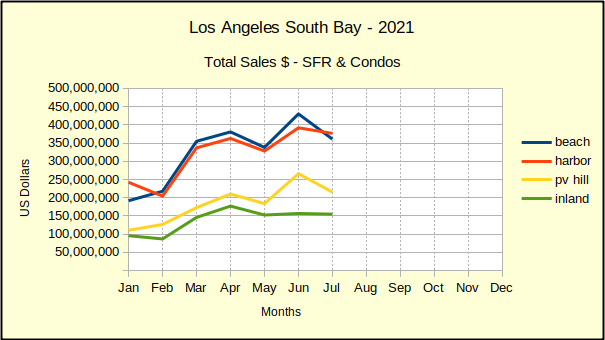
Even with mortgage interest rates under 3% the July market had a hard time keeping momentum. March looked like a game changer, but May went soft. Total dollar sales were up in June but by July prices and sales volume were both headed down again.
So what’s going on here? Sales are yo-yoing across the charts like the economy can’t make up it’s mind. Are we leaving a pandemic or entering one? Banks have started raising the interest rates multiple times. Each time buyers walk away and the rates come down again.
The Coronavirus pandemic has been so pervasive most of us haven’t noticed there is a concurrent recession happening. One pundit I follow recently referred to it as a “two month recession–the shortest in history.” That’s a great punch line, but highly mis-leading. Real estate is a long term business proposition, not an impulse buy.
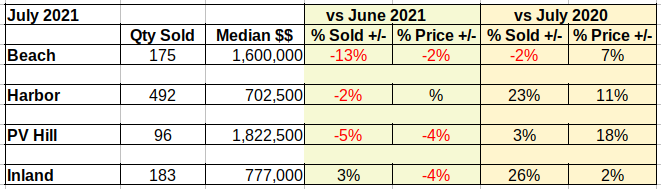
That’s part of the reason forecasting is so challenging this year. The statistics we would normally compare are last year versus this year. To do so is meaningless in today’s situation because last year was anything but normal and the result of a comparison makes no sense. To demonstrate, this table shows the comparison from this month to last month of the current year, and from last month of the current year to the same month last year.
Is the market good? Or just looking good?
Notice that comparing June to July of 2021, nearly every statistic is negative. Quantity sold was up 3% for the Inland cities, but down in all other areas. Prices were flat in the Harbor area, but down in all other areas. Looking just at the current stats, it looks like a slowing market.
However, it’s easy to portray everything as rosy when you only compare 2021 activity to 2020 activity. Reading it that way, sales volume is down 2% at the Beach, but volume and pricing are up in big numbers everywhere else. For those readers who like to study punditry, watch the authors you read to see who compares both ways, versus who only talks about positive numbers.
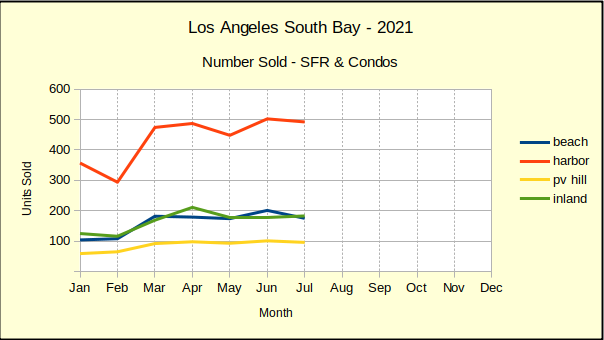
Sales volume flat last four months
By March of this year, all areas took a big jump upward in the number of units sold. The Harbor area, which is often the most friendly to first time buyers, took the biggest jump increasing from roughly 350 units per month to nearly 500 units per month.
Since March the number of units sold has remained stubbornly flat across the South Bay. The Harbor area showed strong activity, recovering almost immediately from a sharp dip in May.
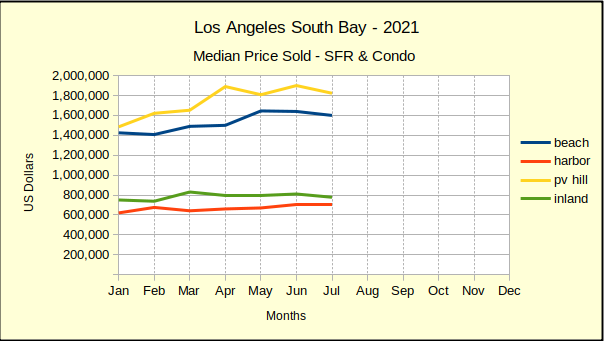
Prices flat last four months
More accurately, Beach prices have been flat the last three months after a $100K jump in May. Inland and Harbor prices have seen very little change since the first of 2021. PV moved upward from January through April, picking up about $400K in median price appreciation. Since then the Hill has also been stable.
Usually more stable than the Beach or the Hill, the median Inland prices have remained very close to their starting point in January. Harbor area prices have bumped up about $100K since the first of the year. We see some of that in appreciation related to retail growth and renewal in San Pedro. On the Long Beach side, we’ve seen good appreciation in the first time buyer community and in the 1-4 rental community.
In summary, real estate in the Los Angeles Suth Bay is on the mend. Don’t mistake that for astronomical growth. We’re getting back to where we were and leveling out.
As more and more employers are considering the possibility of permanent work-from-home, homeowners need to think about ways to create dedicated office space in their home. Of course, if you can afford it, you can make an addition or even just buy a larger home. But not everyone can afford that, so for those who can’t, here are some ways to turn existing space in your home into office space.
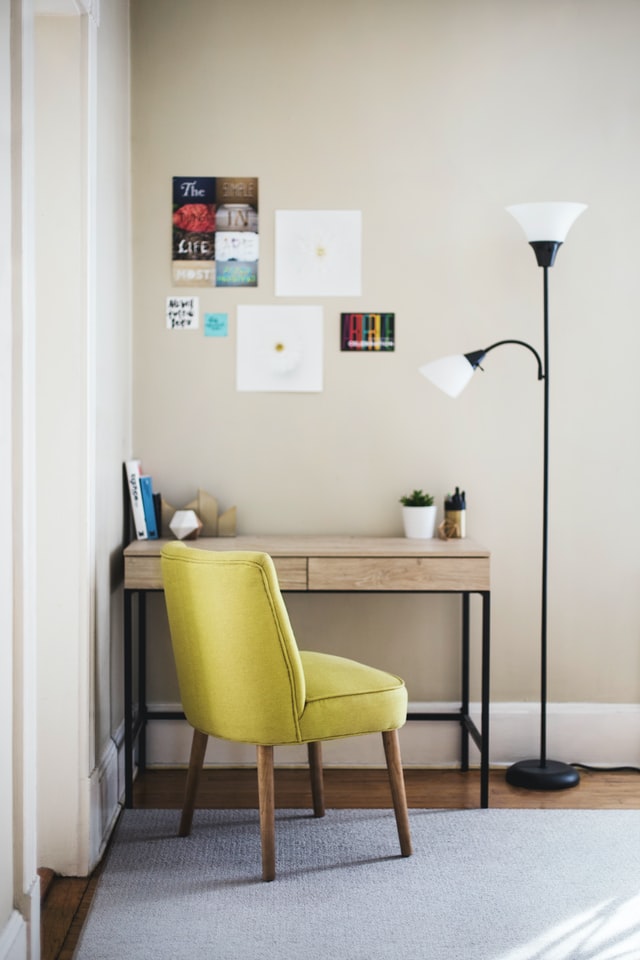
For most jobs, a home office needs a desk. But a desk is just an elevated flat surface — it doesn’t have to look like an office desk. You can use a simple table or even just the shelf of a cabinet. You can also just use your dining table. You probably aren’t eating dinner while working. Other types of rooms can also become split-purpose, such as a guest bedroom. If you don’t have guests over — which you probably don’t during a pandemic — you’re free to use it as your office space whenever you want. Even if it’s occupied during the night when your guests are sleeping, you can still get work done there during the day. If you want to get creative and aren’t too spooked out, you can also turn your attic space into a home office with a table and proper lighting.